

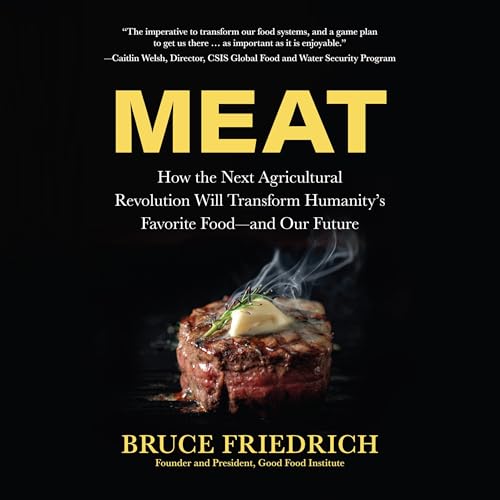
Meat
How the Next Agricultural Revolution Will Transform Humanity's Favorite Food—and Our Future
No se pudo agregar al carrito
Add to Cart failed.
Error al Agregar a Lista de Deseos.
Error al eliminar de la lista de deseos.
Error al añadir a tu biblioteca
Error al seguir el podcast
Error al dejar de seguir el podcast
Prueba gratis de 30 días de Audible Standard

Meat
Compra ahora por $19.10
-
Narrado por:
-
Walter Dixon
"This packed account makes food science feel like an urgent and essential undertaking."—Publishers Weekly (Top 10 New Release in Science)
Good Food Institute founder and president Bruce Friedrich offers a hopeful and rigorously researched exploration of how science, policy, and industry can work together to satisfy the world’s soaring demand for meat, while building a healthier and more sustainable world.
The human love of meat appears to be hard-wired. The world consumes more than 550 million metric tons of meat and seafood each year. That number has been climbing for decades and is expected to continue to rise through at least 2050.
What if we could give humanity the meat it craves, but produced differently? Plant-based and cultivated meat that are just as delicious as the meat you love, but more affordable and healthier.
Think it’s not possible? With examples ranging from the “horseless carriage” (car) to the smart phone in your pocket, Meat reminds readers that scientific innovations often move from disbelief or opposition to inevitability and ubiquity, much faster than almost anyone expects.
Envisioning a future where meat is both a delight and a force for good, Friedrich explores:
- Humanity’s 12,000-year-old practice of raising animals for meat, and why we need to figure out a better way.
- The science and scientists behind the efforts to create plant-based and cultivated meat that is indistinguishable from conventional animal meat, but less expensive, more nutritious, and safer.
- How plant-based and cultivated meat can preserve forests and biodiversity, mitigate climate change and ocean pollution, and lower antimicrobial resistance and pandemic risk.
- The economic and food security benefits of making meat more efficiently, which include trillions of dollars in economic output annually, tens of millions of good jobs, and the possibility of a revitalized farm economy.
Meat offers a vision of the next agricultural revolution that is optimistic, achievable, and delicious.
©2026 by Bruce Friedrich. (P)2025 Brilliance Publishing, Inc., all rights reserved.Los oyentes también disfrutaron:




Las personas que vieron esto también vieron:












Brilliant yet down-to-earth
Se ha producido un error. Vuelve a intentarlo dentro de unos minutos.
The compelling global hunger, climate, and public health arguments have thus far failed to produce a significant decrease in meat consumption, and Friedrich is clear-eyed about that. Rather than doubling down on the personal choice angle that advocates have been pushing for 50 years, he argues that the solution isn't eating less meat, but making it differently. That reframe is genuinely useful, and it's the kind of pragmatic thinking needed for progress. Friedrich makes a convincing argument that there are no inherent scientific barriers for cultivated meat to reach cost competitiveness with conventional meat — and given his access to the full landscape of research across companies, that optimism feels earned rather than naive.
The pandemic angle was what really stuck with me - the epic-scale intensive factory farms are making a worse pandemic inevitable. For anyone tracking how food intersects with climate resilience and global stability, this part of the book alone is worth the read. He also draws some really fun historical parallels — pointing out that we once freaked out about "artificial ice" and "artificial light," but we got over it, making the case that skepticism about new food tech is pretty normal, and probably temporary. This is the clearest book I've read on how food systems actually change. If you're already in this world and feeling worn down by the headlines, Friedrich offers something genuinely rare: a grounded, researched case for optimism.
A grounded case for optimism
Se ha producido un error. Vuelve a intentarlo dentro de unos minutos.
Should be required reading!
Se ha producido un error. Vuelve a intentarlo dentro de unos minutos.
Bruce gets something that many like me missed early in our advocacy: you can't guilt or educate your way to a transformed food system. He explains that meat consumption is a deep-rooted, biologically driven preference — and despite decades of advocacy and the rise of plant-based foods into the mainstream, production and consumption of meat just keep rising. What actually works is when people don't have to give up meat at all, but can simply choose a plant-based or cultivated version that matches the cost, taste, and convenience of conventional meat. When alternative protein is no longer the alternative.
I've met plenty of skeptics of alternative meat, even within animal protection and sustainability circles. Bruce meets that skepticism head-on with compelling example after example and a clear strategy forward, making the case that setbacks are a natural part of the path for any successful innovation. That perspective alone is valuable for anyone in this work who has felt discouraged by headlines proclaiming plant-based meat is dead, or by yet another policy banning cultivated meat or alternative meat labels.
And for those of us fighting every day for a more just and sustainable food system, he offers genuine hope that alternative meat will not only transform our food system — it may even happen within our lifetimes.
This is the clearest, most persuasive book I've read on how food systems actually change. Essential reading for anyone who cares about the planet, public health, food insecurity, and the billions of animals suffering in our food system every day.
Thank you Bruce!
A Psychiatrist's Perspective: This book gets it!
Se ha producido un error. Vuelve a intentarlo dentro de unos minutos.
The call to action on alt proteins!
Se ha producido un error. Vuelve a intentarlo dentro de unos minutos.