Episodios

  • How CMS Administered Risk Arrangements (CARA) bridge the gap between ACOs and specialists | Will Gordon (Manatt Health)
    Apr 14 2026

    Will Gordon, senior advisor at Manatt Health and former CMMI Chief Informatics Officer, explains CARA (a voluntary component of the ACO REACH/LEAD model starting in 2027) and why it matters for value-based care in specialties.

    He outlines three converging themes: episode-based bundles—especially surgical/orthopedic—have shown savings (often from post-acute care); ACOs have struggled to operationalize bundles due to contracting, attribution, and reconciliation complexity; and specialists have largely remained outside value-based care.

    CARA aims to bridge these gaps by letting ACOs and specialists set up CMS-facilitated episode-based risk arrangements via a web-based portal, using predefined episodes or a customizable “max flex” option, while specialists continue billing fee-for-service and CMS performs retrospective reconciliation against target prices.

    The discussion also covers operational platform constraints, market-driven episode design, and the flow of funds in retrospective bundles.

    For more from Health Tech Nerds, subscribe to our weekly newsletters: https://www.healthtechnerds.com/subscribe

    Más Menos
    16 m
  • An investor’s view of the private market, and navigating AI-driven uncertainty | Conor Green (Truehelm)
    Apr 14 2026

    Conor Green of Truehelm (formerly TT Capital Partners) joins to discuss the firm’s rebrand, its healthcare-only growth equity/growth buyout strategy, and current market dynamics. He outlines Truehelm's focus on founder-owned, tech-enabled services businesses selling to hospitals, health plans, employers, and life sciences, often bootstrapped and “skipping venture."

    Conor and HTN cover today’s valuation dislocation amid AI uncertainty, slower deal processes and re-trading, niche investing themes in rev cycle and employer/payer services, and an exit market logjam from peak-era buys that may clear as return expectations reset.

    For more from Health Tech Nerds, subscribe to our weekly newsletters: https://www.healthtechnerds.com/subscribe

    Más Menos
    20 m
  • The case for investing in maternity care and the driving forces behind SimpliFed's $10.8M Series A | Andrea Ippolito (SimpliFed)
    Apr 14 2026

    Andrea Ippolito joins Health Tech NErds to discuss SimpliFed’s $10.8M Series A and how the company is expanding from virtual breastfeeding and baby-feeding support into a broader virtual OB model.

    She explains SimpliFed’s insurance-covered care model across commercial, Medicaid, and TRICARE; its go-to-market strategy through health plans plus provider enrollment and integrations with OB/GYN workflows via an AI-enabled, interoperable maternal health operating system and native EMR.

    The conversation covers the “unbundling” of global maternity payments back toward fee-for-service, the trade-offs across access, quality, and cost, and why investing more in prenatal and postpartum care can reduce costly interventions. Ito outlines SimpliFed’s care team (IBCLCs, some NPs), studies on outcomes and cost reduction, and growth plans to support 5% of US births by 2026.

    For more from Health Tech Nerds, subscribe to our weekly newsletters: https://www.healthtechnerds.com/subscribe

    Más Menos
    16 m
  • CMMI LEAD and three key changes from ACO REACH: incorporating specialists, using AI-inferred risk, and simplifying tracks | Gabe Drapos (Pearl Health)
    Apr 14 2026

    Gabe Drapos, Pearl Health COO and coauthor of the paper informing the LEAD Model, broke down LEAD, the successor to ACO REACH launching in 2027, framing it as a hybrid of REACH and MSSP. Three key changes: bringing specialists formally into total cost of care models for the first time; collapsing the standard and high-needs tracks so ACOs don't have to choose; and piloting AI-inferred risk adjustment, which would derive risk scores from utilization patterns rather than requiring providers to document HCC codes.

    Kevin and Gabe explored how inferred risk could level the playing field for groups with historically weak documentation — and how success in LEAD could open the door to testing the same approach in MA broadly. Gabe also flagged that organizations will be making enrollment decisions with less information than usual given the compressed timeline (application deadline: May 17; lock-in by early September).

    For more from Health Tech Nerds, subscribe to our weekly newsletters: https://www.healthtechnerds.com/subscribe

    Más Menos
    16 m
  • The Grand Roundup: CMMI's LEAD program and engaging specialists via CARA, MA final rates and benefit cuts, Teladoc's valuation conundrum, AI creating confusion in private markets, and SimpliFed's $10.8M Series A to extend OB care
    Apr 13 2026

    The Grand Roundup | April 13, 2026

    Kevin and Martin unpack the MA final rates reaction (2.48% and what it means for plans cutting benefits), break down ACO LEAD with Pearl Health's COO Gabe Drapos, and get the inside story on CARA, the specialist bundle component inside LEAD. Plus: Teladoc's activist investor drama, TrueHelm's growth equity thesis, Blues consolidation inadvertently accelerating, and SimpliFed's $10.8M Series A to extend from feeding support to OB care.

    In this episode:

    • MA final rates: 2.48%, benefit cuts, including BCBS MN beneficiaries losing Life Time memberships
    • Pearl Health on ACO LEAD, AI-inferred risk, and what changes from REACH
    • Manatt Health on CARA: how specialist bundles work inside LEAD
    • Teladoc, BetterHelp, and the activist investor case for a PE buyout
    • TrueHelm's Conor Green on health tech private markets and AI creating the most confusing environment in a decade
    • Chapter's $100M raise, Blues consolidation, Function Health's Getlabs acquisition, Luminai raise + Cleveland Clinic partnership
    • SimpliFed CEO Andrea Ippolito on their $10.8M Series A, expanding from lactation support to OB care, supported by AMA's vote to unbundle maternal care, and supporting 5% of US births

    For more from Health Tech Nerds, subscribe to our weekly newsletters: https://www.healthtechnerds.com/subscribe

    Más Menos
    1 h y 49 m
  • Making GLP-1s work for patients and payers | Evan Richardson (Form Health)
    Apr 9 2026

    This week, Martin takes a step back and look at the early GLP-1 era—where the drama is coming from, how costs are reshaping coverage, and why the care model around these drugs matters as much as the molecule itself.

    Evan Richardson, Founder and CEO of Form Health, shares how his time at Castlight and Grand Rounds/Included Health shaped a thesis that higher-quality care drives better outcomes and lower long-term costs, and why he built Form Health to scale obesity medicine before Ozempic went mainstream.

    They dig into the real-world gap in GLP-1 outcomes and persistence without wraparound care, Form’s high-touch telemedicine approach, and how employers and payers are grappling with explosive demand, falling cash-pay prices via LillyDirect/NovoCare, and center-of-excellence models to control spend and prove ROI.

    For more from Health Tech Nerds, subscribe to our weekly newsletters: https://www.healthtechnerds.com/subscribe

    Más Menos
    29 m
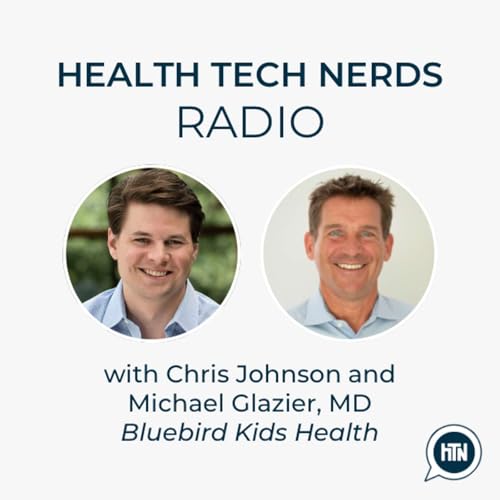
  • Improving pediatric care access and outcomes through value-based Medicaid contracting, technology, and a prevention-first model | Chris Johnson & Michael Glazier, MD (Bluebird Kids Health)
    Apr 8 2026

    Martin welcomes Chris Johnson (Co-Founder and CEO) and Dr. Michael Glazier (CMO) of Bluebird Kids Health to discuss worsening U.S. child health trends and what better pediatric care could look like, especially for Medicaid populations.

    They note that about half of U.S. children are covered by Medicaid/CHIP and describe how lower Medicaid reimbursement contributes to pediatric “care deserts,” worse access, and higher emergency and inpatient use. Glazier highlights rising prevalence of obesity, type 2 diabetes, metabolic syndrome, and behavioral health conditions including anxiety, depression, ADHD, and autism.

    Bluebird’s model emphasizes evidence-based, high-experience, whole-child care, supported by technology (Bluebird OS) for omnichannel access, hybrid virtual/in-person care, automation, and care pathways like asthma management.

    They discuss early-stage Medicaid value-based contracting focused on reducing avoidable utilization, state quality incentives, care coordination for complex kids, and plans for continued Florida growth and eventual multi-state expansion.

    For more from Health Tech Nerds, subscribe to our weekly newsletters: https://www.healthtechnerds.com/subscribe

    Más Menos
    35 m
  • Chris Klomp on the 2027 MA final rate notice, accountable relationships, and why there’s never been a better time to build in Medicare
    Apr 7 2026

    On Health Tech Nerds Radio, Kevin interviews Medicare Director Chris Klomp about the 2027 Medicare Advantage final rate notice, which came in at a 2.48% expected average change versus 0.09% in the advance notice, after 40,000+ comments and updated cost data.

    Chris explains the roughly 40 bps increase, continued normalization of coding risk patterns, a delay in further model updates given V28’s early implementation, and the finalization of the unlinked chart review policy to curb risk-coding and revenue-cycle games.

    He frames “stability” as predictability for payers/providers and consistent choice and access for beneficiaries, while emphasizing program sustainability and a push to align growth with GDP.

    They discuss support for Medicare Advantage and broader accountable/value-based arrangements, cost control expectations for plans and providers, and an invitation for entrepreneurs and “insurgents” to enter the market and compete on cost-adjusted quality outcomes.

    For more from Health Tech Nerds, subscribe to our weekly newsletters: https://www.healthtechnerds.com/subscribe

    Más Menos
    21 m