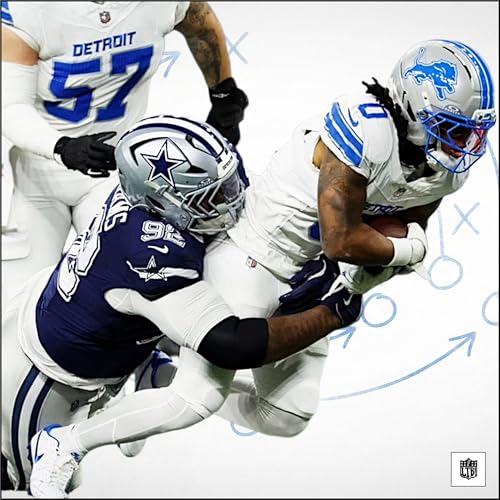
Let's Talk Ball! Podcast Por Cody Alexander & Felix Johnson arte de portada

Let's Talk Ball!

Let's Talk Ball!

De: Cody Alexander & Felix Johnson
Escúchala gratis

High-level football discussion for coaches and serious fans. Join Cody Alexander of MatchQuarters and Felix Johnson as they break down defensive schemes, offensive trends, and interview the best minds in the game — the home for real X's and O's talk.

www.matchquarters.comCody Alexander
Fútbol (Americano)
Episodios
  • The Mechanism of Pressure
    Apr 8 2026

    Stop chasing blitz rates. Defensive efficiency isn’t dictated by how often you send extra bodies; it is defined by the mechanism of the rush and whether you can hit the 40% pressure rate benchmark. If you aren’t affecting the quarterback, your “face melter” pressures are just creating vacated windows for elite passers to exploit.

    In this episode, we break down the shift from rigid 5-man structures to the “glitch blitz” world of simulated pressures. We evaluate why Oregon’s quarter-based pressures failed, while Georgia and Indiana found efficiency by manipulating defensive schemes.

    In this episode:

    The 40% Standard: A 40% pressure rate is the upper echelon of modern defense. If you can’t reach this with four, your blitz package must manufacture one-on-ones, not just volume.

    Oregon’s Spacing Issues: The Ducks struggled with 5-man pressures because their quarters shell was disjointed from the front, leading to the highest touchdown rate allowed on blitzes in the P4.

    Indiana’s Sim Philosophy: The Hoosiers led the country in simulated pressure rate (57%) by using “pick” pressures to isolate defensive linemen on running backs.

    Strategic Layering: Data suggests running Quarters on early downs and Fire Zones on third down is a more efficient “change-up” than traditional single-high philosophies.

    2026 NFL Draft Profiles:

    TJ Parker (Clemson): High pressure rate with Wide-9 utility.

    Emmanuel McNeil-Warren (Toledo): Elite pressure rate for a down-safety or nickel role.

    Kayden McDonald (Ohio State): Quick-three interior disruptor.

    Peter Woods (Clemson): Interior force built for heavy stunt usage.

    Dillon Thieneman (Oregon): Hybrid safety with sideline-to-sideline tracking.

    Timestamps:

    00:00 - The 40% Pressure Rate Benchmark

    01:34 - Pressuring with Four: Chiefs and Giants Lessons

    08:11 - Line Play and Condensing Decision Time

    14:45 - Cowboys and Eagles Pressure Analysis

    17:29 - Oregon vs. Georgia: Quarters vs. Fire Zones

    27:31 - Indiana and the Rise of Simulated Pressures

    34:25 - Flip the Script: First Down Quarters and Third Down Fire Zones

    46:17 - Top 5 Draft Prospects for Pressure Rate

    55:03 - Conclusion: Affecting the Quarterback

    » Join Felix and Cody each Wednesday as we dive deep into the game we love!

    MatchQuarters is a reader-supported publication. So, make sure to subscribe.

    © 2025 MatchQuarters | Cody Alexander | All rights reserved.


    This is a public episode. If you'd like to discuss this with other subscribers or get access to bonus episodes, visit www.matchquarters.com/subscribe
    Más Menos
    56 m
  • The Maturation of the Two-High Revolution
    Apr 1 2026

    Learn how NFL defenses are restoring chaos in the secondary by implementing weak-side vision mechanics and modular coverage rules to muddy modern offensive reads. This technical breakdown explores the transition from rigid spot-dropping to hybrid systems and features an evaluation of the elite 2026 NFL Draft safety class.

    In this episode:

    The two-high shell is the primary vehicle for defensive “entropy,” utilizing static pre-snap alignments to mask modular coverage tools and force offensive post-snap hesitation.

    Secondary geometry is dictated by the functional split between the boundary corner as an elite isolation specialist and the field corner as a long-limbed space player optimized for off-ball zone coverage.

    Weak-side vision mechanics leverage the boundary safety as a hybrid “robber” or “backstop,” effectively marrying Cover 3 rotations with Quarters-based rules to clog the intermediate middle.

    The 2026 safety class is defined by high-IQ “Hash Safeties” like Caleb Downs and Dillon Thieneman, who offer the schematic utility to oscillate between deep-half, box, and nickel roles.

    Defensive guardrails prioritize player ownership and execution over rigid “if-then” systems, using modular rules to funnel the ball into predictable, low-percentage areas on the perimeter.

    Timestamps:

    00:01 - Coverages as the bedrock of the defensive counterpart 01:52 - The Fangio influence vs. Mike Zimmer and Eberflus 03:43 - Historical roots: The 1989 New Orleans Saints and Mora system 05:12 - The Saban/Belichick Rip/Liz Match system 11:51 - Analyzing the 2026 Safety Class 13:56 - Why the Boundary Corner is your most important island 19:30 - Weak Side Vision Mechanics and poach safeties 23:31 - Jim Leonard's transition to the Buffalo Bills 30:30 - The waning of base Quarters in favor of "blitz coverage" tools 41:43 - Scouting Report: Caleb Downs and Dillon Thieneman48:06 - Restoring chaos through player ownership and guardrails

    » Join Felix and Cody each Wednesday as we dive deep into the game we love!

    MatchQuarters is a reader-supported publication. So, make sure to subscribe.

    © 2026 MatchQuarters | Cody Alexander | All rights reserved.


    This is a public episode. If you'd like to discuss this with other subscribers or get access to bonus episodes, visit www.matchquarters.com/subscribe
    Más Menos
    49 m
  • The Politics and Religion of Run Fits: Even vs. Odd Spacing
    Mar 25 2026

    Cody Alexander and Felix Johnson break down the "politics and religion" of defensive football by analyzing the technical "why" behind modern run fit structures. Learn how elite NFL defenses use even and odd spacing, gap-and-a-half techniques, and hybridized fronts to cancel gaps and combat modern spread offenses.

    In this episode:

    Run fit structures are defined by the “politics and religion” of defensive football, acting as the foundational geometry that dictates roster construction and secondary coverage.

    Box spacing is categorized as “even” when there is an open B-gap bubble and “odd” when both B-gaps are closed by a defender.

    Modern spread offenses frequently “drain the box” by using perimeter threats like bubble screens or flat routes to pull defenders away, forcing a standard seven-man box to function as a six-man fit.

    Hybridized front techniques, such as the “lag nose” and “4i,” allow defenses to cancel gaps and squeeze vertical double teams while remaining in nickel personnel.

    Elite NFL defenses, including the Seahawks and Patriots, increasingly utilize “passive pressures” and “read stunts” to reset the line of scrimmage and eliminate gaps without overextending via traditional blitzes.

    Timestamps:

    00:00 - Introduction: The Politics and Religion of Football

    02:01 - Defining the Box: 4-3 vs 3-4 Binary Terms

    04:14 - Even vs Odd Spacing Explained

    08:43 - Seven, Eight, and Nine-Man Spacing

    11:41 - How Spread Offenses Drain the Box

    19:53 - Interior Techniques: Lag, Shade, and G-Nose

    25:21 - The Rise of the 4i and Tight Fronts

    29:56 - Gap and a Half vs Jet Techniques

    34:02 - Lever-Spill-Lever vs Spill-Overlap Fits

    39:50 - Hybridizing Fronts: Bear, Penny, and Walk Looks

    44:33 - Why the NFL’s Best Defenses Stunt the Most

    51:00 - Closing: Multiplicity and Purposeful Stunting

    » Join Felix and Cody each Wednesday as we dive deep into the game we love!

    MatchQuarters is a reader-supported publication. So, make sure to subscribe.

    © 2026 MatchQuarters | Cody Alexander | All rights reserved.


    This is a public episode. If you'd like to discuss this with other subscribers or get access to bonus episodes, visit www.matchquarters.com/subscribe
    Más Menos
    51 m
Todavía no hay opiniones