Episodios

  • The Steunenberg Assassination and the Haywood Trial (1905)
    Apr 14 2026

    ⚖️ Episode 20: The Steunenberg Assassination and the Haywood Trial (1905–1907)

    In this landmark episode of The Glitched Gavel, we witness a explosive clash between industrial titans and radical labor in the "Trial of the Century," where the legal system was pushed to the brink by kidnapping, corporate-funded trains, and a star witness with a history of blowing things up.

    • The Gates of Hell: On New Year’s Eve 1905, former Idaho Governor Frank Steunenberg was assassinated by a bomb rigged to his garden gate. The killer, a drifter named Harry Orchard, confessed to the crime but claimed he was a hired hitman for the "Inner Circle" of the Western Federation of Miners (WFM), specifically targeting Steunenberg for his brutal suppression of mining strikes years earlier.
    • The "Special Train" Kidnapping: The episode highlights a massive procedural "glitch": the illegal extradition of union leaders "Big Bill" Haywood, Charles Moyer, and George Pettibone. With the help of the Pinkerton Detective Agency, Idaho authorities snatched the men from their beds in Colorado and spirited them across state lines on a high-speed train paid for by mine owners. The U.S. Supreme Court later ruled that while the kidnapping was "shameful," it didn't invalidate the trial—a precedent that still haunts habeas corpus law today.
    • The Courtroom Titans: The trial featured a legendary legal showdown between the defense's "Attorney for the Damned," Clarence Darrow, and the prosecution's rising star, William Borah. Darrow didn't just defend Haywood; he put the entire capitalist system on trial, while Borah painted the union as a nest of anarchists.
    • The "Glitch" in the Verdict: Despite Orchard's detailed (and terrifying) testimony, Judge Fremont Wood issued a critical instruction to the jury: they could not convict based on the testimony of an accomplice alone without independent corroborating evidence. This "glitch" in the prosecution's strategy—relying too heavily on a confessed mass murderer—led the jury to return a verdict of Not Guilty for Haywood.

    The episode explores how this trial prevented a full-scale labor war in the American West but left the nation wondering if justice was served or if the gavel had simply been "glitched" by the sheer magnitude of the political stakes.

    Más Menos
    45 m
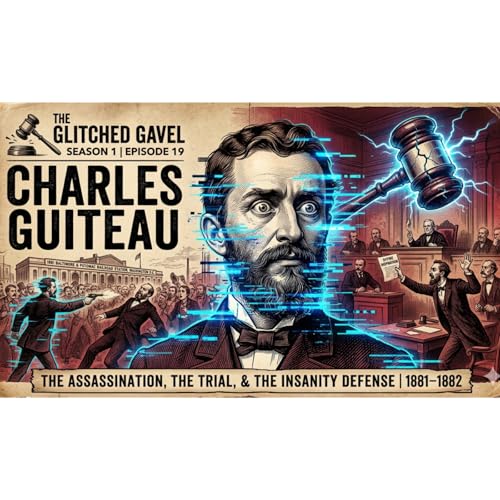
  • The trial of Charles Guiteau (1881)
    Apr 14 2026

    Trial of Charles Guiteau (1881–1882)

    In this episode of The Glitched Gavel, we explore the chaotic and controversial trial of Charles Guiteau, the man who assassinated President James A. Garfield, and how his case forced the American legal system to grapple with the blurred lines between political fanaticism and clinical insanity.

    • The Divine Delusion: After being rejected for a federal appointment he believed he was owed, Charles Guiteau—a failed lawyer, preacher, and former member of a religious commune—convinced himself that God had commanded him to "remove" the President to heal the fractured Republican Party. On July 2, 1881, he shot Garfield at a Washington train station, famously shouting, "I am a Stalwart of the Stalwarts!"
    • The Insanity Defense on Trial: The trial was one of the first high-profile cases in the U.S. to center almost entirely on the insanity defense. Guiteau’s defense team argued he was legally insane, while Guiteau himself frequently interrupted the proceedings with bizarre outbursts, poems, and insults, claiming he was not medically insane but that God had simply "suspended his free will."
    • The "Glitch" in the Gavel: The "glitch" in this episode highlights the rigidity of the M'Naghten Rule—the legal standard used at the time. Judge Walter Cox instructed the jury that Guiteau could only be acquitted if he literally did not understand that his actions were wrong. Because Guiteau had meticulously planned the shooting and sought protection afterward, the law viewed him as a sane criminal, even though his behavior throughout the trial suggested a profound mental collapse (later suspected to be neurosyphilis).
    • The Verdict: Despite the obvious signs of mental illness, the jury took only one hour to find Guiteau guilty. He was hanged on June 30, 1882, dancing his way to the gallows and reciting a poem he had written for the occasion.

    The episode concludes by examining how the Guiteau trial led to a massive public distrust of the insanity defense and indirectly triggered the end of the "spoils system" in American politics, proving that even a "glitched" trial can result in systemic reform.

    Más Menos
    43 m
  • The Zenger Trial and the Roots of Press Freedom (1735)
    Apr 14 2026

    ⚖️ Episode 18: The Zenger Trial and the Roots of Press Freedom (1735)

    In this episode of The Glitched Gavel, we explore the 1735 trial of John Peter Zenger, a case that transformed the American legal landscape by turning a humble printer into a champion of free speech and introducing the revolutionary idea that the truth cannot be a crime.

    • The Printing Press vs. The Crown: John Peter Zenger, a German immigrant and printer of the New York Weekly Journal, became the voice of the "Popular Party" opposition against the corrupt and arrogant Royal Governor of New York, William Cosby. The journal published scathing, anonymous articles accusing Cosby of rigging elections and various other administrative abuses.
    • The Accusation of Seditious Libel: In 1734, Zenger was arrested and charged with seditious libel. Under the English common law of the time, the legal standard was "the greater the truth, the greater the libel." This meant that if a statement brought the government into disrepute, it was illegal even if it was 100% true. In fact, being true made it more "dangerous" to the state.
    • The "Glitch" in the Gavel: The "glitch" in this episode is the brilliant legal maneuvering of defense attorney Andrew Hamilton. Knowing the law was technically against his client, Hamilton appealed directly to the jury's sense of justice rather than the judge's instructions. He argued that the jury had the right—and the duty—to determine the truth of the statements. This was an early and powerful instance of jury nullification, where the citizens in the jury box chose to ignore a law they deemed unjust.
    • The Verdict: Despite the judge’s strict instructions to the jury to only decide if Zenger had published the papers (leaving the "libel" determination to the court), the jury returned a verdict of Not Guilty in under ten minutes. They effectively ruled that because the criticisms were true, they could not be considered libelous.

    The episode examines how this single "glitch" in the colonial legal system laid the groundwork for the First Amendment, establishing the press as a "watchdog" over government power.

    Más Menos
    33 m
  • Latter Day Saint Succession Crisis of 1844
    Apr 14 2026

    ⚖️ The Succession Crisis of 1844 and the Trial of the Assassins

    This episode of The Glitched Gavel examines the chaotic power vacuum left by the assassination of Joseph Smith and the subsequent legal failure to hold his killers accountable in a court of law.

    • The Power Vacuum: Following the June 27, 1844, murder of Joseph and Hyrum Smith in Carthage Jail, the Latter Day Saint movement faced an unprecedented leadership crisis. The episode details the competing claims between Brigham Young (leading the Quorum of the Twelve), Sidney Rigdon (the last surviving member of the First Presidency), and James Strang, who claimed a "Letter of Appointment."
    • The Trial (May 1845): While the church wrestled with its future, the State of Illinois held a trial for five men indicted for the murders: Thomas C. Sharp, Levi Williams, Mark Aldrich, Jacob C. Davis, and William N. Grover. These men were prominent local leaders and members of the anti-Mormon militia.
    • The "Glitch" in the Gavel: The trial was a textbook example of jury nullification and local bias. Despite eyewitness testimony and the defendants' open admission of their presence at the jail, the defense successfully argued that the killing was a "public necessity." The prosecution's key witnesses were discredited based on their religious affiliation, and the jury was composed entirely of local non-Mormons who were openly hostile to the victims.
    • The Verdict: On May 30, 1845, the jury acquitted all five defendants. The legal failure to provide justice for the murders signaled to the Latter Day Saints that they would never find protection under Illinois law, directly catalyzing the mass exodus to the Salt Lake Valley.

    The episode explores how the "glitch" wasn't just in a single ruling, but in a legal system that allowed communal prejudice to override the basic right to life and due process.

    Más Menos
    48 m
  • The hanging of Mary Dyer
    Mar 6 2026

    ⚖️ Episode 16: The Hanging of Mary Dyer (1660)

    In this episode of The Glitched Gavel, we travel to the Massachusetts Bay Colony to witness the ultimate standoff between a woman of conscience and a legal system designed to enforce spiritual uniformity through the noose.

    • The Relentless Witness: Mary Dyer was once a respected Puritan in Boston, but her journey toward the "Inner Light" of Quakerism turned her into the colony’s most dangerous dissenter. After being banished multiple times for her faith, Dyer repeatedly returned to Boston, not to cause chaos, but to challenge the very legality of her exclusion.
    • The Law of Banishment: The trial of Mary Dyer was centered on the "Banishment on Pain of Death" statute—a draconian law enacted by the Puritan authorities to keep the Quaker "contagion" out of their "City upon a Hill." In 1659, Dyer had already stood on the gallows with a noose around her neck, only to be granted a last-minute reprieve.
    • The "Glitch" in the Gavel: The "glitch" in this case was the colony’s tactical failure to understand the power of martyrdom. The court, led by Governor John Endecott, expected the threat of death to act as a deterrent. Instead, Dyer used their own legal system against them, returning in 1660 to force the authorities to either repeal their "unrighteous" laws or commit a public execution that would outrage the King and the world.
    • The Verdict: Faced with a woman who refused to stay banished or recant her beliefs, the court chose the path of blood. On June 1, 1660, Mary Dyer was led to the giant elm on the Boston Common and hanged.

    The episode explores how Dyer’s death became the "glitch" that broke the system: her execution so horrified King Charles II that he eventually ordered an end to the hanging of Quakers, proving that while the gavel could end a life, it could not silence a movement.

    Más Menos
    33 m
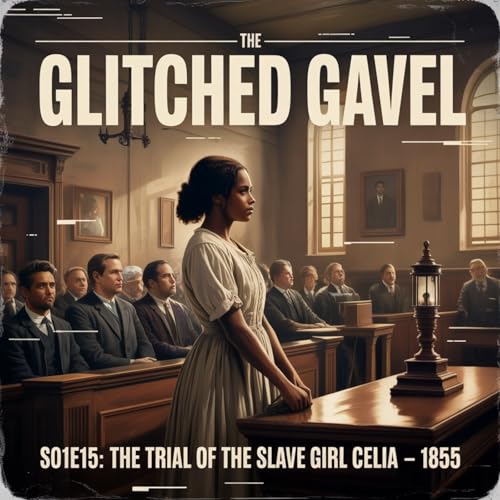
  • The Trial of the Slave Girl Celia (1855)
    Mar 6 2026

    ⚖️ Episode 15: The Trial of the Slave Girl Celia (1855)

    On this episode of The Glitched Gavel,it takes us to pre-Civil War Missouri to examine a case that dared to ask a forbidden question: Did an enslaved woman have a legal right to her own body?

    • The Breaking Point: In 1850, 14-year-old Celia was purchased by Robert Newsom, a Missouri farmer who immediately began a five-year cycle of sexual abuse. By 1855, having already borne two of Newsom’s children and pregnant with a third, Celia warned her master to stay away while she was ill. When he ignored her and entered her cabin on the night of June 23, Celia struck him twice with a heavy stick, killing him, and subsequently burned his remains in her fireplace.
    • The "Glitch" in the Gavel: This trial exposed a massive, intentional contradiction in the American legal system. Missouri law at the time stated that "any woman" had the right to use force to resist sexual assault. Celia’s defense team, led by John Jameson, argued that "any woman" must include Celia. However, Judge William Augustus Hall "glitched" the interpretation of the law by instructing the jury that as a piece of property, Celia had no virtue the law was bound to protect, effectively stripping her of the right to self-defense.
    • The Verdict: The all-white, all-male jury followed the judge’s narrow instructions and found Celia guilty of first-degree murder. Despite a brief escape and an appeal to the Missouri Supreme Court, she was executed by hanging on December 21, 1855.

    The episode sets the stage for the series by illustrating how the law can be weaponized to dehumanize individuals, transforming a clear-cut case of self-defense into a state-sanctioned execution.

    Más Menos
    24 m
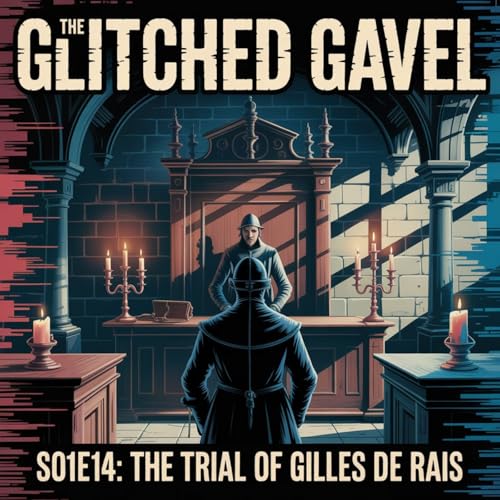
  • The trial of Gilles de rais
    Mar 1 2026

    Episode 14: The 1440 Trial of Gilles de Rais

    This episode of The Glitched Gavel dives into the chilling downfall of Gilles de Rais, a national hero turned legendary monster, examining whether his trial was a pursuit of justice or a calculated land grab.

    • The Fallen Hero: Gilles de Rais was a Marshal of France and a former brother-in-arms to Joan of Arc. By 1440, however, the once-wealthy nobleman was drowning in debt and surrounded by rumors of occult practices and horrific disappearances in his castles.
    • The Dark Allegations: The trial centered on accusations of Satanism, alchemy, and the systematic murder of scores of children. The prosecution presented a narrative of a man who turned to the dark arts to regain his squandered fortune.
    • The "Glitch" in the Gavel: The episode explores the heavy political and financial motivations behind the trial. The Duke of Brittany and the Bishop of Nantes—the very men presiding over the case—stood to gain significantly from the confiscation of de Rais's remaining lands. Furthermore, the pivotal confession was extracted only after de Rais was threatened with excommunication and torture.
    • The Verdict: Despite the questionable motives of the court, de Rais’s detailed (and perhaps coerced) confession led to a swift conviction. On October 26, 1440, he was hanged and burned in Nantes.

    The episode concludes by questioning if de Rais was truly the "medieval Bluebeard" or a victim of a legal system "glitched" by the greed of the ruling elite.

    Más Menos
    29 m
  • Nat Turner's Rebellion: Confession and Trials)
    Feb 2 2026

    🩸 The Glitched Gavel S01E13: The Commonwealth vs. The Prophet (Nat Turner's Rebellion: Confession and Trials)

    Gavel (The Narrator/Prosecutor): "Southampton County, Virginia, 1831. A summer of terror. Nat Turner, an enslaved preacher who believed he received divine visions, led a bloody, two-day revolt that resulted in the deaths of approximately 60 white men, women, and children. The inevitable reaction was swift, brutal, and utterly without mercy. This week, we analyze the only record of the trial and Turner's own chilling confession." (The rapid, discordant sound of axes hitting wood is heard, overlaid with a static pulse.)

    Static (The Analyst/Defense): "The court proceedings were less a trial and more a formality before execution. The legal system in Virginia offered virtually no defense for an enslaved person charged with insurrection. We dissect the pivotal document: 'The Confessions of Nat Turner,' transcribed by lawyer Thomas Ruffin Gray. Was this a genuine testament of a divinely inspired revolutionary, or a highly edited, self-serving document designed by Gray to demonize Turner and justify the subsequent draconian laws that crushed all hope for education and assembly among the enslaved?"

    Gavel: "We examine the chilling aftermath: over fifty enslaved people were executed, and the fear unleashed by the rebellion led to dozens of brutal, extrajudicial killings of Black people across the county. The resulting legislation—the 'Black Codes'—destroyed what little freedom and literacy existed among the enslaved population. Turner’s trial was not the end of a rebellion, but the catalyst for a societal tightening that cemented the path toward the Civil War. The Gavel here was used to shatter all resistance, leaving only the distorted echo of Turner's fateful prophecy."

    Más Menos
    29 m