

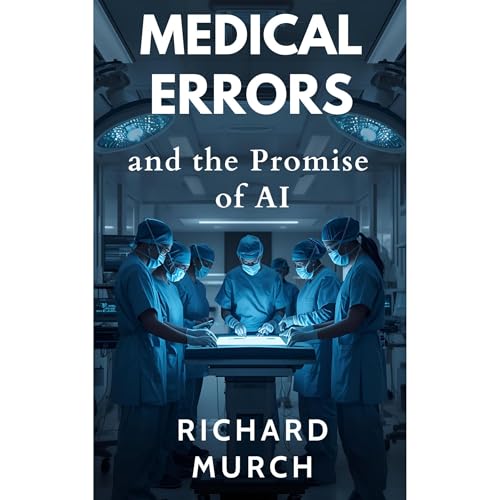
AI Can Save Lives
By Reducing Medical Error Deaths
Failed to add items
Sorry, we are unable to add the item because your shopping cart is already at capacity.
Add to Cart failed.
Please try again later
Add to Wish List failed.
Please try again later
Remove from wishlist failed.
Please try again later
Adding to library failed
Please try again
Follow podcast failed
Please try again
Unfollow podcast failed
Please try again
Audible Standard 30-day free trial
Select 1 audiobook a month from our entire collection of titles.
Yours as long as you’re a member.
Get unlimited access to bingeable podcasts.
Standard auto renews for $8.99 a month after 30 days. Cancel anytime.

AI Can Save Lives
Narrated by:
Virtual Voice
Buy for $9.00
-
Narrated by:
-
Virtual Voice
-
By:
-
Richard Murch

This title uses virtual voice narration
Virtual voice is computer-generated narration for audiobooks.
This journey begins with a stark number: ----- 440,000 Americans die each year from preventable medical errors. That figure represents the third leading cause of death in the United States, behind only heart disease and cancer.
It means that every day, more than 1,200 people die from mistakes that shouldn't have happened—wrong diagnoses, medication errors, surgical complications, hospital-acquired infections, and communication failures that cascade into tragedy.
Throughout this book, we will explore how artificial intelligence offers a path forward. Not a complete solution, there is no silver bullet for a problem as complex as medical error—but a powerful set of tools that address the fundamental sources of preventable harm in modern healthcare.
The solution synthesizes multiple AI capabilities, each targeting different types of errors. Clinical decision support systems catch diagnostic errors by suggesting diagnoses that clinicians might not consider, flagging when key tests have been omitted, and providing differential diagnoses based on comprehensive analysis of symptoms, history, and test results. These systems don't replace physician judgment—they augment it, serving as a safeguard against the cognitive biases and knowledge gaps that contribute to diagnostic mistakes.
AI-powered medication management prevents prescribing errors by screening every order against a patient's complete medication list, allergies, organ function, and genetic variants that affect drug metabolism. These systems detect interactions that would be nearly impossible for humans to remember across the thousands of drugs in use today. They suggest dosing adjustments for patients with kidney or liver disease, flag drugs that are inappropriate for elderly patients, and even consider cost and insurance coverage to recommend therapeutic alternatives.
No reviews yet