

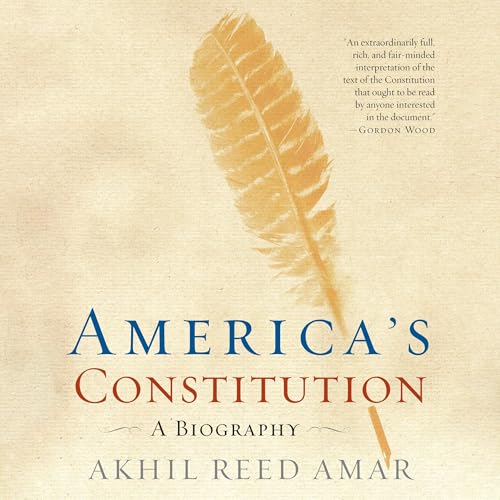
America's Constitution
A Biography
Failed to add items
Sorry, we are unable to add the item because your shopping cart is already at capacity.
Add to Cart failed.
Please try again later
Add to Wish List failed.
Please try again later
Remove from wishlist failed.
Please try again later
Adding to library failed
Please try again
Follow podcast failed
Please try again
Unfollow podcast failed
Please try again
 Prime members: New to Audible?
Get 2 free audiobooks during trial.
Pick 1 audiobook a month from our unmatched collection.
Unlimited access to our all-you-can listen catalog of 150K+ audiobooks and podcasts.
Access exclusive sales and deals.
Premium Plus auto-renews for $14.95/mo after 30 days. Cancel anytime.

America's Constitution
Narrated by:
Steve Hendrickson
Pre-order for $30.60
-
Narrated by:
-
Steve Hendrickson
-
By:
-
Akhil Reed Amar
“Elegantly written, thorough but concise, and consistently enlightening . . . an indispensable reference.”—Scott Turow, The Washington Post Book World (Best Books of the Year)
WINNER OF THE AMERICAN BAR ASSOCIATION’S SILVER GAVEL AWARD
In America’s Constitution, eminent constitutional-law scholar Akhil Reed Amar gives the first comprehensive account of one of the world’s great political texts. Skillfully placing the document in the context of late-eighteenth-century American politics, Amar reveals how a document that was in large part drafted by slaveholding landed gentry could later be instrumental in the emancipation of slaves, the enfranchisement of women, and many other modern expansions of liberty and equality. Amar celebrates the Constitution’s remarkable durability, noting how debate over its central role in American government remains vital and dynamic more than two centuries after it was written.
Ambitious, evenhanded, accessible, and often surprising, America’s Constitution is an invaluable work, bound to become a standard reference for any student of history and all citizens of the United States.
Listeners also enjoyed...





adbl_web_anon_alc_button_suppression_c
Critic reviews
“Authoritative, important . . . a masterly showcase of scholarship . . . Amar has a knack for assembling surprising bits of historical context that freshen one’s outlook.”—The New York Times Book Review
“Elegantly written, thorough but concise, and consistently enlightening . . . an indispensable reference.”—Scott Turow, The Washington Post Book World (Best Books of the Year)
“Amar writes with fluidity and grace. . . . [America’s Constitution is] a book of large provocations, liberally peppered with surprising observations, small but fascinating insights, and unexpected connections.”—National Review
“As a reference book, it is superb. It is the fullest and most reliable explanation of the written Constitution that we have. [Amar’s] case for the fundamentally popular and democratic origins of the Constitution gives his book a special distinction as a work of history.”—Gordon S. Wood
“Scholarly, reflective and brimming with ideas . . . Rarely do you find a book that embodies scholarship at its most solid and invigorating; this is such a book.”—Publishers Weekly (starred review)
“The most fascinating character in American history—our enduring Constitution— finally has its great and deserving biographer. And what a biographer Akhil Reed Amar is! He writes like Jefferson, thinks like Madison, and speaks like Lincoln. Everyone who appreciates the Constitution must read this wonderful biography. It is indispensable to an understanding of the constitutional world in which we live.”—Alan Dershowitz, author of Preemption
“Elegantly written, thorough but concise, and consistently enlightening . . . an indispensable reference.”—Scott Turow, The Washington Post Book World (Best Books of the Year)
“Amar writes with fluidity and grace. . . . [America’s Constitution is] a book of large provocations, liberally peppered with surprising observations, small but fascinating insights, and unexpected connections.”—National Review
“As a reference book, it is superb. It is the fullest and most reliable explanation of the written Constitution that we have. [Amar’s] case for the fundamentally popular and democratic origins of the Constitution gives his book a special distinction as a work of history.”—Gordon S. Wood
“Scholarly, reflective and brimming with ideas . . . Rarely do you find a book that embodies scholarship at its most solid and invigorating; this is such a book.”—Publishers Weekly (starred review)
“The most fascinating character in American history—our enduring Constitution— finally has its great and deserving biographer. And what a biographer Akhil Reed Amar is! He writes like Jefferson, thinks like Madison, and speaks like Lincoln. Everyone who appreciates the Constitution must read this wonderful biography. It is indispensable to an understanding of the constitutional world in which we live.”—Alan Dershowitz, author of Preemption
People who viewed this also viewed...










No reviews yet