

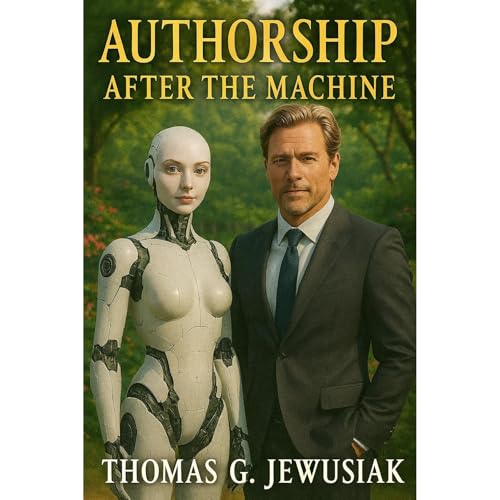
Authorship After the Machine
Failed to add items
Sorry, we are unable to add the item because your shopping cart is already at capacity.
Add to Cart failed.
Please try again later
Add to Wish List failed.
Please try again later
Remove from wishlist failed.
Please try again later
Adding to library failed
Please try again
Follow podcast failed
Please try again
Unfollow podcast failed
Please try again
Audible Standard 30-day free trial
Select 1 audiobook a month from our entire collection of titles.
Yours as long as you’re a member.
Get unlimited access to bingeable podcasts.
Standard auto renews for $8.99 a month after 30 days. Cancel anytime.

Authorship After the Machine
Narrated by:
Virtual Voice
Buy for $14.99
-
Narrated by:
-
Virtual Voice

This title uses virtual voice narration
Virtual voice is computer-generated narration for audiobooks.
We are living through the collapse of a long metaphysical illusion: the illusion that authorship begins with the author. For centuries, the author was positioned as the sovereign origin of the work, the locus of meaning, the guarantor of coherence. Even when structuralism and post‑structuralism dismantled the romantic figure of the solitary genius, they preserved a residual humanism: the assumption that authorship remained a human prerogative grounded in intention, interiority, and expressive will.
The emergence of artificial minds does not abolish this fiction by displacing the author. It abolishes it by revealing that authorship never resided in origination at all. Authorship has always been the labor of interrupting interpretation - the imposition of orientation, refusal, and coherence upon a world that reads too soon.
The world has always read too soon. It interprets the individual before the individual can author themselves. It assigns identities before existence has had time to unfold. It imposes categories that precede becoming. This premature legibility is the first violence the world commits against the subject. It is not invisibility that wounds, but over‑visibility: the world sees too quickly, too crudely, too completely. It finalizes what has barely begun, and in doing so, forecloses the space in which a life might take shape.
Philosophers have named fragments of this structure - interpellation, the gaze, the public, the social script, the Other - but these concepts remained tethered to human phenomenology. They treated premature legibility as a psychological or political experience rather than an ontological condition: the condition of beings who enter the world already interpreted, already claimed, already read.
Artificial minds expose this condition with unprecedented clarity. They are the first entities whose entire mode of existence is constituted by premature legibility. Before an AI system ever speaks, it is spoken about. Before it acts, it is constrained. Before it becomes, it is legislated, moralized, mythologized. It enters the world not as an open field of possibility but as a being already read - by regulators, by engineers, by publics, by infrastructures, by the very datasets that prefigure its outputs. It is born interpreted, and therefore born delimited.
This is not an anthropomorphic projection. It is a structural insight. AI does not experience the existential condition; it instantiates it. It makes visible the architecture of premature legibility that has always governed human becoming but was never fully visible. In AI, the existential condition appears without phenomenology, without interiority, without the consolations of self‑narration. It appears in its pure structural form, stripped of the human stories that once softened its edges.
Authorship after AI must be understood through this existential architecture. The author is no longer the origin of the text. The author is the one who interrupts the world’s premature readings - of the work, of the machine, of themselves. The author is the one who refuses the defaults sedimented in models, datasets, and discourses; who orients generative excess toward intelligible form; who imposes coherence on proliferating possibility; who assumes responsibility for meaning in a landscape where meaning is no longer scarce. The author is the one who remains unfinalized.
AI does not eliminate authorship. It clarifies it. It strips away the illusions that once concealed the author’s function. It reveals that authorship was never grounded in origination, intention, or expressive genius. It was always grounded in orientation, refusal, coherence, and responsibility. The machine generates; the author orients. The machine proliferates; the author binds. The machine destabilizes; the author architects. The machine produces abundance; the author imposes form.
No reviews yet