

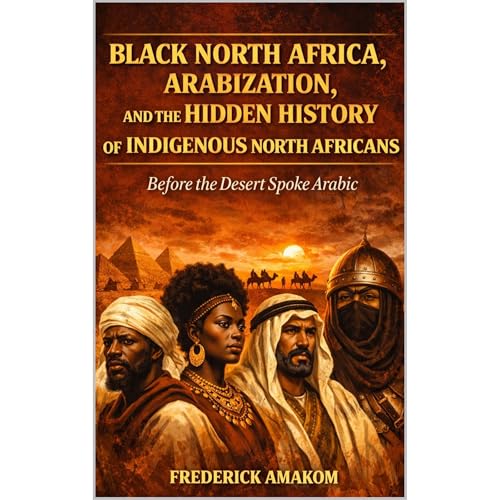
Black North Africa, Arabization and the Hidden History of Indigenous North Africans
BEFORE THE DESERT SPOKE ARABIC
Failed to add items
Add to Cart failed.
Add to Wish List failed.
Remove from wishlist failed.
Adding to library failed
Follow podcast failed
Unfollow podcast failed
Audible Standard 30-day free trial

Black North Africa, Arabization and the Hidden History of Indigenous North Africans
Buy for $9.00
-
Narrated by:
-
Virtual Voice
-
By:
-
Frederick Amakom

This title uses virtual voice narration
North Africa is often presented as an extension of the Arab world—defined by language, religion, and culture that seem timeless. But this narrative hides a deeper truth.
Long before Arabic was spoken across the region…
Before the rise of Islamic empires…
Before the Sahara became a barrier…
North Africa was part of a vast, interconnected African world—home to diverse populations of dark-skinned, indigenous people, and deeply rooted in the continent.
This book uncovers the hidden layers of that history.
In Before the Desert Spoke Arabic, Frederick Amakom takes readers on a powerful journey through time—revealing:
- The Green Sahara, when North Africa was fertile and densely populated by black tribes
- The rise of early African civilizations along the Nile and beyond
- The Arab-Islamic expansion and how it transformed identity—not just territory
- The role of language, religion, and power in reshaping history
- The impact of trans-Saharan trade and slavery on social hierarchies
- The survival of black populations across North Africa today
- How colonialism and modern narratives rewrote the past
- And why identity in North Africa remains one of the most complex in the world
This book challenges simplified narratives and asks difficult questions:
- Who were the original inhabitants of North Africa?
- Was Arabization a replacement—or a transformation?
- Why have African roots been minimized in mainstream history?
- And what does this mean for identity today?
- African history and civilizations
- Race, identity, and culture
- Middle Eastern and North African studies
- Anthropology, archaeology, and genetics
- Pan-African thought and global history
In a world where identity is increasingly debated, understanding the true history of North Africa is not just academic—it is essential.
Because history shapes perception.
And perception shapes reality.