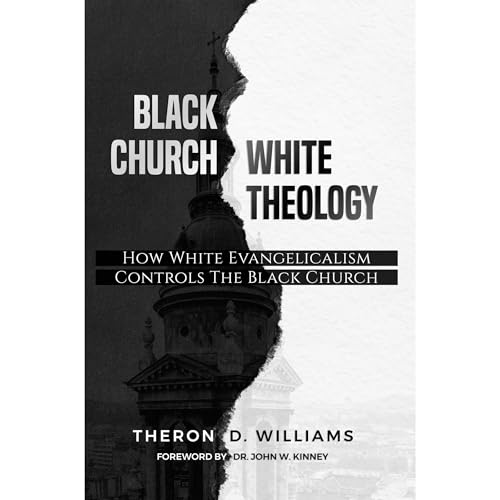
Black Church, White Theology Audiobook By Theron Williams cover art

Black Church, White Theology

How White Evangelicalism Controls the Black Church

Virtual Voice Sample

Audible Standard 30-day free trial

Try Standard free
Select 1 audiobook a month from our entire collection of titles.
Yours as long as you’re a member.
Get unlimited access to bingeable podcasts.
Standard auto renews for $8.99 a month after 30 days. Cancel anytime.

Black Church, White Theology

By: Theron Williams
Narrated by: Virtual Voice
Try Standard free

$8.99 a month after 30 days. Cancel anytime.

Buy for $14.99

Buy for $14.99

Background images

This title uses virtual voice narration

Virtual voice is computer-generated narration for audiobooks.
The late Walter Wink, brilliant scholar, theologian, and social activist revealed the troubling truth about our world that humans negotiate life, mostly unconsciously, within hierarchical power arrangements that he labeled the Domination System. He described this system as an evil social hierarchy with the privileged class occupying the top, and as it descends, the less privileged the rungs until the bottom is reached where the oppressed reside. Historically, in the United States, the lower rungs of the hierarchy have been reserved for people of color, the poor, the disabled, women, and the LGBTQ community, with the top designated for white, heterosexual, Judeo-Christian men. From this social matrix, all theologies emerge from its various rungs. For example, some theological constructs emerge from communities occupying the lowest rungs on the hierarchy, such as black theology, from Black people, liberation theology from poor people and their advocates, womanist theology from women, and queer theology from the LGBTQ community. Central to these theologies is the struggle for liberation on behalf, and along with those stuck at the bottom as they seek to eradicate the Domination System. On the other hand, white evangelical theology also emanates within this social hierarchy but from the highest rungs. Rather than advocating for its deconstruction, its salient feature is providing biblical, moral, and theological justification for keeping hierarchical systems sound and in place so that oppression and domination may flourish. Therein lies the contradiction between the Black church and white theology. When the Black church embraces white evangelical theology to inform and shape its ministry, message, and morality, it becomes complicit in its own oppression. Out of love, this book confronts the Black church, pleading for its purging of the toxic influence of white evangelicalism to embrace a theology consistent with its experience as Christians of African descent in America. Church & State Religious Studies Science & Religion Morality
No reviews yet
