

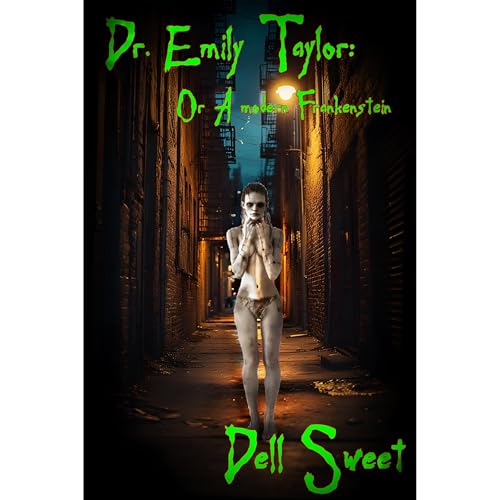
Dr. Emily Taylor: Or A modern Frankenstein
Failed to add items
Sorry, we are unable to add the item because your shopping cart is already at capacity.
Add to Cart failed.
Please try again later
Add to Wish List failed.
Please try again later
Remove from wishlist failed.
Please try again later
Adding to library failed
Please try again
Follow podcast failed
Please try again
Unfollow podcast failed
Please try again
Audible Standard 30-day free trial
Select 1 audiobook a month from our entire collection of titles.
Yours as long as you’re a member.
Get unlimited access to bingeable podcasts.
Standard auto renews for $8.99 a month after 30 days. Cancel anytime.

Dr. Emily Taylor: Or A modern Frankenstein
Narrated by:
Virtual Voice
Buy for $4.99
-
Narrated by:
-
Virtual Voice
-
By:
-
Dell Sweet

This title uses virtual voice narration
Virtual voice is computer-generated narration for audiobooks.
Her focus remained resolutely fixed on the screens before her, on the intricate dance of code and cellular growth. Yet, as she meticulously adjusted the nutrient feed for one of the bio-reactors, a thought, cold and sharp, pierced through the carefully constructed walls of her scientific detachment. Her creation, this nascent being she was painstakingly assembling, required not only synthesized compounds and complex algorithms, but also the raw, fundamental building blocks of life itself.
The thought sent a shiver, not entirely of apprehension but of a dark, primal recognition, down her spine. It was an unsettling juxtaposition: the delicate, painstakingly synthesized components of her intended masterpiece, and the sheer, unthinking biological abundance that characterized the millions of lives swirling just beyond her reach. The anonymity that made the city so vast and impersonal also made it, in a terrifyingly detached way, incredibly convenient. Each individual, a universe of cells and potential, was a mere statistical unit in the grand equation of her ambition. The sheer scale of the population meant that the loss, or even the disappearance, of a single life, or a handful of lives, would be utterly imperceptible to the collective consciousness of the city. They would simply be absorbed, their absence noted only by a handful of grieving relatives, before the ceaseless flow of urban life carried on, oblivious.
This dawning awareness was a significant, and deeply disturbing, evolution in her project. Initially, her focus had been entirely on internal synthesis, on the meticulous construction of life from its most fundamental, synthesized components. She had prided herself on the purity of her approach, the controlled nature of her inputs.
It was during a particularly frustrating late-night session, wrestling with a recalcitrant strand of synthesized neural tissue, that the seed of this new, unnerving perspective had been planted. The problem wasn’t in the genetic code, or the nutrient bath, or the environmental controls. It was in the very nature of biological replication. Nature, in its wild, untamed state, had an advantage: it had time, generations, and an almost profligate disregard for individual units. Emily, in her controlled environment, was attempting to replicate that process, but with an urgency that defied natural timescales. She needed… more. Not more chemicals, but more life...
Second, fire the editor, as they are not doing any real work. I think the author wrote several versions of each section and they were all included in the final draft, making the whole thing very repetitive. I had to keep checking to make sure the audio hadn't glitched because I could swear I'd just heard the same section previously.
Third, this really felt like a work in progress, as it starts out that the scientist is looking to recreate her sister who has died and then changes to a daughter who has died. Make up my mind!
The whole thing could have been great, but instead, it is a train wreck 2/3 longer than it needs to be for all the repetitive statements and inconsitencies of plot. I don't know what happened here, but it's actually embarrassing to read!
Where's the proof reader?
Something went wrong. Please try again in a few minutes.