

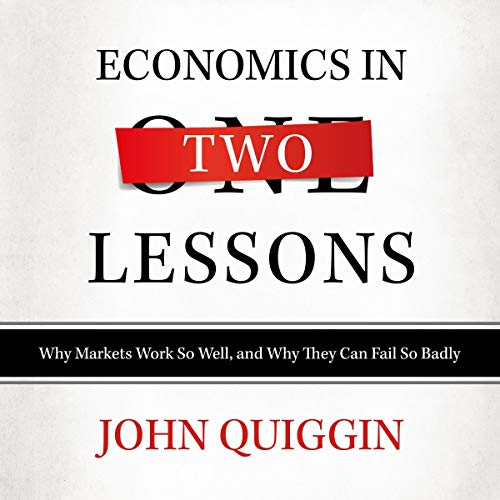
Economics in Two Lessons
Why Markets Work so Well, and Why They Can Fail so Badly
Failed to add items
Add to Cart failed.
Add to Wish List failed.
Remove from wishlist failed.
Adding to library failed
Follow podcast failed
Unfollow podcast failed
Audible Standard 30-day free trial

Economics in Two Lessons
Buy for $20.78
-
Narrated by:
-
Gildart Jackson
-
By:
-
John Quiggin
A masterful introduction to the key ideas behind the successes - and failures - of free-market economics
Since 1946, Henry Hazlitt's best-selling Economics in One Lesson has popularized the belief that economics can be boiled down to one simple lesson: market prices represent the true cost of everything. But one-lesson economics tells only half the story. It can explain why markets often work so well, but it can't explain why they often fail so badly - or what we should do when they stumble. As Nobel Prize-winning economist Paul Samuelson quipped, "When someone preaches 'economics in one lesson', I advise: go back for the second lesson." In Economics in Two Lessons, John Quiggin teaches both lessons, offering a masterful introduction to the key ideas behind the successes - and failures - of free markets.
Economics in Two Lessons explains why market prices often fail to reflect the full cost of our choices to society as a whole. For example, every time we drive a car, fly in a plane, or flick a light switch, we contribute to global warming. But, in the absence of a price on carbon emissions, the costs of our actions are borne by everyone else. In such cases, government action is needed to achieve better outcomes.
Two-lesson economics means giving up the dogmatism of laissez-faire as well as the reflexive assumption that any economic problem can be solved by government action, since the right answer often involves a mixture of market forces and government policy. But the payoff is huge: understanding how markets actually work - and what to do when they don't.
Brilliantly accessible, Economics in Two Lessons unlocks the essential issues at the heart of any economic question.
©2019 John Quiggin (P)2019 Blackstone Audio, Inc.Listeners also enjoyed...


Excellent
Something went wrong. Please try again in a few minutes.
simple
Something went wrong. Please try again in a few minutes.
Many economics texts are very dogmatic teaching only microeconomics or macroeconomics. This book discusses both as well and the interplay between microeconomics and macroeconomics. Highly recommended.
Excellent balanced text
Something went wrong. Please try again in a few minutes.
A little removed from reality
Something went wrong. Please try again in a few minutes.
Sparkling clear author and reader.
Something went wrong. Please try again in a few minutes.