

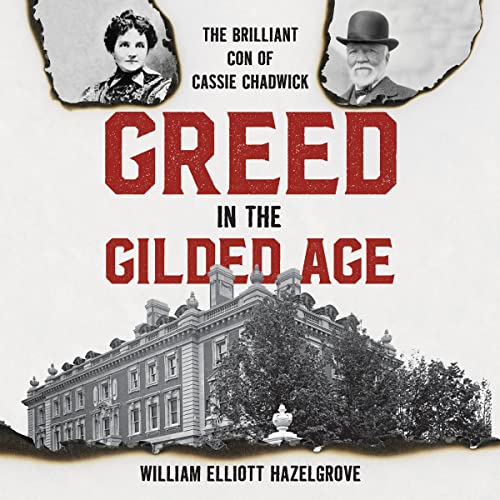
Greed in the Gilded Age
The Brilliant Con of Cassie Chadwick
Failed to add items
Add to Cart failed.
Add to Wish List failed.
Remove from wishlist failed.
Adding to library failed
Follow podcast failed
Unfollow podcast failed
Audible Standard 30-day free trial

Greed in the Gilded Age
Buy for $19.10
-
Narrated by:
-
Cindy Piller
Bloomsbury presents Greed in the Gilded Age by William Elliott Hazelgrove, read by Cindy Piller.
Greed in the Gilded Age is a Gatsby-esque tale of mystery, money, sex, and scandal. ‘Millionaire’ had just entered the American lexicon and Cassie Chadwick was front page news, becoming a media sensation before mass media, even eclipsing President Roosevelt’s inauguration. Using these newspaper articles, Hazelgrove tells the story of one of the greatest cons in American history.
Combining the sexuality and helplessness her gender implied, Chadwick conned at least 2 million dollars, equivalent to about 60 million today, simply by claiming to be the illegitimate daughter and heir of steel titan, Andrew Carnegie. Playing to their greed, she was able to convince highly educated financiers to loan hundreds of thousands of dollars, on nothing more than a rumor and her word.
She was a product of her time and painting her as a criminal is only one way to look at it. Those times rewarded someone who was smart, inventive, bold, and aggressive. She was able to break through boundaries of class, education, and gender, to beat the men of the one percent at their own game.
©2022 William Elliott Hazelgrove (P)2022 Bloomsbury Publishing PlcListeners also enjoyed...




It was a great book in that painting a picture of unruled and totally unrestricted banking in the late 19th century and early 1900s. It took this case to remind us of the possibilities of people overall to take advantage of trust and individual wants.
My main complaint about the book overall is that the timeline is far from linear, and very confusing. I understand that doing a straight line makes the whole story lose some of its punch and overall impact, but it also clears the whole thing up more and makes it less confusing.
In total, however, I enjoyed it and learned a lot from it. I have been totally unaware of what was possible! And I learned something about Andrew Carnegie, as well (overall a jerk but reality minded)
People have always taken advantage of weaknesses
Something went wrong. Please try again in a few minutes.