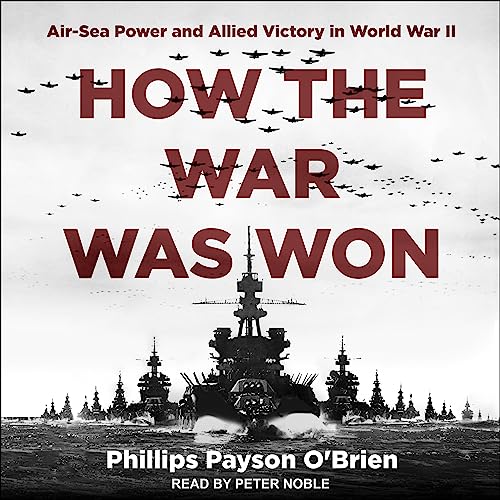
How the War Was Won Audiobook By Phillips Payson O'Brien cover art

How the War Was Won

Air-Sea Power and Allied Victory in World War II

Preview

Audible Standard 30-day free trial

Try Standard free
Select 1 audiobook a month from our entire collection of titles.
Yours as long as you’re a member.
Get unlimited access to bingeable podcasts.
Standard auto renews for $8.99 a month after 30 days. Cancel anytime.

How the War Was Won

By: Phillips Payson O'Brien
Narrated by: Peter Noble
Try Standard free

$8.99 a month after 30 days. Cancel anytime.

Buy for $30.76

Buy for $30.76

World War II is usually seen as a titanic land battle, decided by mass armies, most importantly those on the Eastern Front. Phillips Payson O'Brien shows us the war in a completely different light. In this compelling new history of the Allied path to victory, he argues that in terms of production, technology, and economic power, the war was far more a contest of air and sea than of land supremacy. He shows how the Allies developed a predominance of air and sea power which put unbearable pressure on Germany and Japan's entire war-fighting machine from Europe and the Mediterranean to the Pacific. Air and sea power dramatically expanded the area of battle and allowed the Allies to destroy over half of the Axis's equipment before it had even reached the traditional 'battlefield'. Battles such as El Alamein, Stalingrad, and Kursk did not win World War II; air and sea power did.

©2015 Phillips Payson O’Brien (P)2023 Tantor
World War II US Air Force Wars & Conflicts Armed Forces Air Force Military War Interwar Period Imperial Japan Naval Forces Franklin D. Roosevelt Imperialism Submarine
Enlightening Analysis • Well-researched History • Convincing Arguments • Insightful Perspective • Educational Content

Highly rated for:

All stars
Most relevant
The details are insane literally someone can write a book about this book and have not done it justice
If you don’t like details stay home

The details are insane literally

Something went wrong. Please try again in a few minutes.

I had always thought that World War II had a grand strategy determined at the top and carried out by the generals. What I learned from this book was that each service commander had their own ideas of what was best and that they often worked at cross purposes. Each wanted their own service to lead the war effort. Ernest King the commander of the American Navy spent far more resources in the Pacific than the President directed, and he ignored the less glamorous need to safeguard the convoys in the Atlantic, costing many lives and ships. Similarly, the key Air Force commanders were much more interested in destroying cities rather than destroying the enemy’s means of transportation. This meant the wasting of allied resources and the prolonging of the war.

Gave a new understanding of World War II

Something went wrong. Please try again in a few minutes.

A compelling analysis of industrial priorities in WWII . Definitely worth the read but this book is heavy on facts and statistics. Don’t read this book unless you are already very familiar with the general history of WWII.

A look at the numbers

Something went wrong. Please try again in a few minutes.

Very interesting and convincing arguments, but the story lacks due to too many repeating paragraphs

Very interesting arguments

Something went wrong. Please try again in a few minutes.

As a book, this is a great history, well researched and lots of supporting evidence. However, as an audio book, it’s too detailed and repetitive. I can’t quickly skim over content that has been addressed previously or presents detailed statistics.

Excellent history, but repetitive

Something went wrong. Please try again in a few minutes.

See more reviews