

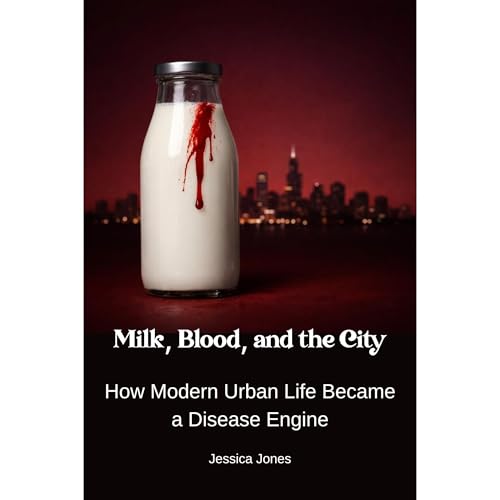
Milk, Blood, and the City
How Modern Urban Life Became a Disease Engine
Failed to add items
Add to Cart failed.
Add to Wish List failed.
Remove from wishlist failed.
Adding to library failed
Follow podcast failed
Unfollow podcast failed
Audible Standard 30-day free trial

Milk, Blood, and the City
Buy for $14.99
-
Narrated by:
-
Virtual Voice
-
By:
-
Jessica Jones

This title uses virtual voice narration
Cities are often celebrated as monuments to human progress — engines of culture, innovation, and economic growth.
But they were also laboratories of disease.
Milk, Blood, and the City traces the biological consequences of rapid urbanization from the 19th century to the modern era. It examines how density, food distribution, sanitation failures, industrial waste, and political denial created predictable patterns of infection and chronic illness.
This book is not simply a history of disease.
It is an analysis of structure.
Inside, readers will explore:
• How overcrowding transformed tuberculosis into an urban epidemic
• The role of unpasteurized milk in spreading infection before refrigeration
• Slaughterhouses and the public health cost of industrial meat processing
• Cholera outbreaks and the deadly myth of “bad air”
• Sewage systems shaped by class inequality
• How the poor became test subjects for public health experimentation
• The normalization of chronic illness in dense environments
• Why warnings were ignored in favor of profit and growth
• How sanitation reforms arrived only after catastrophic loss
• The persistence of urban disease engines into the modern era
The book demonstrates that disease outbreaks were rarely random. They were consequences of policy decisions, infrastructure neglect, and economic incentives.
Milk transported without refrigeration became a vector.
Waste dumped into waterways became transmission systems.
Tenement overcrowding became incubation chambers.
Class privilege determined survival rates.
Urban planners and political leaders often celebrated industrial success while ignoring the biological toll unfolding in working-class neighborhoods. The affluent insulated themselves through access to clean water and private systems, while the poor endured contaminated supplies and inadequate sanitation.
Even when scientific breakthroughs occurred — such as the identification of cholera’s waterborne transmission — resistance to reform delayed life-saving action. Economic interests and political hesitation repeatedly overrode public health urgency.
The book also examines how chronic illness gradually became background noise in urban life. Respiratory disease, pollution exposure, stress disorders, and metabolic conditions became normalized as part of modern existence.
The core argument is stark:
Cities did not simply experience disease.
They engineered environments where disease could thrive.
The parallels to modern urban crises — from air pollution to COVID-19 — are not accidental. Hyperconnectivity, density, and global trade continue to amplify biological risk.
Readers will gain:
• A structural understanding of how urban design shapes health
• Insight into the relationship between class and disease exposure
• Historical context for modern public health systems
• A framework for evaluating current urban vulnerabilities
This book does not romanticize the past. Nor does it condemn urban life.
Instead, it asks a critical question:
If cities are built environments, what responsibility do we bear for the health consequences embedded within them?
The legacy of milk contamination, blood-filled streets, sewage neglect, and ignored warnings still echoes in contemporary policy debates. Infrastructure, housing density, environmental regulation, and public health funding remain intertwined.
Urban health is not accidental.
It is designed.
And design can change.