

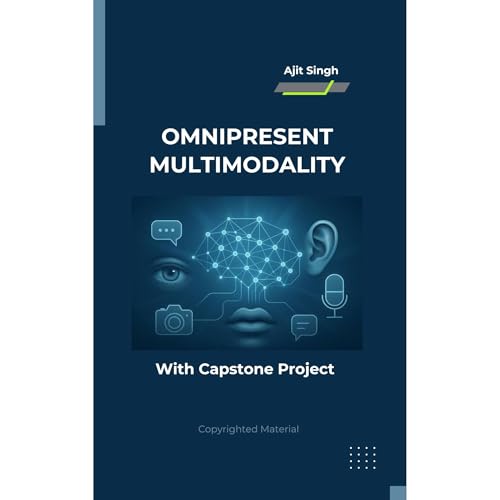
Omnipresent Multimodality
Failed to add items
Sorry, we are unable to add the item because your shopping cart is already at capacity.
Add to Cart failed.
Please try again later
Add to Wish List failed.
Please try again later
Remove from wishlist failed.
Please try again later
Adding to library failed
Please try again
Follow podcast failed
Please try again
Unfollow podcast failed
Please try again
Audible Standard 30-day free trial
Select 1 audiobook a month from our entire collection of titles.
Yours as long as you’re a member.
Get unlimited access to bingeable podcasts.
Standard auto renews for $8.99 a month after 30 days. Cancel anytime.

Omnipresent Multimodality
Narrated by:
Virtual Voice
Buy for $6.90
-
Narrated by:
-
Virtual Voice
-
By:
-
Ajit Singh

This title uses virtual voice narration
Virtual voice is computer-generated narration for audiobooks.
Key Features:
1. Beginner to Advanced Trajectory: The book is structured logically, starting with fundamental concepts in Chapter 1 and culminating in a full-fledged capstone project in Chapter 10, making it suitable for all levels of learners.
2. Hands-On Learning: Every theoretical concept is reinforced with practical code examples, hands-on tutorials, and implementation details using popular Python libraries and AI frameworks.
3. Real-World Case Studies: The book is rich with case studies from diverse domains such as healthcare, e-commerce, autonomous driving, and human-computer interaction, illustrating how multimodality is transforming industries.
4. Focus on Modern Architectures: In-depth coverage of a cornerstone of modern AI—the Transformer architecture—and its application in leading multimodal models like CLIP and DALL-E.
5. Complete Capstone Project: The final chapter guides the reader step-by-step through building and deploying a live, working multimodal search engine, complete with fully explained code for both the backend and frontend.
6. Ethics and Responsibility: A dedicated chapter addresses the critical aspects of bias, fairness, explainability, and the responsible deployment of multimodal AI systems.
7. Future-Ready Content: A forward-looking chapter explores emerging trends and the future frontiers of the field, preparing readers for the next wave of innovation.
8. NEP 2020 and AICTE Compliant: The content and structure are aligned with modern educational frameworks that promote interdisciplinary learning, critical thinking, problem-solving, and practical skills.
To Whom This Book Is For:
1. B.Tech and M.Tech Students: Primarily aimed at students of Computer Science, Information Technology, Artificial Intelligence, and related engineering disciplines. It serves as a core textbook that aligns with their curriculum.
2. AI/ML Practitioners and Software Developers: Professionals working in the industry who want to expand their skill set to include multimodal data processing and build more sophisticated AI applications.
3. Researchers and Academics: Provides a structured overview of the field, from foundational theories to open research problems, making it a valuable reference for academic work.
4. Data Scientists: For data scientists looking to move beyond tabular or single-modality data and leverage the rich information present in images, text, and audio combined.
5. Self-Taught Learners and Enthusiasts: Anyone with a basic understanding of programming and machine learning who is curious about the future of AI will find the book’s clear explanations and practical examples highly accessible.
The book is meticulously designed to bridge the gap between foundational academic principles and real-world industrial practice. It begins with the absolute basics, demystifying core concepts with simple analogies and clear examples, and progressively builds up to advanced, state-of-the-art topics. Its unique pedagogy, which is fully compliant with India's NEP 2020 and the AICTE model curriculum, emphasizes conceptual understanding and hands-on, skill-based learning over rote memorization.
No reviews yet