

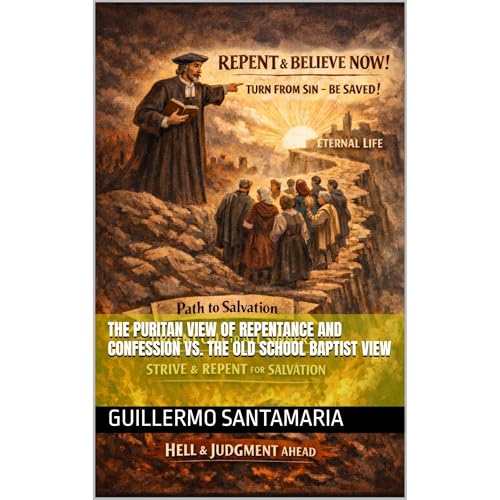
THE PURITAN VIEW OF REPENTANCE AND CONFESSION VS. THE OLD SCHOOL BAPTIST VIEW
Failed to add items
Add to Cart failed.
Add to Wish List failed.
Remove from wishlist failed.
Adding to library failed
Follow podcast failed
Unfollow podcast failed
Audible Standard 30-day free trial

THE PURITAN VIEW OF REPENTANCE AND CONFESSION VS. THE OLD SCHOOL BAPTIST VIEW
Buy for $3.99
-
Narrated by:
-
Virtual Voice

This title uses virtual voice narration
The question before us is not whether repentance matters. Scripture commands repentance, godly sorrow is real, and the believer’s life includes ongoing humbling before God. The question is where repentance and confession are allowed to sit in the structure of the gospel. When repentance becomes a hinge that turns forgiveness on and off—when confession is treated as the mechanism by which pardon is obtained or regained—then even evangelical language can drift into a practical re-legalization of the Christian life. This is precisely the danger Old School Baptists repeatedly resisted, not because they minimized repentance, but because they feared any scheme that quietly relocates the sinner’s peace from Christ’s blood to the sinner’s performance.
THE PURITAN VIEW OF REPENTANCE …
The Puritan tradition, represented here by Watson, Goodwin, and Burroughs, sought to form holy lives through “practical divinity.” Their urgency about procrastinated repentance, their detailed counsel for the wounded conscience, and their use of Scripture’s “marks” are often spiritually searching and morally bracing. Yet this method—especially when popularized—can foster a habit of spiritual bookkeeping: an anxious tendency to measure pardon by the intensity, completeness, or recurrence of confession. The result may be serious devotion, but devotion shadowed by the suspicion that Christ’s peace is only as stable as today’s repentance.
THE PURITAN VIEW OF REPENTANCE …
Against this, the Old School Baptist witness insists upon the finality of Christ’s atonement and the distinction between judicial pardon and fatherly restoration. The believer does confess, does mourn sin, and does repent in lived experience; but these are fruits of life and light, not conditions of acceptance. In 1 John 1:6–10, confession stands opposite the self-deceptive “if we say…” claims, while cleansing is grounded in the blood that “cleanseth” as an ongoing reality for those walking in the light. God is “faithful and just” to forgive because justice has already been satisfied in Christ, who remains the Advocate and Propitiation of His people (1 John 2:1–2). In this light, confession ceases to be a transaction and becomes what it was always meant to be: truthful fellowship, the speech of children who no longer hide, and the pathway by which God restores the conscience to enjoy what Christ has already secured.