

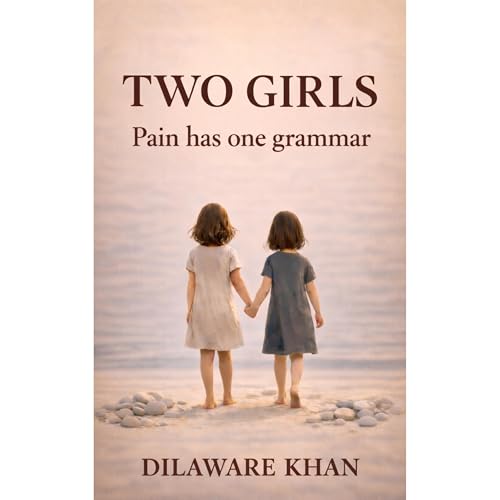
TWO GIRLS – Pain Has One Grammar
A Literary Novella About Memory, Childhood, and Shared Pain
Failed to add items
Sorry, we are unable to add the item because your shopping cart is already at capacity.
Add to Cart failed.
Please try again later
Add to Wish List failed.
Please try again later
Remove from wishlist failed.
Please try again later
Adding to library failed
Please try again
Follow podcast failed
Please try again
Unfollow podcast failed
Please try again
Audible Standard 30-day free trial
Select 1 audiobook a month from our entire collection of titles.
Yours as long as you’re a member.
Get unlimited access to bingeable podcasts.
Standard auto renews for $8.99 a month after 30 days. Cancel anytime.

TWO GIRLS – Pain Has One Grammar
Narrated by:
Virtual Voice
Buy for $3.99
-
Narrated by:
-
Virtual Voice
-
By:
-
Dilaware Khan

This title uses virtual voice narration
Virtual voice is computer-generated narration for audiobooks.
The light does not change. The ground is gentle. Nothing asks them to hurry.
They play with stones. They count. They listen. They learn how to keep their bodies quiet. Slowly, through games and shared rituals, they begin to speak about what their bodies remember. Hunger. Fear. Night. The sound of watching. The voices of their mothers.
When one girl names the place she came from, and the other names hers, the space between them must learn to hold two truths at once.
TWO GIRLS is a minimalist literary novella about childhood, trauma, and the fragile work of listening. Told in spare, rhythmic language, it refuses spectacle and explanation, choosing instead to explore how pain lives in the body and how it can be made shareable without being compared.
This is a book about what survives.
About words that grow lighter when spoken carefully.
About the small rules we make so that stories can be told without harm.
Quiet, devastating, and exact, TWO GIRLS is a meditation on memory, safety, and the possibility of understanding without erasing difference.
Readers of Kazuo Ishiguro, W. G. Sebald, and Cormac McCarthy will recognize the lineage of TWO GIRLS in its restraint, ethical seriousness, and child-voiced precision.
No reviews yet