

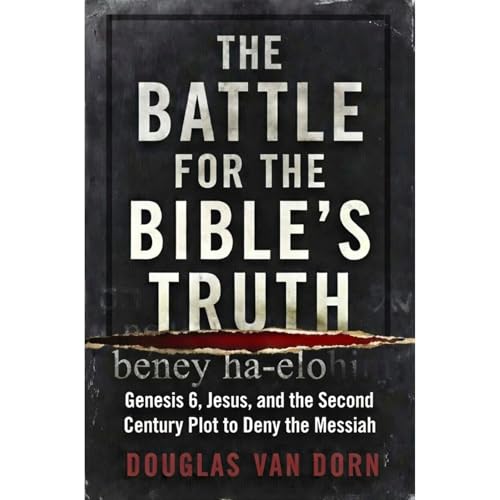
The Battle for the Bible's Truth
Genesis 6, Jesus, and the Second Century Plot to Deny the Messiah
Failed to add items
Add to Cart failed.
Add to Wish List failed.
Remove from wishlist failed.
Adding to library failed
Follow podcast failed
Unfollow podcast failed
Audible Standard 30-day free trial

The Battle for the Bible's Truth
Buy for $12.99
-
Narrated by:
-
Virtual Voice
-
By:
-
Douglas Van Dorn

This title uses virtual voice narration
What if the most common modern interpretations of some of the Bible’s most debated passages were deliberately crafted—not by early Christians, but by those who opposed them?
In The Battle for the Bible’s Truth, Douglas Van Dorn uncovers a forgotten second-century campaign that reshaped how key Old Testament texts were read—and how they are still read today.
Genesis 6:1–4, Deuteronomy 32:8, Psalm 82, and related passages once carried a clear supernatural meaning shared by Jews and the earliest Christians alike: heavenly “sons of God,” a divine council, and a coming divine Son who would inherit the nations. These texts were foundational to early Christian claims that Jesus is the unique Son of God, the second divine figure who stands in the council, judges the lesser “gods,” and receives the worship of angels.
Then, in the decades after the temple’s destruction (70 AD) and the Bar Kokhba revolt (135 AD), rabbinic authorities made targeted changes—altering wording, reinterpreting long-established meanings, and even introducing new traditions—to neutralize these very passages. The goal? To sever the scriptural links early Christians used to proclaim Jesus as Messiah and God incarnate.
The result: interpretations that desupernaturalized the Bible at precisely the points where it pointed most clearly to Christ. These novel readings—later adopted by much of the church—were not ancient Christian tradition. They were anti-Christian countermeasures.
In Part I, Van Dorn presents the accessible overview: the targeted texts, the pattern of changes, the rabbinic motives, and the New Testament payoff—especially Jesus’ own use of Psalm 82 in John 10 to defend His divine Sonship. In Part II, he provides the detailed historical and textual evidence, drawing from the Dead Sea Scrolls, Septuagint, Masoretic Text, early Church Fathers, and rabbinic sources.
This is not just another book on Genesis 6 or the divine council. It is a call to recover the original, supernatural reading of Scripture—a reading that once fueled mass Jewish conversions to Christ and that still reveals the glory of Jesus as the Son of God who inherits the nations.
For Christians seeking to understand the Bible’s supernatural worldview, for those wrestling with why Jewish people rarely embrace the New Testament today, and for anyone who wants to see how history’s most important battle over Scripture continues to shape our faith—this book is essential reading.
“Your Rabbis have absolutely expunged many passages out of the Septuagint version… Still, I will argue with you even from those received passages which you still allow.” — Justin Martyr, Dialogue with Trypho 71
People who viewed this also viewed...




I listened to the audiobook version, so I wasn’t always able to pause and check citations as carefully as I would have liked. Some of my questions may simply reflect a desire to revisit certain sections in print. Even so, the book raises important issues that are worth thinking through. The AI reader was excellent quality, only struggled with biblical reference abbreviation, but are easily discernible.
The central issue that stood out to me is how different communities inherited and reshaped the Second Temple worldview. That seems to be where much of the tension really sits.
For me, the discussion raises two related but distinct questions. Were the rabbis deliberately altering the text? Or were they protecting and defining their theological boundaries by choosing an existing variation in the text? The author makes the case with evidentiary support that they changed their biblical interpretation on the Two Powers doctrine because of Christianity.
The evidence of pre-Christian textual variation makes a big difference here. If a reading like Deuteronomy 32 with “sons of God” is attested in the Dead Sea Scrolls and also reflected in the Septuagint—both clearly pre-Christian traditions— when and why did the Rabbis change to was the other reading "sons of Israel" produced. Even now, why do some Christians cling to the latter reading? In my view, that distinction is really key to the whole argument and is why one should read this.
What is their motivation? Are they just carefully protecting a strict monotheistic framework? But altering the Torah to do that? Van Dorn is not the first to raise this "why question" that Alan Segal called the “Two Powers in Heaven.” The same resistance that the Pharisees had against Jesus is shown to be the same that the Rabbis also were still resisting. Now, are they still willing to alter Torah?
Since reading the text I had a chance to verify some of the references. Where I currently land is that it seems more likely that early Christianity preserved one older layer of Israelite theology—one that included divine council language and a more complex heavenly worldview—while later rabbinic Judaism refused like the Pharisees to accept Jesus as Messiah and kindly put narrowed the interpretive boundaries by altering the text in response to historical trauma and the rise of Christian claims.
Overall, this book is stimulating and well worth reading. I love the Jewish people, and wonder how they cannot see "what I see". Perhaps they were misled by the third century Rabbis who made a dramatic change and textual response that they thought was best for their people. Like the Pharisees felt in the NT towards Jesus. Many Christian texts hold to that reading as well. How is that interpretation influencing the effectiveness of the Church in sharing the Gospel to all? It raises the right questions and encourages careful thinking about how Second Temple Judaism developed into the distinct trajectories we later see in rabbinic Judaism and Christianity.
Readers interested in the Dead Sea Scrolls, the Septuagint, and early Jewish-Christian debates about Scripture will find this book well worth their time.
A definite must read! Dr Van Dorn raises serious questions about how the Biblical interpretation from the Rabbinic tradition.
Something went wrong. Please try again in a few minutes.