

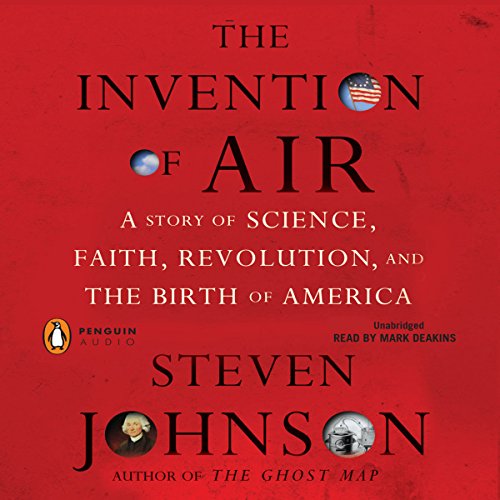
The Invention of Air
Failed to add items
Sorry, we are unable to add the item because your shopping cart is already at capacity.
Add to Cart failed.
Please try again later
Add to Wish List failed.
Please try again later
Remove from wishlist failed.
Please try again later
Adding to library failed
Please try again
Follow podcast failed
Please try again
Unfollow podcast failed
Please try again
Audible Standard 30-day free trial
Select 1 audiobook a month from our entire collection of titles.
Yours as long as you’re a member.
Get unlimited access to bingeable podcasts.
Standard auto renews for $8.99 a month after 30 days. Cancel anytime.

The Invention of Air
Narrated by:
Mark Deakins
Buy for $15.75
-
Narrated by:
-
Mark Deakins
-
By:
-
Steven Johnson
The Invention of Air is a book of world-changing ideas wrapped around a compelling narrative, a story of genius and violence and friendship in the midst of sweeping historical change that provokes us to recast our understanding of the Founding Fathers.
It is the story of Joseph Priestley—scientist and theologian, protégé of Benjamin Franklin, friend of Thomas Jefferson—an eighteenth-century radical thinker who played pivotal roles in the invention of ecosystem science, the discovery of oxygen, the founding of the Unitarian Church, and the intellectual development of the United States. And it is a story that only Steven Johnson, acclaimed juggler of disciplines and provocative ideas, can do justice to.
In the 1780s, Priestley had established himself in his native England as a brilliant scientist, a prominent minister, and an outspoken advocate of the American Revolution, who had sustained long correspondences with Franklin, Jefferson, and John Adams. Ultimately, his radicalism made his life politically uncomfortable, and he fled to the nascent United States. Here, he was able to build conceptual bridges linking the scientific, political, and religious impulses that governed his life. And through his close relationships with the Founding Fathers—Jefferson credited Priestley as the man who prevented him from abandoning Christianity—he exerted profound if little-known influence on the shape and course of our history.
As in his last bestselling work, The Ghost Map, Steven Johnson here uses a dramatic historical story to explore themes that have long engaged him: innovation and the way new ideas emerge and spread, and the environments that foster these breakthroughs. And as he did in Everything Bad Is Good for You, Johnson upsets some fundamental assumptions about the world we live in—namely, what it means when we invoke the Founding Fathers—and replaces them with a clear-eyed, eloquent assessment of where we stand today.
Listeners also enjoyed...




People who viewed this also viewed...


Wordy
Something went wrong. Please try again in a few minutes.
Breath it now while you still can
Something went wrong. Please try again in a few minutes.
broaden your historical knowledge
Something went wrong. Please try again in a few minutes.
The book's main strength is its explanation of how multiple influences, including Priestley's aptitudes and education, the conventions of English coffee house society, England's easily accessible coal deposits, and luck, came together to make Priestley's work possible. Johnson argues persuasively that scientific breakthroughs depend not just on scientific tradition, experimentation and individual brilliance, but also on the political and economic environments within which scientists operate.
Johnson also contrasts the all-encompassing intellectual grasp of America's founders with the anti-intellectual stance of many of today's politicians. He claims such anti-intellectualism is therefore un-American. In doing so, however, he overlooks the anti-intellectual strains in our history dating back at least as far as the Jacksonians.
Good scientific history
Something went wrong. Please try again in a few minutes.
Compact and Provocative
Something went wrong. Please try again in a few minutes.