

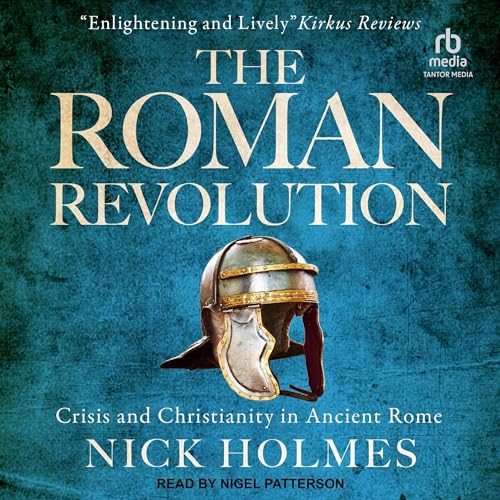
The Roman Revolution
Crisis and Christianity in Ancient Rome
Failed to add items
Add to Cart failed.
Add to Wish List failed.
Remove from wishlist failed.
Adding to library failed
Follow podcast failed
Unfollow podcast failed
Audible Standard 30-day free trial

The Roman Revolution
Buy for $17.33
-
Narrated by:
-
Nigel Patterson
-
By:
-
Nick Holmes
It was a time of revolution. The Roman Revolution describes the little known "crisis of the third century", and how it led to a revolutionary new Roman Empire. Long before the more famous collapse of the Western Roman Empire in the fifth century, in the years between AD 235-275, barbarian invasions, civil war, and plague devastated ancient Rome. Out of this ordeal came new leaders, new government, new armies, and a new vision of what it was to be Roman. Best remembered today is the rapid rise of Christianity in this period, as Rome's pagan gods were rejected, and the emperor Constantine converted to this new religion. Less well remembered is the plethora of other changes that conspired to provide an environment well suited to a religious revolution.
Drawing on the latest research, Nick Holmes looks for new answers to old questions. He charts the rise of the Roman Republic and the classical Roman Empire, examining the roles played by sheer good luck and the benign climate. Focusing on the reigns of the critically important but under-researched emperors in the third century, such as Aurelian, Diocletian, and Constantine, he vividly brings to life how Rome just escaped catastrophe in the third century, and embarked on a journey that would take it into a brave new world-one which provided the foundations for modern Europe and America.
©2022 Nick Holmes (P)2024 TantorListeners also enjoyed...


Continue the series


People who viewed this also viewed...



Popular history of Diocletian and Constantine
Something went wrong. Please try again in a few minutes.
Rome crisis in the third century.
Something went wrong. Please try again in a few minutes.
Holmes begins with a quick recounting of the Roman Republic and how it's legions began and developed. He then goes into the reign of Augustus and his successors, showing what they accomplished and how it all fell apart in the third century. Then we get to the revolution as emperors begin to restructure the way that the Roman government and its legions work to create something that extends the life of Rome for another couple of centuries. There is nothing particular new in this other than thinking of the changes wrought by Diocletian and Constantine as a revolution rather than reform. I've taught the details in my Western Civ classes for more than twenty years. But it is a very nice account of those changes and why they are important.
A Good Overview
Something went wrong. Please try again in a few minutes.
Poor History, with an axe to grind with Christianity
Something went wrong. Please try again in a few minutes.