

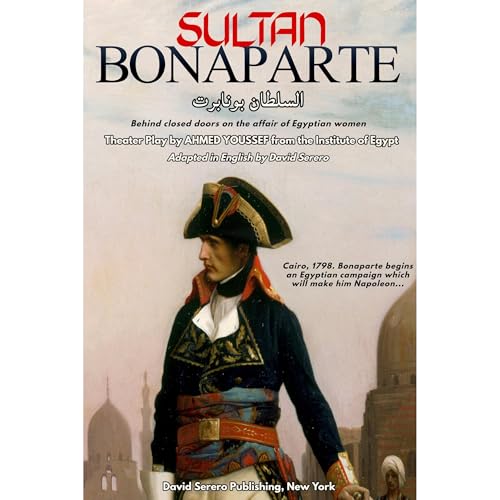
The Sultan Bonaparte
Theater Play about Bonaparte in Egypt
Failed to add items
Sorry, we are unable to add the item because your shopping cart is already at capacity.
Add to Cart failed.
Please try again later
Add to Wish List failed.
Please try again later
Remove from wishlist failed.
Please try again later
Adding to library failed
Please try again
Follow podcast failed
Please try again
Unfollow podcast failed
Please try again
Audible Standard 30-day free trial
Select 1 audiobook a month from our entire collection of titles.
Yours as long as you’re a member.
Get unlimited access to bingeable podcasts.
Standard auto renews for $8.99 a month after 30 days. Cancel anytime.

The Sultan Bonaparte
Narrated by:
Virtual Voice
Buy for $9.99
-
Narrated by:
-
Virtual Voice

This title uses virtual voice narration
Virtual voice is computer-generated narration for audiobooks.
Bonaparte, torn between his desire to inflict on his soldiers a punishment commensurate with the crime but, above all, confirming his policy of respect for Islam, and the pressure from his generals not to execute the soldiers so as not to arouse anger within the army had to be pronounced quickly so as not to let rumors of partiality circulate among the population. Before deciding, Bonaparte summons the two most illustrious of his generals, Kléber and Menou. The closed-door meeting took place at the legendary Saladin citadel on the heights of the Egyptian capital.
Ahmed Youssef weaves a severe dialogue between these three generals, who have opposing temperaments, contradictory aspirations, and different conceptions of the Orient and Islam. A dialogue which, despite the sensitive issue of murdered Muslim women, is not devoid of humor, irony, and the strange art of repartee between these three sons of the Enlightenment. On leaving this closed session, Bonaparte announced an unexpected decision.
Ahmed Youssef is a famous writer and author of several reference works on the question of the Egyptian campaign, including "Bonaparte and Mahomet" and "Captain Bouchard, this unknown man who discovered the Rosetta Stone". He also translated the monumental Correspondence of Bonaparte in Egypt into Arabic. He is today a member of the board of directors of the Egypt Institute.
Adapted in English by David Serero.
No reviews yet