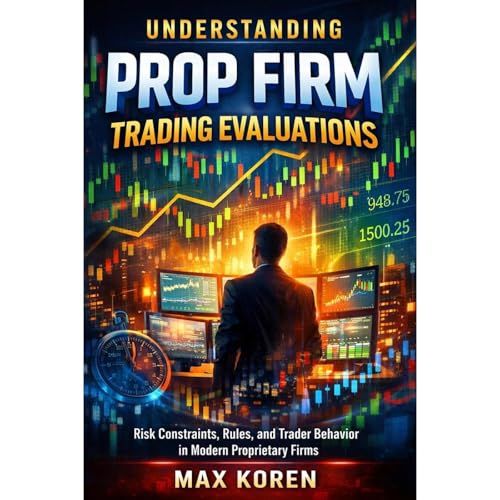
Understanding Prop Firm Trading Evaluations
Risk Constraints, Rules, and Trader Behavior in Modern Proprietary Firms
Failed to add items
Add to Cart failed.
Add to Wish List failed.
Remove from wishlist failed.
Adding to library failed
Follow podcast failed
Unfollow podcast failed
Audible Standard 30-day free trial

Understanding Prop Firm Trading Evaluations
Buy for $3.99
-
Narrated by:
-
Virtual Voice
-
By:
-
Max Koren

This title uses virtual voice narration
Understanding Prop Firm Trading Evaluations examines how modern proprietary trading firms design evaluations, manage risk, and monitor participant behavior under tightly defined rules.
Rather than focusing on tactics or outcomes, this book explores the structure of prop firm environments themselves. It looks at why evaluations are built around drawdowns, time limits, rule density, and consistency constraints, and how those design choices shape behavior, perception, and pressure.
Written in plain English for non-specialists, this book treats proprietary trading evaluations as systems to be understood, not challenges to be conquered. It explains why large account labels can feel smaller in practice, why deadlines influence pacing even when markets are unchanged, and why oversight often continues after approval in different forms.
Topics examined include:
How drawdown rules define usable risk rather than headline account size
Why time windows and deadlines change decision pacing and urgency
The role of rule density, automation, and monitoring systems
How consistency constraints affect the interpretation of uneven outcomes
Why funded account oversight often emphasizes long-term alignment
The psychological effects of operating under continuous constraints
Sustainability and longevity in tightly governed trading environments
All examples in the book are fictional and illustrative. The focus remains educational and descriptive, emphasizing interpretation over instruction and structure over strategy.
This book does not offer trading advice, step-by-step guidance, or performance claims. Instead, it provides a framework for understanding how proprietary trading evaluations function and why they feel the way they do to participants operating inside them.
Understanding Prop Firm Trading Evaluations is intended for readers interested in market structure, risk management, behavioral finance, and the design of constraint-based systems. It may appeal to those researching proprietary trading firms, studying decision-making under pressure, or seeking clearer language for experiences they already recognize.
By making the structure visible, the book aims to reduce confusion and replace assumptions with clarity. It does not promise outcomes. It offers context.
People who viewed this also viewed...