

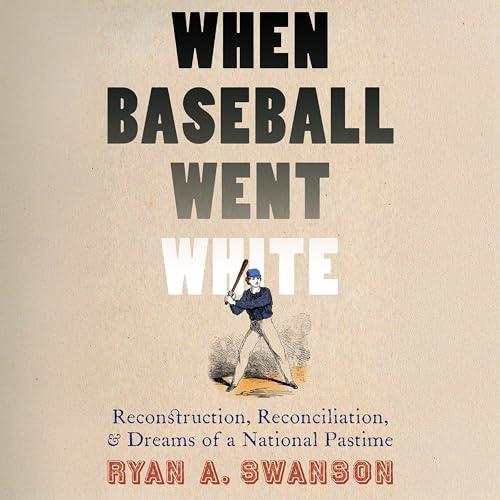
When Baseball Went White
Reconstruction, Reconciliation, and Dreams of a National Pastime
Failed to add items
Add to Cart failed.
Add to Wish List failed.
Remove from wishlist failed.
Adding to library failed
Follow podcast failed
Unfollow podcast failed
Audible Standard 30-day free trial

When Baseball Went White
Buy for $20.56
-
Narrated by:
-
Marlin May
-
By:
-
Ryan A. Swanson
The story of Jackie Robinson valiantly breaking baseball’s color barrier in 1947 is one that most Americans know. But less recognized is the fact that some seventy years earlier, following the Civil War, baseball was tenuously biracial and had the potential for a truly open game. How, then, did the game become so firmly segregated that it required a trailblazer like Robinson? The answer, Ryan A. Swanson suggests, has everything to do with the politics of “reconciliation” and a wish to avoid the issues of race that an integrated game necessarily raised.
The history of baseball during Reconstruction, as Swanson tells it, is a story of lost opportunities. Thomas Fitzgerald and Octavius Catto (a Philadelphia baseball tandem), for example, were poised to emerge as pioneers of integration in the 1860s. Instead, the desire to create a “national game”—professional and appealing to white Northerners and Southerners alike—trumped any movement toward civil rights. Focusing on Philadelphia, Washington DC, and Richmond—three cities with large African American populations and thriving baseball clubs—Swanson uncovers the origins of baseball’s segregation and the mechanics of its implementation. An important piece of sports history, his work also offers a better understanding of Reconstruction, race, and segregation in America.
The book is published by University of Nebraska Press. The audiobook is published by University Press Audiobooks.
©2014 Board of Regents of the University of Nebraska (P)2025 Redwood AudiobooksCritic reviews
"An intriguing, insightful, and provocative book that opens exciting possibilities for future researchers." (Journal of Sport History)
“Carefully researched and wonderfully nuanced... A must-read.” (Peter Morris, author of A Game of Inches)
"Lively and engaging." (Sport in American History)
Listener received this title free
This book addresses the segregation issue during the reconstruction period with a survey of the relevant sources of the era, and the influencers - such as Col. Tom Fitzgerald, Henry Chadwick, Arthur Gorman and Nicholas Young. This book explains the hostilities and objections to Moses Fleetwood Walker playing professional baseball and his eventual exile from the sport.
The author explains the history of the Philadelphia Pythians, and describes the impact of civil rights activist and sportsman Octavius Catto's 1871 assignation. The book dissects the coverage the media played in shaping public opinion of the sport. This work points out that it wasn't uncommon for violence to break out at a game, and that black ball players often had to participate in games armed for fear of their lives.
"When Baseball Went White" establishes Philadelphia as a hotbed in baseball during this uneasy era and demonstrates the mechanics of segregation. Swanson sustains the spirit of black baseball, and the stereotypical challenges and the rampant racism teams often faced.
How baseball become segregated
Something went wrong. Please try again in a few minutes.