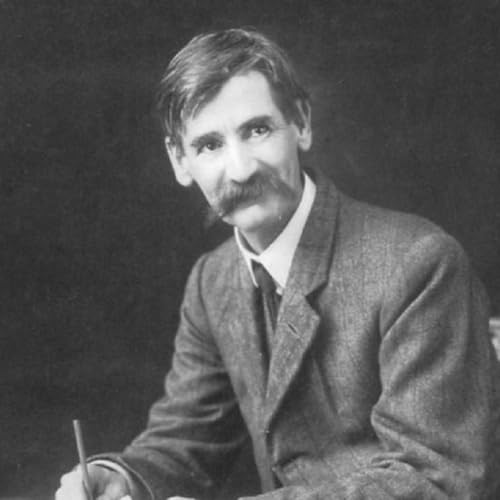
• THE PRETTY GIRL IN THE ARMY by HENRY LAWSON
    Mar 29 2026
    "That Pretty Girl in the Army" by Henry Lawson
    In this light, good‑humored tale, Henry Lawson turns his attention to the small misunderstandings and quiet vanities that make everyday life so entertaining. The story follows a narrator who becomes intrigued by a striking young woman dressed in a military-style uniform—an unusual and eye‑catching sight that sparks curiosity and a bit of harmless speculation.
    As he observes her and tries to make sense of her role, Lawson gently pokes fun at the assumptions people make based on appearances. The narrator's imagination fills in the gaps, building a picture of who she must be and what her "army" position might involve. But as the truth gradually comes into focus, the situation proves far more ordinary—and far more amusing—than the narrator's initial theories.
    Lawson's trademark charm is on full display: dry wit, affectionate character sketches, and a warm appreciation for the quirks of human nature. The story offers a playful reminder that people are rarely what they first appear to be, and that sometimes the smallest encounters leave the biggest smiles.
    Show more Show less
    48 mins
  • THE LAST FIGHT IN THE COLISEUM by CHARLOTTE YONGE
    Mar 27 2026
    "The Last Fight in the Coliseum" — Charlotte Yonge
    Episode Summary
    In this episode, we bring you Charlotte Yonge's powerful historical tale "The Last Fight in the Coliseum," a story that blends imagination with the fading echoes of ancient Rome. Set during the final years of the Roman Empire, the narrative follows a young Christian who finds himself thrust into the brutal world of the gladiatorial arena—not as a warrior, but as a witness to the clash between old Rome and the rising Christian faith.
    Yonge uses the grandeur and cruelty of the Coliseum to explore themes of courage, conviction, and the moral transformation of a civilization. The story captures the moment when the old pagan world, built on spectacle and violence, begins to crumble, and a new spiritual worldview takes its place. ⭐ What the Story Is About
    • A Christian hermit named Telemachus is brought into the Coliseum during one of the last gladiatorial spectacles.
    • Instead of a traditional gladiator's duel, the confrontation becomes a symbolic struggle between the old Roman order and the new Christian faith.
    • Yonge highlights the contrast between physical might and moral courage, showing how one person's steadfastness can echo louder than the roar of the crowd.
    • The story reflects the broader historical shift as Christianity spreads and the gladiatorial games fade into history. ⭐ Fact vs. Fiction
    While the characters and specific events in the story are fictional, the historical backdrop is real:
    • By the 4th century, the gladiatorial games were declining due to cost, political instability, and the growing influence of Christianity.
    • Early Christian writers recorded accounts of believers who were executed in the arena for refusing to renounce their faith.
    • The idea of a final symbolic confrontation in the Coliseum is poetic rather than literal, but it reflects the genuine cultural transition taking place in Rome.
    Yonge's story is not meant as strict history—it is a moral and emotional portrait of a world in transformation. ⭐ About Charlotte Yonge
    Charlotte Mary Yonge (1823–1901) was a prolific Victorian author known for her historical fiction, moral tales, and character‑driven narratives. Deeply influenced by her Anglican faith, she wrote more than 100 works, many of them exploring themes of virtue, sacrifice, and spiritual courage.
    Yonge had a gift for taking historical settings and using them to illuminate the human heart. In "The Last Fight in the Coliseum," she blends history with imagination to create a story that is both dramatic and reflective—a reminder of how individual acts of bravery can shape the moral memory of a civilization.
    Show more Show less
    26 mins
  • THE CHEST OF BROKEN GLASS and FEDERALIST No. 55 by JAMES MADISON
    Mar 25 2026
    The Chest of broken Glass is an old folk tale about a father who has grown old- to old to care for himself, and in order to gain more time from his three sons who only visit now and then, fills an old locked chect with broken glass. The sons, upon seeing the chect, and hearing the content inside, believe their father has filled it with gold, and decide to take turns living with and caring for their father further into his old age. In Federalist No. 55 one of our nations founders James Madison, admits that for our democratic republic to work, its elected leaders must be honest and virtuous- otherwise,it will become ruled by tyrants.
    Show more Show less
    12 mins
  • AN O.HENRY DOUBLE PLAY! AFTER TWENTY YEARS and BRICKDUST ROW
    Mar 22 2026
    "After Twenty Years" — Summary
    Set on a quiet, rain‑slicked street in early‑20th‑century Manhattan, After Twenty Years explores loyalty, fate, and the unexpected turns life can take. Two friends—Jimmy Wells and Bob—made a pact twenty years earlier to meet again at the same spot, no matter where life had taken them.
    When the night finally arrives, one man keeps the appointment… but the reunion that follows is not the one either of them imagined.
    O. Henry delivers one of his most famous twist endings here—an ending that raises questions about duty, friendship, and the choices that define us. "Brickdust Row" — Summary
    In Brickdust Row, O. Henry shifts from the streets to the shabby boarding houses of New York's working class. Here we meet Blinker, a shy, lonely clerk, and Florence, the gentle young woman who lives across the hall.
    Their lives unfold quietly—two people navigating poverty, pride, and unspoken affection. O. Henry paints the world of Brickdust Row with tenderness and humor, showing how small acts of kindness can brighten even the most worn‑down corners of the city.
    And, true to form, he delivers a twist—one that reveals the hidden hopes and quiet sacrifices of ordinary people trying to find connection in a big, indifferent city.
    Show more Show less
    33 mins
  • MIX WAR, ART, AND DANCING and CAT IN THE RAIN by ERNEST HEMINGWAY
    Mar 18 2026
    AN ERNEST HEMINGWAY DOUBLE PLAY 🎙️ Mix War, Art, and Dancing
    Hemingway's early newspaper sketch drops listeners into a Kansas City Y.W.C.A. ballroom during World War I, where soldiers on leave mingle with art students in a swirl of jazz, fox‑trotting, and youthful bravado. The piece captures a vivid contrast: outside, a lone woman walks through sleet on a dark, wet sidewalk, while inside, music, laughter, and flirtation pulse through the Fine Arts Institute. Soldiers swap stories, girls in bright dresses compete for dances, and the pianist shifts from ragtime to sentimental wartime tunes.
    What emerges is a snapshot of wartime America that blends innocence, longing, and the strange normalcy people try to build in the shadow of global conflict. Hemingway's eye for detail—paintings on the walls, fruit punch in the intermission, the girl in the red dress surrounded by eager partners—turns a simple community dance into a portrait of a nation trying to stay human while the world changes around it.
    Added twist for listeners: This isn't just a dance; it's a moment where art, youth, and war brush shoulders. The story invites the question: What do people cling to when the world is shifting beneath their feet? 🎙️ Cat in the Rain
    Set in a quiet Italian seaside hotel, this story follows an American wife who spots a small cat crouched under a dripping green table in the rain. Her desire to rescue the cat becomes the spark that reveals deeper emotional currents in her marriage—unspoken needs, loneliness, and a longing for comfort and identity. Her husband remains absorbed in his book while she wanders downstairs, encountering the dignified hotel‑keeper whose attentiveness makes her feel seen in a way she hasn't felt in a long time.
    When the cat disappears, her disappointment opens into a confession of all the things she wants—stability, beauty, tenderness, and something of her own. The rain‑soaked setting, the quiet hotel corridors, and the wife's growing sense of yearning all build toward a final gesture that suggests someone else has been listening after all.
    Added twist for listeners: The cat becomes more than a cat—it's a symbol of everything she feels slipping out of reach. The story's power lies in what Hemingway doesn't say, leaving listeners to sense the emotional iceberg beneath the surface.
    Show more Show less
    19 mins
  • HOT POTATOES by ARNOLD BENNETT
    Mar 15 2026
    Hot Potatoes by Arnold Bennett
    Arnold Bennett's Hot Potatoes is a gentle comedy of good intentions gone wrong, centered on a devoted mother, her musically gifted son, and two very ill‑timed potatoes.
    On a bitterly cold evening, Mrs.Swann'son is preparing to play in the orchestra at an important social event hosted by local businessmen. His mother, proud but anxious, fusses over him as he leaves. At the last moment she is struck by a "brilliant" idea: Hiss hands must be kept warm for the performance—so she bakes two large potatoes and hurries out into the night to deliver them to him.
    Her son, meanwhile, has already arrived at the elegant home where the pre‑concert dinner is being held. Things fall apart quickly from that point forward.
    Enjoy all our stories at www.bestof1001stories.com and send us a kind review-thanks!
    Show more Show less
    37 mins
  • THE FIRST CLASS PASSENGER by ANTON CHEKHOV
    Mar 11 2026
    The First‑Class Passenger unfolds during a winter train journey, where a modest, observant narrator finds himself seated vis‑à‑vis a well‑dressed stranger. The man, eager for an audience, begins talking about his life—boasting about his cleverness, his ambition, and the way he has outmaneuvered others to get ahead. As he speaks, his pride slowly exposes something darker: a past marked by cruelty, selfishness, and a lack of remorse.
    Chekhov builds the tension not through action but through revelation. The more the man talks, the more he condemns himself, until the narrator—and the reader—see the moral emptiness behind the polished exterior. The story becomes a quiet study of guilt, self‑deception, and the thin line between success and moral failure. 🖋️ What Inspired Chekhov (Based on What We Know)
    There is no single recorded anecdote from Chekhov explaining the origin of this story, but its themes and structure align closely with several well‑documented aspects of his life and writing:
    • Chekhov traveled constantly, especially by rail, and often used trains as settings where strangers reveal themselves in unexpected ways. Encounters with talkative fellow passengers were a common feature of Russian travel in the 1880s and 1890s.
    • He was fascinated by casual confession, especially the way ordinary people reveal their flaws unintentionally. Many of his stories hinge on a character who talks too freely, exposing truths they never meant to share.
    • He frequently explored moral blindness, showing how people justify their actions while remaining unaware of the harm they cause. The first‑class passenger fits this pattern perfectly.
    • Chekhov's medical background gave him a keen eye for psychological detail. He often said that people reveal themselves most clearly in unguarded, everyday conversation—exactly the dynamic at play in this story.
    While we don't have a diary entry saying "this is why I wrote it," the story reflects Chekhov's lifelong interest in the quiet dramas of ordinary people and the moral contradictions hidden beneath polite conversation. Enjoy all our stories at www.bestof1001stories.com and sign up for our newsletter after leaving a great review! Thanks!
    Show more Show less
    24 mins
  • THE CELEBRATED JUMPING FROG OF CALAVERAS COUNTY by MARK TWAIN
    Mar 8 2026
    Enjoy ALL our story podcasts at www.bestof1001stories.com for free and sign up for ourmonthly newsletter after leaving a review! 🐸 Summary of The Celebrated Jumping Frog of Calaveras County
    Mark Twain's story centers on a narrator who visits a mining camp in California to inquire about a man named Leonidas W. Smiley. Instead, he is cornered by the endlessly talkative Simon Wheeler, who launches into a long, deadpan tale about Jim Smiley, a compulsive gambler who would bet on anything that moved. Smiley's prize possession is Dan'l Webster, a frog he has trained to jump higher and farther than any other. A stranger tricks Smiley by secretly filling the frog with buckshot, causing Dan'l Webster to lose the contest. By the time Wheeler finishes his rambling anecdote, the narrator realizes he has been the victim of a frontier tall tale—one told with such sincerity that it becomes its own kind of art. 📚 Why the Story Mattered to Mark Twain
    • It launched his national career. The story was first published in 1865 and became Twain's breakout success, bringing him widespread recognition as a humorist. It is widely acknowledged as the piece that "jumpstarted his career," establishing his voice and reputation.
    • It showcased his signature style early. Twain's blend of dry humor, regional dialect, and satirical observation is already fully formed here. The story's structure—a straight‑faced narrator listening to an outrageous yarn—became a hallmark of his comedic technique.
    • It connected him to the American West. Twain's mining‑camp experiences in California and Nevada shaped his early writing. This story captures the rough‑and‑ready storytelling culture of the frontier, grounding his humor in lived experience. How to support our show- check us out at www.patreon.com/1001storiesnetwork and donate maybe $5 a month to help pay our basic expenses-thanks!
    Show more Show less
    21 mins