• Episode 29 From Bananas and Pineapples to iPhones: A New Framework for Industrial Policy
    Mar 17 2026
    Low-income countries target an average of 13 industries in their development plans—compared with just 5 in high-income economies. Yet many lack the fiscal space for large subsidies. In this episode we explore what’s new about industrial policy today. Rather than trying to “pick winners,” the emerging framework focuses on matching policy tools to a country’s fiscal space, market size, and institutional capacity—and managing a portfolio of risks. From Costa Rica’s shift from bananas to pineapples to India assembling the latest iPhones, the discussion highlights how countries can upgrade industries and move up the value chain using a more pragmatic approach to development. Generated with AI using wondercraft.ai and guided by our experts. Read more at: https://www.worldbank.org/en/publication/industrial-policy-for-development
    Show more Show less
    13 mins
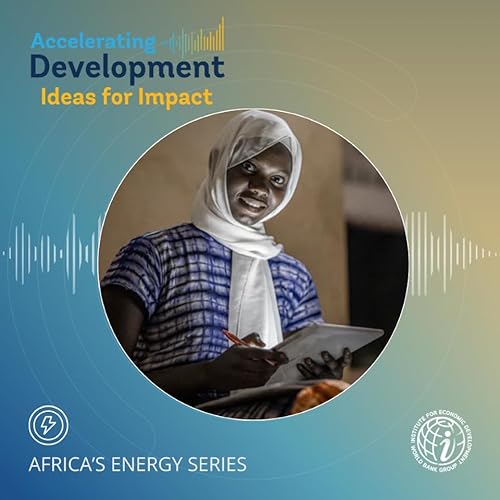
  • Episode 28 Research Currents: Africa’s Energy – 1 When the Lights Stay Off
    Mar 13 2026

    Over 90% of people in Sub-Saharan Africa live within reach of electricity infrastructure—yet many homes remain dark. Why? Because access depends on more than just building the grid. This episode, the first in the three-part series “Research Currents: Africa’s Energy,” explores new research on why investment does not always translate into real electricity use. Evidence from Togo, Rwanda, Kenya, and refugee settlements shows how affordability, pricing, and reliability shape whether households actually adopt and use electricity. Generated with AI using wondercraft.ai and guided by our experts. Read more at https://www.sciencedirect.com/science/article/pii/S004727272500074X https://www.sciencedirect.com/science/article/pii/S030438782500046X

    https://www.sciencedirect.com/science/article/pii/S0301421525002277

    https://www.sciencedirect.com/science/article/pii/S2214629624001373

    Show more Show less
    13 mins
  • Episode 27 Monitoring, Managing, and Markets: Tools for Clean Air 1 - Monitoring
    Mar 7 2026

    This episode is the first in the three-part series “Monitoring, Managing, and Markets: Tools for Clean Air.” Over 90% of the global population lives in places where air pollution exceeds safe guidelines—and one in nine deaths worldwide is linked to polluted air. Yet pollution often remains invisible. In this episode, we explore why monitoring is the foundation of effective clean air policy. Evidence from cities such as Beijing, Lahore, Tbilisi, and London shows that when pollution data becomes visible, credible, and usable, people change behavior and governments respond. From embassy monitors to SMS pollution forecasts and household air sensors, the research reveals a powerful insight: information itself can be an intervention. Generated with AI using wondercraft.ai and guided by our experts. Read more at: https://www.pnas.org/doi/10.1073/pnas.2201092119 https://academic.oup.com/ej/advance-article/doi/10.1093/ej/ueaf071/8239786?utm_source=authortollfreelink&utm_campaign=ej&utm_medium=email&guestAccessKey=a9b61781-d56a-4d4d-9c01-4e637fdb13ad&login=false https://documents1.worldbank.org/curated/en/099412307162491936/pdf/IDU-35eca82b-9a89-41f7-8b23-22bedfeef378.pdf https://www.nber.org/system/files/working_papers/w33510/w33510.pdf

    Show more Show less
    11 mins
  • Episode 26 Unlocking Growth by Closing Gender and Implementation Gaps: Insights from Women, Business and the Law 2026
    Mar 1 2026

    Only 58% of women participate in the labor force vs. 76% of men—and no economy grants women the full set of legal rights measured today. In this episode, we unpack Women, Business and the Law 2026 and the growing “implementation gap” between laws on paper and reality on the ground. From safety and childcare to credit and political representation, we explore why closing gender gaps could raise global GDP per capita by up to 20%. Generated with AI using wondercraft.ai and guided by our experts. Read more at https://wbl.worldbank.org/en/publications/flagship-report

    Show more Show less
    10 mins
  • Episode 25 One Apple, Fifteen Rules: How Agrifood Standards Shape Markets
    Feb 20 2026

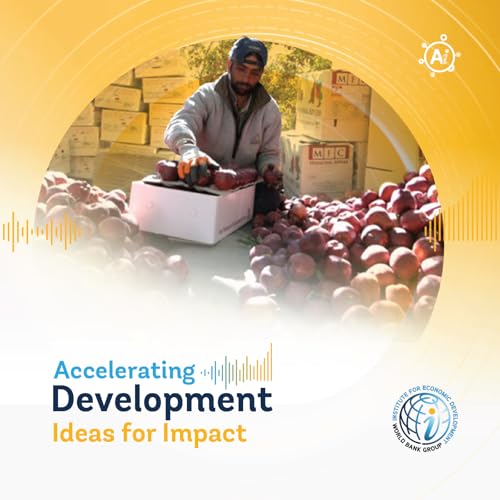
    Nearly 90% of global trade is affected by non-tariff measures. Exporters face an average of more than 15 distinct compliance requirements per shipment. What looks like a simple apple on a grocery shelf is governed by a dense web of agrifood standards—covering safety limits, labeling, audits, and certification. As tariffs decline, these standards increasingly determine who can access global markets. This episode explores how regulatory distance shapes trade flows, why small producers face disproportionate compliance costs, and how the “Adapt, Align, Author” framework can help countries turn standards from barriers into springboards for growth. From quality infrastructure gaps to the economic payoff of certification, we unpack what it takes to compete in today’s rule-based food economy. Generated with AI using wondercraft.ai and guided by our experts. Read more at https://www.worldbank.org/en/publication/wdr2025

    Show more Show less
    11 mins
  • Episode 24 Rethinking Growth: How Investing in Education Lifted the World’s Poorest
    Feb 13 2026

    45% of global growth. Nearly 60% of income gains for the poorest. 📊 What if education has been one of the most powerful forces reshaping the global economy? This episode explores new evidence from Distributional Growth Accounting: Education and the Reduction of Global Poverty, 1980–2019, showing that schooling explains roughly one-third of the decline in extreme poverty worldwide. We unpack how expanding secondary and tertiary education transformed labor markets, reduced inequality, and moderated skill premiums across 154 countries. Discover why traditional growth models may be underestimating education’s true economic impact—and what this means for policy today. Generated with AI using wondercraft.ai and guided by our experts. Read more at https://amory-gethin.fr/files/pdf/Gethin2025QJE.pdf?deliveryName=DM272505

    Show more Show less
    12 mins
  • Episode 23 Can Frontier Markets Deliver Jobs in Time for the World’s Next 2.6 Billion People?
    Feb 6 2026

    1.8 billion people today—and 2.6 billion by 2050. Frontier Market Economies are countries that sit between low-income and emerging markets: more developed than the poorest economies, with some access to global financial markets, but still facing significant structural constraints. This episode dives into the world’s biggest jobs challenge, unpacking why slowing investment, volatile capital flows, and rising debt risks are holding these economies back—and what has worked for those that succeeded. Drawing on insights from the Global Economic Prospects 2026, we explore how smart policy choices can turn demographic pressure into a driver of sustainable growth. Generated with AI using wondercraft.ai and guided by our experts.

    Read more here at https://openknowledge.worldbank.org/server/api/core/bitstreams/a8c9b8ba-4558-4195-9826-1185f0b41283/content

    Show more Show less
    12 mins
  • Episode 22 Resilient on the Surface, Fragile Underneath: Inside the Global Growth Downshift
    Jan 29 2026

    Global growth looks resilient—but is it? In 2025, global GDP grew 2.7%, yet 1 in 4 developing countries is poorer than before the pandemic. This episode looks beyond the headlines to uncover a slowing global economy, deepening divergence, rising debt, and the race to create jobs for 1.2 billion young people. We explore why fiscal rules and private investment may be the difference between a temporary rebound and lasting stability.

    Generated with AI using wondercraft.ai and guided by our experts.

    Read the full report here at https://www.worldbank.org/en/publication/global-economic-prospects

    Show more Show less
    12 mins