• Catholic Reflections – Friday 27 March 2026, Friday of the 5th week of Lent, John 10:31-42
    Mar 25 2026

    On Friday, 27 March 2026, the Church celebrates the Friday of the 5th week of Lent. In John 10:31-42, Jesus faces rejection and accusations of blasphemy because He claims to be the Son of God. Despite this, He invites us to believe in His works as a sign of His divine mission and relationship with the Father. Many come to believe in Him even where John the Baptist had first baptized. This passage encourages faith in Jesus’ identity and the power of His works.


    Catholic Reflections – The Father Is in Me

    Date: Friday 27 March 2026

    Liturgical: Lent

    Title: Friday of the 5th week of Lent

    Outline:

    • Opening prayer

    • Full Gospel reading (word for word)

    • Key points

    • Concluding prayer

    • Tags

    Gospel – John 10:31–42 (full reading, word for word):

    They sought to arrest him, but he escaped from their hands.

    At that time: The Jews picked up stones again to stone him. Jesus answered them, ‘I have shown you many good works from the Father; for which of them are you going to stone me?’ The Jews answered him, ‘It is not for a good work that we are going to stone you but for blasphemy, because you, being a man, make yourself God.’ Jesus answered them, ‘Is it not written in your Law, “I said, you are gods”? If he called them gods to whom the word of God came — and Scripture cannot be broken — do you say of him whom the Father consecrated and sent into the world, “You are blaspheming,” because I said, “I am the Son of God”? If I am not doing the works of my Father, then do not believe me; but if I do them, even though you do not believe me, believe the works, that you may know and understand that the Father is in me and I am in the Father.’ Again they sought to arrest him, but he escaped from their hands.

    He went away again across the Jordan to the place where John had been baptising at first, and there he remained. And many came to him. And they said, ‘John did no sign, but everything that John said about this man was true.’ And many believed in him there.

    Key Points:

    1. Jesus’ works reveal the Father

    His actions—healing, teaching, loving—are signs of God’s presence.

    2. The challenge of belief

    Even when truth is visible, hearts can remain closed. Jesus invites belief through His works.

    3. Unity with the Father

    “The Father is in me and I am in the Father.” Jesus reveals a profound divine unity.

    4. Rejection and persistence

    Despite attempts to arrest Him, Jesus continues His mission faithfully.

    5. Witness leads to faith

    The testimony of John the Baptist helps others recognise the truth and believe.

    6. Faith grows through encounter

    Those who come to Jesus with openness begin to believe in Him.

    Concluding Prayer:

    Lord Jesus,

    help us to see Your works

    and recognise the presence of the Father in You.

    Open our hearts to believe,

    even when we struggle with doubt.

    Give us the grace to trust in Your truth

    and to follow You faithfully.

    Strengthen us when we face resistance or misunderstanding,

    and keep us rooted in Your love.

    May we, like those who came to You,

    grow in faith and proclaim

    that all You say is true.

    Amen.

    Tags: Catholic, Lent, 5th Week of Lent, Friday, John 10, Son of God, Father and Son, Faith, Belief, Works of Jesus, Witness, John the Baptist, Truth, Unity with God, Discipleship, Conversion, Daily Gospel, Catholic Podcast, Catholic Reflections


    Show more Show less
    4 mins
  • Reflexiones Católicas – viernes 27 de marzo 2026, viernes de la 5ª semana de Cuaresma, Juan 10:31-42
    Mar 25 2026

    El viernes 27 de marzo de 2026, la Iglesia celebra el viernes de la 5ª semana de Cuaresma. En Juan 10:31-42, Jesús enfrenta rechazo y acusaciones de blasfemia por decir que es el Hijo de Dios. A pesar de ello, nos invita a creer en sus obras como señal de su misión divina y su relación con el Padre. Muchos llegan a creer en Él incluso en el lugar donde Juan Bautista comenzó a bautizar. Este pasaje nos anima a confiar en la identidad de Jesús y en el poder de sus obras.


    Reflexiones Católicas – El Padre está en mí

    Fecha: Viernes 27 de marzo de 2026

    Litúrgico: Cuaresma

    Título: Viernes de la 5.ª semana de Cuaresma

    Esquema:

    • Oración inicial

    • Lectura completa del Evangelio (palabra por palabra)

    • Puntos clave

    • Oración final

    • Etiquetas

    Evangelio – Juan 10,31–42 (lectura completa, palabra por palabra):

    Intentaban detenerlo, pero se escapó de sus manos.

    En aquel tiempo: Los judíos tomaron de nuevo piedras para apedrearlo. Jesús les respondió: «Os he mostrado muchas obras buenas que vienen del Padre; ¿por cuál de ellas me apedreáis?».

    Los judíos le contestaron: «No te apedreamos por una obra buena, sino por blasfemia, porque tú, siendo hombre, te haces Dios».

    Jesús les respondió: «¿No está escrito en vuestra Ley: “Yo he dicho: vosotros sois dioses”? Si llama dioses a aquellos a quienes vino la palabra de Dios —y la Escritura no puede ser anulada—, ¿a quien el Padre consagró y envió al mundo le decís: “Blasfemas”, porque dije: “Soy Hijo de Dios”?

    Si no hago las obras de mi Padre, no me creáis; pero si las hago, aunque no me creáis a mí, creed a las obras, para que sepáis y comprendáis que el Padre está en mí y yo en el Padre».

    De nuevo intentaban detenerlo, pero se escapó de sus manos.

    Se fue otra vez al otro lado del Jordán, al lugar donde Juan había estado bautizando al principio, y permaneció allí. Muchos acudieron a él y decían: «Juan no hizo ningún signo, pero todo lo que Juan dijo de este era verdad». Y muchos creyeron en él allí.

    Puntos clave:

    1. Las obras de Jesús revelan al Padre

    Sus acciones—sanar, enseñar, amar—son signos de la presencia de Dios.

    2. El desafío de creer

    Incluso cuando la verdad es visible, los corazones pueden permanecer cerrados. Jesús invita a creer a través de sus obras.

    3. Unidad con el Padre

    «El Padre está en mí y yo en el Padre». Jesús revela una profunda unidad divina.

    4. Rechazo y perseverancia

    A pesar de los intentos de arrestarlo, Jesús continúa fielmente su misión.

    5. El testimonio conduce a la fe

    El testimonio de Juan el Bautista ayuda a otros a reconocer la verdad y creer.

    6. La fe crece a través del encuentro

    Quienes se acercan a Jesús con apertura comienzan a creer en Él.

    Oración final:

    Señor Jesús,

    ayúdanos a ver tus obras

    y a reconocer la presencia del Padre en Ti.

    Abre nuestros corazones para creer,

    incluso cuando luchamos con la duda.

    Danos la gracia de confiar en tu verdad

    y de seguirte fielmente.

    Fortalécenos cuando enfrentamos resistencia o incomprensión,

    y mantennos arraigados en tu amor.

    Que nosotros, como aquellos que acudieron a Ti,

    crezcamos en la fe y proclamemos

    que todo lo que dices es verdad.

    Amén.

    Etiquetas: Católica, Cuaresma, 5.ª semana de Cuaresma, Viernes, Juan 10, Hijo de Dios, Padre e Hijo, Fe, Creencia, Obras de Jesús, Testimonio, Juan el Bautista, Verdad, Unidad con Dios, Discipulado, Conversión, Evangelio del día, Podcast católico, Reflexiones Católicas


    Show more Show less
    7 mins
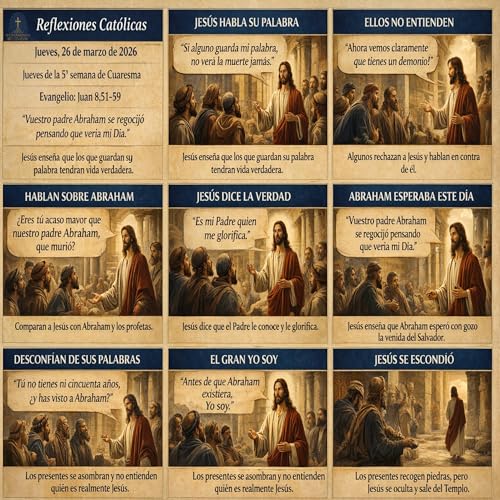
  • Reflexiones Católicas – Jueves 26 de marzo de 2026, Jueves de la 5ª semana de Cuaresma, Juan 8:51-59
    Mar 24 2026

    El jueves 26 de marzo de 2026, la Iglesia celebra el jueves de la 5ª semana de Cuaresma. El Evangelio de hoy, Juan 8:51-59, presenta a Jesús proclamando la promesa de la vida eterna para quienes guardan su palabra. A pesar de la oposición, Jesús revela su identidad divina al declarar: "Antes que Abraham fuese, yo soy", afirmando su existencia eterna y unidad con el Padre. Este pasaje nos invita a profundizar nuestra fe en Cristo como el Hijo de Dios que vence a la muerte.


    Reflexiones Católicas – Antes de que Abraham existiera, Yo Soy

    Fecha: Jueves 26 de marzo de 2026

    litúrgico

    Litúrgico: Jueves de la 5.ª semana de Cuaresma

    Esquema:

    • Oración inicial

    • Lectura completa del Evangelio (palabra por palabra)

    • Puntos clave

    • Oración final

    • Etiquetas

    Evangelio – Juan 8,51–59 (lectura completa, palabra por palabra):

    «Vuestro padre Abraham se alegró de ver mi día».

    En aquel tiempo: Jesús dijo a los judíos: «En verdad, en verdad os digo: si alguno guarda mi palabra, no verá la muerte jamás».

    Los judíos le dijeron: «Ahora sabemos que tienes un demonio. Abraham murió, y también los profetas, y tú dices: “Si alguno guarda mi palabra, no probará la muerte jamás”. ¿Eres tú más grande que nuestro padre Abraham, que murió? ¡También los profetas murieron! ¿Quién te crees que eres?».

    Jesús respondió: «Si yo me glorifico a mí mismo, mi gloria no es nada; es mi Padre quien me glorifica, de quien vosotros decís: “Es nuestro Dios”. Pero vosotros no lo conocéis; yo lo conozco. Y si dijera que no lo conozco, sería un mentiroso como vosotros; pero yo lo conozco y guardo su palabra.

    Vuestro padre Abraham se alegró de ver mi día; lo vio y se alegró».

    Entonces los judíos le dijeron: «Aún no tienes cincuenta años, ¿y has visto a Abraham?».

    Jesús les dijo: «En verdad, en verdad os digo: antes de que Abraham existiera, Yo Soy».

    Entonces tomaron piedras para arrojárselas; pero Jesús se ocultó y salió del templo.

    Puntos clave:

    1. Guardar la palabra de Jesús conduce a la vida

    El verdadero discipulado no es solo escuchar, sino vivir su palabra—esto abre el camino a la vida eterna.

    2. Jesús revela su identidad divina

    «Antes de que Abraham existiera, Yo Soy». Jesús usa el nombre divino, revelando que Él es Dios.

    3. Conocer a Dios requiere relación

    Jesús contrasta el verdadero conocimiento del Padre con simples afirmaciones. La fe real es vivida y personal.

    4. La fe de Abraham apunta a Cristo

    Abraham se alegró en la esperanza del Mesías. La fe siempre mira hacia Jesús.

    5. La verdad puede provocar rechazo

    La respuesta a la afirmación de Jesús es la hostilidad. No todos acogen la verdad.

    6. La Cuaresma invita a una obediencia más profunda

    «Guardar su palabra» significa confiar, obedecer y permanecer en Él cada día.

    Oración final:

    Señor Jesús,

    Tú eres el eterno «Yo Soy»,

    el que existía antes de todas las cosas

    y quien nos da la vida.

    Enséñanos a guardar tu palabra fielmente,

    no solo en lo que decimos

    sino en cómo vivimos.

    Atráenos a una verdadera relación con el Padre,

    para que lo conozcamos como Tú lo conoces.

    Fortalece nuestra fe,

    incluso cuando seguirte sea difícil.

    En este tiempo de Cuaresma,

    ayúdanos a permanecer en tu verdad

    y a caminar hacia la vida que prometes.

    Amén.

    Etiquetas: Católica, Cuaresma, 5.ª semana de Cuaresma, Jueves, Juan 8, Yo Soy, Abraham, Vida eterna, Palabra de Dios, Obediencia, Fe, Identidad divina, Verdad, Discipulado, Relación con Dios, Conversión, Evangelio del día, Podcast católico, Reflexiones Católicas


    Show more Show less
    17 mins
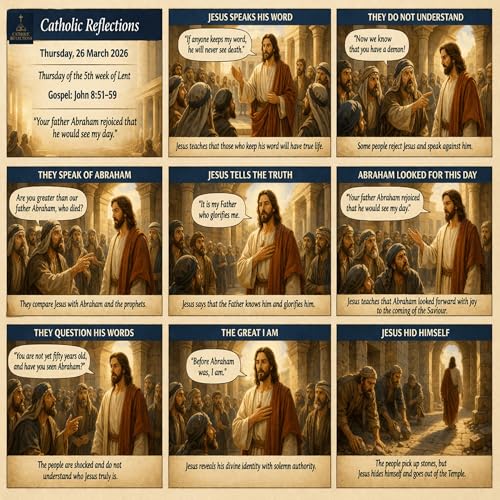
  • Catholic Reflections – Thursday 26 March 2026, Thursday of the 5th week of Lent, John 8:51-59
    Mar 24 2026

    On Thursday, 26 March 2026, the Church celebrates the Thursday of the 5th week of Lent. Today's Gospel, John 8:51-59, features Jesus proclaiming the promise of eternal life to those who keep His word. Despite opposition, Jesus reveals His divine identity by declaring, "Before Abraham was, I am," affirming His eternal existence and unity with the Father. This passage challenges us to deepen our faith in Christ as the Son of God who conquers death.


    Catholic Reflections – Before Abraham Was, I Am

    Date: Thursday 26 March 2026

    Liturgical: Thursday of the 5th week of Lent

    Outline:

    • Opening prayer

    • Full Gospel reading (word for word)

    • Key points

    • Concluding prayer

    • Tags

    Gospel – John 8:51–59 (full reading, word for word):

    ‘Your father Abraham rejoiced that he would see my day.’

    At that time: Jesus said to the Jews, ‘Truly, truly, I say to you, if anyone keeps my word, he will never see death.’ The Jews said to him, ‘Now we know that you have a demon! Abraham died, as did the prophets, yet you say, “If anyone keeps my word, he will never taste death.” Are you greater than our father Abraham, who died? And the prophets died! Who do you make yourself out to be?’ Jesus answered, ‘If I glorify myself, my glory is nothing. It is my Father who glorifies me, of whom you say, “He is our God.” But you have not known him. I know him. If I were to say that I do not know him, I would be a liar like you, but I do know him and I keep his word. Your father Abraham rejoiced that he would see my day. He saw it and was glad.’ So the Jews said to him, ‘You are not yet fifty years old, and have you seen Abraham?’ Jesus said to them, ‘Truly, truly, I say to you, before Abraham was, I am.’ So they picked up stones to throw at him, but Jesus hid himself and went out of the Temple.

    Key Points:

    1. Keeping Jesus’ word leads to life

    True discipleship is not just hearing but living His word—this opens the way to eternal life.

    2. Jesus reveals His divine identity

    “Before Abraham was, I am.” Jesus uses the divine name, revealing that He is God.

    3. Knowing God requires relationship

    Jesus contrasts true knowledge of the Father with mere claims. Real faith is lived and personal.

    4. Abraham’s faith points to Christ

    Abraham rejoiced in hope of the Messiah. Faith always looks forward to Jesus.

    5. Truth can provoke rejection

    The response to Jesus’ claim is hostility. Not everyone welcomes the truth.

    6. Lent invites deeper obedience

    To “keep His word” means to trust, obey, and remain in Him daily.

    Concluding Prayer:

    Lord Jesus,

    You are the eternal “I Am,”

    the One who was before all things

    and who gives us life.

    Teach us to keep Your word faithfully,

    not only in what we say

    but in how we live.

    Draw us into a true relationship with the Father,

    so that we may know Him as You know Him.

    Strengthen our faith,

    even when following You is difficult.

    In this Lenten season,

    help us to remain in Your truth

    and walk toward the life You promise.

    Amen.

    Tags: Catholic, Lent, 5th Week of Lent, Thursday, John 8, I Am, Abraham, Eternal Life, Word of God, Obedience, Faith, Divine Identity, Truth, Discipleship, Relationship with God, Conversion, Daily Gospel, Catholic Podcast, Catholic Reflections


    Show more Show less
    15 mins
  • Reflexiones Católicas – miércoles 25 de marzo de 2026, La Anunciación del Señor, Lucas 1:26-38
    Mar 24 2026

    El miércoles 25 de marzo de 2026 celebramos la Anunciación del Señor. La lectura del Evangelio de hoy, Lucas 1:26-38, relata la visita del ángel Gabriel a María para anunciarle que concebiría y daría a luz a Jesús, el Hijo de Dios. Este pasaje destaca la fe de María y su respuesta obediente al plan de Dios. Nos recuerda el poder de las promesas divinas y el inicio de la historia de la salvación a través de la humilde aceptación de la Virgen.


    Reflexiones Católicas – Hágase

    Fecha: Miércoles 25 de marzo de 2026

    Litúrgico: La Anunciación del Señor — Solemnidad

    Esquema:

    • Oración inicial

    • Lectura completa del Evangelio (palabra por palabra)

    • Puntos clave

    • Oración final

    • Etiquetas

    Evangelio – Lucas 1,26–38 (lectura completa, palabra por palabra):

    «He aquí que concebirás en tu seno y darás a luz un hijo».

    En aquel tiempo: El ángel Gabriel fue enviado por Dios a una ciudad de Galilea llamada Nazaret, a una virgen desposada con un hombre llamado José, de la casa de David. El nombre de la virgen era María.

    Y entrando donde ella estaba, dijo: «Alégrate, llena de gracia, el Señor está contigo». Pero ella se turbó por estas palabras y se preguntaba qué significaba aquel saludo.

    El ángel le dijo: «No temas, María, porque has hallado gracia delante de Dios. Y he aquí que concebirás en tu seno y darás a luz un hijo, y le pondrás por nombre Jesús. Él será grande y será llamado Hijo del Altísimo. El Señor Dios le dará el trono de David, su padre, y reinará sobre la casa de Jacob para siempre, y su reino no tendrá fin».

    María dijo al ángel: «¿Cómo será esto, puesto que no conozco varón?».

    El ángel le respondió: «El Espíritu Santo vendrá sobre ti, y la fuerza del Altísimo te cubrirá con su sombra; por eso el que va a nacer será santo, será llamado Hijo de Dios.

    Y mira, tu pariente Isabel, en su vejez, también ha concebido un hijo, y ya está de seis meses la que llamaban estéril; porque nada es imposible para Dios».

    María dijo: «He aquí la esclava del Señor; hágase en mí según tu palabra».

    Y el ángel se retiró.

    Puntos clave:

    1. Dios toma la iniciativa

    El ángel es enviado por Dios. La salvación comienza con la acción y la gracia de Dios.

    2. «No temas»

    María se turba, pero es invitada a confiar. La llamada de Dios suele venir con consuelo.

    3. El misterio de la Encarnación

    El Espíritu Santo cubre a María con su sombra—Dios se hace hombre por su «sí».

    4. Nada es imposible para Dios

    Este es el corazón de la fe. Lo que nos parece imposible es posible con Él.

    5. El fiat de María

    «Hágase en mí…» Su respuesta libre y confiada abre el camino a la salvación.

    6. La obediencia humilde cambia el mundo

    El «sí» silencioso de María se convierte en el punto decisivo de la historia.

    Oración final:

    Señor Dios,

    Tú elegiste a María en su humildad

    para ser la madre de tu Hijo.

    Danos un corazón como el suyo—

    abierto, confiado y dispuesto a decir sí a tu voluntad.

    Cuando tengamos miedo o estemos inseguros,

    ayúdanos a recordar que nada es imposible para Ti.

    Señor Jesús,

    enséñanos a seguir el ejemplo de María:

    a escuchar, a confiar y a obedecer.

    Que nuestras vidas repitan sus palabras:

    «Hágase en mí según tu palabra».

    Por la intercesión de la Bienaventurada Virgen María,

    acércanos más a Ti

    y haznos siervos fieles de tu plan.

    Amén.

    Etiquetas: Católica, Anunciación, Solemnidad, Lucas 1, María, Fiat, Hágase, Encarnación, Ángel Gabriel, Espíritu Santo, Hijo de Dios, Fe, Obediencia, Confianza, Nada es imposible, Bienaventurada Virgen María, Cuaresma, Evangelio del día, Podcast católico, Reflexiones Católicas

    Show more Show less
    23 mins
  • Catholic Reflections – Wednesday 25 March 2026, The Annunciation of the Lord, Luke 1:26-38
    Mar 24 2026

    On Wednesday, 25 March 2026, we celebrate the Annunciation of the Lord. Today's Gospel reading from Luke 1:26-38 recounts the moment when the angel Gabriel visits Mary to announce that she will conceive and bear Jesus, the Son of God. This passage highlights Mary's faith and her obedient response to God's plan. It reminds us of the power of God's promises and the beginning of salvation history through the humble acceptance of the Virgin Mary.


    Catholic Reflections – Let It Be Done

    Date: Wednesday 25 March 2026

    Liturgical: The Annunciation of the Lord — Solemnity

    Outline:

    • Opening prayer

    • Full Gospel reading (word for word)

    • Key points

    • Concluding prayer

    • Tags

    Gospel – Luke 1:26–38 (full reading, word for word):

    ‘Behold, you will conceive in your womb and bear a son.’

    At that time: The angel Gabriel was sent from God to a city of Galilee named Nazareth, to a virgin betrothed to a man whose name was Joseph, of the house of David. And the virgin’s name was Mary. And he came to her and said, ‘Hail, full of grace, the Lord is with you!’ But she was greatly troubled at the saying, and tried to discern what sort of greeting this might be. And the angel said to her, ‘Do not be afraid, Mary, for you have found favour with God. And behold, you will conceive in your womb and bear a son, and you shall call his name Jesus. He will be great and will be called the Son of the Most High. And the Lord God will give to him the throne of his father David, and he will reign over the house of Jacob for ever, and of his kingdom there will be no end.’

    And Mary said to the angel, ‘How will this be, since I am a virgin?’ And the angel answered her, ‘The Holy Spirit will come upon you, and the power of the Most High will overshadow you; therefore the child to be born will be called holy — the Son of God. And behold, your relative Elizabeth in her old age has also conceived a son, and this is the sixth month with her who was called barren. For nothing will be impossible with God.’ And Mary said, ‘Behold, I am the servant of the Lord; let it be to me according to your word.’ And the angel departed from her.

    Key Points:

    1. God takes the initiative

    The angel is sent by God. Salvation begins with God’s action and grace.

    2. “Do not be afraid”

    Mary is troubled, yet invited to trust. God’s call often comes with reassurance.

    3. The mystery of the Incarnation

    The Holy Spirit overshadows Mary—God becomes man through her “yes.”

    4. Nothing is impossible with God

    This is the heart of faith. What seems beyond us is possible with Him.

    5. Mary’s fiat

    “Let it be to me…” Her free and trusting response opens the way for salvation.

    6. Humble obedience changes the world

    Mary’s quiet yes becomes the turning point of history.

    Concluding Prayer:

    Lord God,

    You chose Mary in her humility

    to become the mother of Your Son.

    Give us hearts like hers—

    open, trusting, and ready to say yes to Your will.

    When we are afraid or uncertain,

    help us to remember that nothing is impossible with You.

    Lord Jesus,

    teach us to follow Mary’s example:

    to listen, to trust, and to obey.

    May our lives echo her words:

    “Let it be done to me according to Your word.”

    Through the intercession of the Blessed Virgin Mary,

    draw us closer to You

    and make us faithful servants of Your plan.

    Amen.

    Tags: Catholic, Annunciation, Solemnity, Luke 1, Mary, Fiat, Let It Be Done, Incarnation, Angel Gabriel, Holy Spirit, Son of God, Faith, Obedience, Trust, Nothing Is Impossible, Blessed Virgin Mary, Lent, Daily Gospel, Catholic Podcast, Catholic Reflections


    Show more Show less
    16 mins
  • Reflexiones Católicas – 24 de marzo de 2026, Martes de la 5ª semana de Cuaresma, Juan 8:21-30
    Mar 22 2026

    Acompáñanos el martes 24 de marzo de 2026, martes de la 5ª semana de Cuaresma, para reflexionar sobre Juan 8:21-30. En este pasaje, Jesús habla con los fariseos sobre su partida y la importancia de creer en él para no morir en pecado. Revela su origen divino y la unidad que comparte con el Padre, prometiendo que cuando sea levantado, se conocerá la verdad sobre quién es. Esta lectura nos invita a profundizar nuestra fe en Cristo durante esta temporada de Cuaresma.


    Reflexiones Católicas – Cuando hayáis elevado al Hijo del hombre

    Fecha: Martes 24 de marzo de 2026

    Litúrgico: Martes de la 5.ª semana de Cuaresma

    Esquema:

    • Oración inicial

    • Lectura completa del Evangelio (palabra por palabra)

    • Puntos clave

    • Oración final

    • Etiquetas

    Evangelio – Juan 8,21–30 (lectura completa, palabra por palabra):

    «Cuando hayáis elevado al Hijo del hombre, entonces sabréis que yo soy».

    En aquel tiempo: Jesús dijo a los fariseos: «Yo me voy, y me buscaréis, y moriréis en vuestro pecado. Adonde yo voy, vosotros no podéis venir». Entonces los judíos decían: «¿Acaso se va a matar, porque dice: “Adonde yo voy, vosotros no podéis venir”?».

    Él les dijo: «Vosotros sois de abajo; yo soy de arriba. Vosotros sois de este mundo; yo no soy de este mundo. Ya os dije que moriréis en vuestros pecados, porque si no creéis que yo soy, moriréis en vuestros pecados».

    Entonces le dijeron: «¿Tú quién eres?». Jesús les respondió: «Lo que desde el principio os estoy diciendo. Tengo mucho que decir sobre vosotros y mucho que juzgar; pero el que me envió es veraz, y yo digo al mundo lo que he oído de él».

    Ellos no comprendieron que les hablaba del Padre. Entonces Jesús les dijo: «Cuando hayáis elevado al Hijo del hombre, entonces sabréis que yo soy, y que no hago nada por mi propia cuenta, sino que hablo según lo que el Padre me ha enseñado. Y el que me envió está conmigo; no me ha dejado solo, porque yo hago siempre lo que le agrada».

    Mientras decía estas cosas, muchos creyeron en él.

    Puntos clave:

    1. «Yo soy de arriba»

    Jesús revela su origen divino. No es solo de este mundo—viene del Padre.

    2. La urgencia de creer

    «Si no creéis… moriréis en vuestros pecados». La fe en Jesús es esencial para la salvación.

    3. La Cruz revela quién es Jesús

    «Cuando hayáis elevado al Hijo del hombre…» La crucifixión manifestará su verdadera identidad.

    4. Obediencia perfecta al Padre

    Jesús vive en total unidad con el Padre, haciendo siempre lo que le agrada.

    5. Dios nunca está distante

    «No me ha dejado solo». El Padre está siempre con el Hijo—y con nosotros.

    6. La fe crece al escuchar

    Mientras Jesús habla, muchos comienzan a creer. Escuchar su palabra abre el corazón a la fe.

    Oración final:

    Señor Jesús,

    Tú eres de lo alto,

    enviado por el Padre para salvarnos.

    Fortalece nuestra fe en Ti,

    para que no permanezcamos en el pecado,

    sino que caminemos en la luz de tu verdad.

    Ayúdanos a reconocer tu amor en la Cruz,

    donde eres elevado para nuestra salvación.

    Enséñanos a confiar en Ti,

    a seguirte,

    y a vivir en obediencia al Padre.

    Permanece con nosotros, Señor,

    como nunca fuiste dejado solo.

    Atráenos cada día más hacia Ti,

    hasta que participemos plenamente en tu vida.

    Amén.

    Etiquetas: Católica, Cuaresma, 5.ª semana de Cuaresma, Martes, Juan 8, Hijo del hombre, Elevado, Cruz, Fe, Creencia, Salvación, De arriba, Obediencia, Padre e Hijo, Vida eterna, Conversión, Evangelio del día, Podcast católico, Reflexiones Católicas


    Show more Show less
    6 mins
  • Catholic Reflections – Tuesday 24 March 2026, Tuesday of the 5th week of Lent, John 8:21-30
    Mar 22 2026

    Join us on Tuesday, 24 March 2026, the Tuesday of the 5th week of Lent, as we reflect on John 8:21-30. In this passage, Jesus speaks to the Pharisees about his departure and the importance of believing in him to avoid dying in sin. He reveals his divine origin and the unity he shares with the Father, promising that when he is lifted up, the truth of who he is will be known. This reading invites us to deepen our faith in Christ during this Lenten season.


    Catholic Reflections – When You Have Lifted Up the Son of Man

    Date: Tuesday 24 March 2026

    Liturgical: Tuesday of the 5th week of Lent

    Outline:

    • Opening prayer

    • Full Gospel reading (word for word)

    • Key points

    • Concluding prayer

    • Tags

    Gospel – John 8:21–30 (full reading, word for word):

    ‘When you have lifted up the Son of Man, then you will know that I am he.’

    At that time: Jesus said to the Pharisees, ‘I am going away, and you will seek me, and you will die in your sin. Where I am going, you cannot come.’ So the Jews said, ‘Will he kill himself, since he says, “Where I am going, you cannot come”?’ He said to them, ‘You are from below; I am from above. You are of this world; I am not of this world. I told you that you would die in your sins, for unless you believe that I am he you will die in your sins.’ So they said to him, ‘Who are you?’ Jesus said to them, ‘Just what I have been telling you from the beginning. I have much to say about you and much to judge, but he who sent me is true, and I declare to the world what I have heard from him.’ They did not understand that he had been speaking to them about the Father. So Jesus said to them, ‘When you have lifted up the Son of Man, then you will know that I am he, and that I do nothing on my own authority, but speak just as the Father taught me. And he who sent me is with me. He has not left me alone, for I always do the things that are pleasing to him.’ As he was saying these things, many believed in him.

    Key Points:

    1. “I am from above”

    Jesus reveals His divine origin. He is not merely of this world—He comes from the Father.

    2. The urgency of belief

    “Unless you believe… you will die in your sins.” Faith in Jesus is essential for salvation.

    3. The Cross reveals who Jesus is

    “When you have lifted up the Son of Man…” The crucifixion will unveil His true identity.

    4. Perfect obedience to the Father

    Jesus lives in complete unity with the Father, always doing what pleases Him.

    5. God is never distant

    “He has not left me alone.” The Father is always with the Son—and with us.

    6. Faith grows through listening

    As Jesus speaks, many begin to believe. Hearing His word opens the heart to faith.

    Concluding Prayer:

    Lord Jesus,

    You are from above,

    sent by the Father to save us.

    Strengthen our faith in You,

    so that we may not remain in sin

    but walk in the light of Your truth.

    Help us to recognise Your love on the Cross,

    where You are lifted up for our salvation.

    Teach us to trust in You,

    to follow You,

    and to live in obedience to the Father.

    Stay with us, Lord,

    as You were never left alone.

    Draw us closer to You each day,

    until we share fully in Your life.

    Amen.

    Tags: Catholic, Lent, 5th Week of Lent, Tuesday, John 8, Son of Man, Lifted Up, Cross, Faith, Belief, Salvation, From Above, Obedience, Father and Son, Eternal Life, Conversion, Daily Gospel, Catholic Podcast, Catholic Reflections


    Show more Show less
    6 mins