Catholic Saints & Feasts Podcast By Fr. Michael Black cover art

Catholic Saints & Feasts

Catholic Saints & Feasts

By: Fr. Michael Black
Listen for free

"Catholic Saints & Feasts" offers a dramatic reflection on each saint and feast day of the General Calendar of the Catholic Church. The reflections are taken from the four volume book series: "Saints & Feasts of the Catholic Calendar," written by Fr. Michael Black.

These reflections profile the theological bone breakers, the verbal flame throwers, the ocean crossers, the heart-melters, and the sweet-chanting virgin-martyrs who populate the liturgical calendar of the Catholic Church.Copyright Fr. Michael Black
Christianity Ministry & Evangelism Spirituality
Episodes
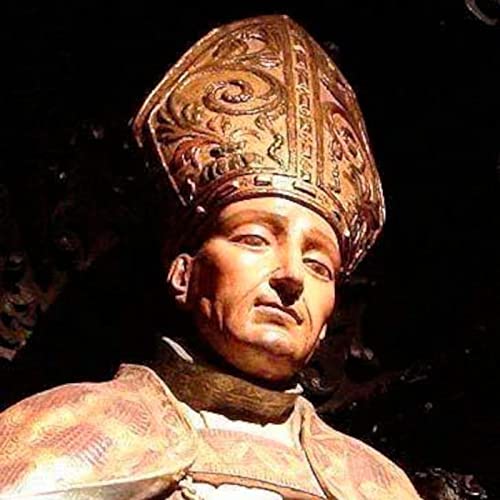
  • March 23: Saint Turibius of Mogrovejo, Bishop
    Mar 21 2025
    March 23: Saint Turibius of Mogrovejo, Bishop 1538–1606 Optional Memorial; Liturgical Color: Violet (Lenten Weekday) Patron Saint of Latin American Bishops and native people’s rights He died in the field six thousand miles from home Today’s saint was the second Archbishop of the second most important city in Spain’s Latin American empire in the 1500s. Lima, Peru, stood only behind Mexico City in importance to the Spanish Crown during the pinnacle of its colonial ambitions. So when Lima’s first Archbishop died in 1575, the King of Spain, not the Pope, searched for a suitable candidate to send over sea and land to replace him. The King found his man close at hand, and he was more than suitable to the task. Turibius of Mogrovejo was a learned scholar of the law who held teaching and other posts in Spain’s complex of Church and civil courts. Yet for all his learning, piety, faith, and energy, there was one huge obstacle to him being a bishop. Turibius was not a priest. He was not even a deacon. He was a very good, albeit unmarried, layman. The arrangement for centuries between Spain and the Holy See was that the Spanish Crown chose bishops while the Pope approved, or rejected, them. So after the Pope approved the appointment, over the candidate’s fierce objections, Turibius received the four minor orders on four successive weeks, was ordained a deacon and then ordained a priest. He said his first Mass when he was over forty years old. About two years later, Turibius was consecrated as the new archbishop, and then sailed the ocean blue, arriving in Lima in May 1581. Archbishop Turibius was extraordinarily dedicated to his episcopal responsibilities. He exhausted himself on years-long visits to the parishes of his vast territory, which included present day Peru and beyond. He acquainted himself with the priests and people under his care. He convoked synods (large Church meetings) to standardize sacramental, pastoral, and liturgical practice. He produced an important trilingual catechism in Spanish and two native dialects, learned to preach in these indigenous dialects himself, and encouraged his priests to be able to hear confessions and preach in them as well. Archbishop Turibius’ life also providentially intersected with the lives of other saints active in Peru at the same time, including Martin de Porres, Francisco Solano, and Isabel Flores de Oliva, to whom Turibius gave the name Rose when he confirmed her. She was later canonized as Saint Rose of Lima, the first saint born in the New World. Saints know saints. Archbishop Turibius was a fine example of a counter-reformation bishop, except that he did not serve in a counter-reformation place. That is, Peru was not split by the Catholic versus Protestant theological divisions wreaking such havoc in the Europe of that era. Saint Turibius implemented the reforms of the Council of Trent, not to combat heretics, but to simply make the Church healthier and holier, Protestants or no Protestants. From this perspective, the reforms of Trent were not a cure but an antidote. If Turibius’ energy and holiness were motivated by any one thing besides evangelical fervor, it was his desire to make the Spanish colonists of Peru recover the integrity of their own baptisms. The indigenous population needed authentic examples of Christian living to respect and emulate, and few Spanish colonialists provided such models of right living. Saint Turibius’ greatest enemy, then, was simply original sin, which returns to the battlefield every time a baby is born. After exhausting himself through total dedication to his responsibilities, Saint Turibius fell ill on the road and died at age sixty-seven in a small town far from home. His twenty-four years as Archbishop were a trial of strength. He had baptized and confirmed half a million souls, had trekked thousands of miles on narrow paths made for goats, had never neglected to say Mass, and did not accept any gifts in return for what he gave. Turibius was canonized in 1726 and named the Patron Saint of Latin American Bishops by Pope Saint John Paul II in 1983. Perhaps his unforeseen ordination explains his sustained fervor and drive. What came late was valued for having come at all. He bloomed late and bloomed beautifully, becoming the Spanish equivalent of his great contemporary, the Italian Saint Charles Borromeo. If a visitor searches for the tomb of the saintly Archbishop in the Cathedral of Lima today, he will not find it. There are only fragments of bones in a reliquary. His reputation for holiness was immediate and his relics were distributed far and wide after his death. He is in death as widely shared as he was in life, all the faithful wanting just a piece of the great man. In January 2018, Pope Francis prayed before the relics of Saint Turibius in Lima and invoked his memory in a talk to Peru’s bishops. Saint Turibius did not, Pope Francis said, shepherd his diocese from behind a desk but was “a ...
    Show more Show less
    7 mins
  • March 19: Saint Joseph, Husband of the Blessed Virgin Mary
    Mar 19 2025
    March 19: Saint Joseph, Husband of the Blessed Virgin Mary
    First Century
    Solemnity; Liturgical Color: White
    Patron Saint of the Universal Church, fathers, and a happy death

    Jesus and Mary lived under his gentle, fatherly authority

    The husband of Mary had a perfect spouse, untouched by original sin. He was also the foster father to a boy who was the Son of God and the Second Person of the Holy Trinity. Yet Saint Joseph, the least perfect member of his household, was still the head of the family. Authority does not always flow from moral or intellectual superiority. Authority in the Church, in particular, is God given. Because God chooses a certain person to fulfill a task in His household of faith, that person acts with a divine mandate to teach, sanctify, and govern the people and things entrusted to him. Saint Joseph is a model for how God uses imperfect instruments to exercise His perfect will. God does not want robots, machines, or zombies to mindlessly implement His plan for mankind. The history of the Church is replete with imperfect tools who have caused scandal and division. Wayward leaders have cost the Church entire countries. Yet despite all these unworthy instruments in the hands of the Divine Master, truth and shelter and grace continue to be provided to those baptised into the Church, the Master’s family.

    God wants personality. God wants us to have character. God’s angels, created spirits, lack the restrictions imposed by a human body. But in not having a body, the angels also lack what makes us unique. They lack the spit, vinegar, and spark that make a man a man. Every man is an enfleshed soul, the coming together of a body and a spirit. This coming together is not half soul and half body, like the mythical centaur with the body of a horse but the torso and head of a man. When copper and zinc are welded together, they are superficially united into one larger piece of metal. But the union is not total and does not create something new. The copper is still copper, and the zinc is still zinc. But when copper and zinc are each melted down and then mixed together, they form brass. Brass is not just the joining of copper to zinc but an entirely new material with unique properties. In a similar way, the union of a body and a soul together composes a human person with unique properties, a child of God unlike any other. The saints, in particular, were unique people often possessing hot tempers, forceful personalities, and unbending wills. They placed their uniqueness at the service of God and His Church and helped to change the world. God did not make, and does not want, just vanilla ice cream. Everyone likes vanilla. But no one likes only vanilla. God wants flavor.

    Saint Joseph was, like all the saints, unique. He probably had personal traits which were less than perfect. These imperfections were absolutely no obstacle to Mary and Jesus obeying him, loving him, and ceding to his authority in the Holy Family of Nazareth. Mary and Jesus would have happily bent to the will of their God-given guide, despite their metaphysical, moral, spiritual, and intellectual superiority.

    Ancient traditions hold that Saint Joseph was considerably older than the Virgin Mary. Other traditions tell that he was married previously and that the “brothers” of Jesus were half-brothers from Saint Joseph’s previous marriage. Scripture tells us Jesus was a carpenter and was known as the “carpenter’s son” (Mt 13:55). Joseph may have been more precisely a builder who worked with the native stone so common to Palestinian construction. A Jewish ritual bath made of stone discovered beneath the church of Saint Joseph in Nazareth, a church which long tradition says was built over the Holy Family’s home, may be Joseph’s very own handiwork. A firm tradition teaches that Saint Joseph died long before his Son’s death. This is based not on biblical evidence but on the lack of it. It can be reasonably presumed that Saint Joseph would have been present at his Son’s crucifixion, as was Mary. Yet no mention is made of him being there. From this absence, biblical scholars have, from the beginning of the Church, surmised that Saint Joseph was by then dead. Thus, Saint Joseph is the Patron Saint of a Happy Death, because he presumably died with Jesus and the Virgin Mary at his side. This is how all of us want to die, with Christ holding our hand on one side of the bed and the Virgin Mary seated beside us on the other side. Saint Joseph died in the best of company. May we do so as well.

    Saint Joseph, Patron of the Universal Church, guide all those under the care of their pastors to see not their imperfections but their God-given obligation to fulfill God’s plan. May your humble and faithful service inspire all fathers to lead their flocks with tenderness, wisdom, and strength.
    Show more Show less
    6 mins
  • March 18: Saint Cyril of Jerusalem, Bishop and Doctor
    Mar 18 2026
    March 18: Saint Cyril of Jerusalem, Bishop and Doctor
    c. 315–386
    Optional Memorial; Liturgical Color: Violet (Lenten Weekday)

    A wise and persevering bishop teaches his flock

    It is the Christ-given obligation of every Catholic bishop, and the priests and deacons who share in his ministry, to teach, sanctify, and govern all people under their spiritual care. Regarding teaching, the letters of Saint Paul, as well as the writings of early Christian theologians, abundantly attest to the duty of the Apostles and their appointed successors to ensure that false doctrine never infects their flocks. The episcopal duty to teach was not a charism or gift of the Holy Spirit such as speaking in tongues, performing miracles, or healing the infirm. Teaching correct doctrine might be aided by the Holy Spirit, but it was first a mandate from the Lord Himself. To not teach, to teach incompletely, or to teach falsely, was for the shepherd to ignore, neglect, or scatter the sheep entrusted to his care and protection.

    Today’s saint, Cyril, the Bishop of Jerusalem in the late fourth century, was a model teacher of right doctrine. He did not just teach teachers what to teach. He did not deputize or delegate others to teach on his behalf. He was the local Father, and, concerned for Christian formation in the household of faith, he personally taught the faith. How do we know this? Two reasons: First, because a holy woman named Egeria went on pilgrimage to Jerusalem in the 380s. She documented her travels in a journal identifying the bishop, known to be Cyril, as the catechist in the domed mausoleum covering the tomb of Christ (part of today’s church of the Holy Sepulchre). Second, we know of Bishop Cyril’s talks because many of them were dutifully recorded and preserved, presumably because of their high caliber. The talks are rich, early testimony to the perennial, consistent doctrines of the Catholic Church.

    Egeria states that the bishop of Jerusalem taught about Lent and Easter to catechumens and neophytes (the newly baptized) by going through the entire Bible and the Creed, article by article. He taught for three hours each day, every one of the forty days of Lent and during Easter week. In his letter to the Romans, Saint Paul wrote, “But how are they to call on one in whom they have not believed? And how are they to believe in one of whom they have never heard? And how are they to hear without someone to proclaim him?” (Rm 10:14). Bishop Cyril admirably fulfilled his apostolic duty to teach and to proclaim so that others would know the Lord.

    Among the profound teachings of Saint Cyril on the Mass, Baptism, and the Sacraments are his extended reflections on the nature of the Holy Eucharist. He is explicit: "Since He Himself has declared and said of the bread: This is My Body, who shall dare to doubt any more? And when He asserts and says: This is My Blood, who shall ever hesitate and say it is not His Blood?...Do not think it mere bread and wine, for it is the Body and Blood of Christ, according to the Lord's declaration" (St. Cyril Catechetical Lecture XXII). Cyril notes that if Christ could change water into wine, why could He not change wine into His own Blood? Reading these words of Cyril, it is perplexing that any modern Christian could doubt the real presence of Christ in the Holy Eucharist. As Saint John Henry Newman wrote: “To be deep in history is to cease to be a Protestant” (An Essay on the Development of Christian Doctrine, Introduction, Ch. 5).

    Bishop Cyril was deeply involved in various consequential theological controversies of his day, was banished from Jerusalem, and participated in the First Council of Constantinople. He lived a long, complicated, and impactful life in the heart of the Church. He is in many ways a model to all bishops for his zealous yet tender care of souls, especially those preparing to be washed in the saving waters of baptism at Easter. Saint Cyril fortified the content of the Church’s teaching with his personal presence, and by extension, the presence of the Sacrament of Holy Orders in his very person. He is a bishop remote in time, yet near in doctrine. Far removed from us historically, he is still close at our side when we stand to recite the same Creed he recited at every Sunday Mass.

    Saint Cyril of Jerusalem, through your generous dedication to teaching the faith, come to the assistance of all catechists, ordained and lay, to be equally committed to teaching those under their care, in season and out of season, knowing that fidelity to the Lord and His Church is what counts the most.
    Show more Show less
    6 mins
All stars
Most relevant
Impressive storytelling. Humanizes the exceptional faithful people who have lived among us. These truly are models for all of us.

Enlightening

Something went wrong. Please try again in a few minutes.

I enjoy the episodes… Just wish it was possible to reflect on tomorrow’s episode the evening before…

Fabulous find

Something went wrong. Please try again in a few minutes.