• Pauline Steinhorn, *Dreaming of the River: A Mother and Daughter’s Fight for Survival in Slave Labor Camps and Bergen-Belsen*. Amsterdam: Amsterdam Publishers, 2026.
    Mar 10 2026

    Send a text

    Bronia Feldman never anticipated becoming the cornerstone of an underground medical network, particularly not within the harsh confines of the HASAG munitions factory's forced-labor system in occupied Poland. In September 1942, she was forcibly separated from her family, arriving there completely overwhelmed by sorrow. The only thing strong enough to keep her going is the hope of saving others. Left behind in the Skarzysko-Kamienna ghetto are her husband and two young daughters. Her 13-year-old daughter, Hajuta, has been dispatched to a nearby labor camp. Seizing a rare chance to escape, Bronia manages to reach her daughter. After a brief reunion, she is faced with an agonizing decision: to flee into the woods and join the partisans or to return to the very place she has just escaped from.

    When they finally reunite months later, the moment is both miraculous and heart-wrenching. Hajuta is no longer the child Bronia remembers. Together, they endure even darker days as they are deported to Bergen-Belsen in January 1945. This true account of a Jewish mother and daughter stands as a testament to bravery, love, and the delicate thread of hope that kept them going. Amidst brutality and fear, they also experience fleeting moments of humanity. Through it all, both hold onto memories of the River Kamienna, where they once danced, played music, and dreamed of a brighter future. For Bronia and Hajuta, the river symbolizes more than just a memory; it represents a promise that they may one day return home. The introduction is penned by Menachem Rosensaft, an attorney, human rights advocate, professor of law, and a prominent figure in the Second Generation movement of children of Holocaust survivors.

    Show more Show less
    1 hr and 20 mins
  • Evan McGilvray, *Marshal Pilsudski and his Wars for Polish Freedom: Poland's Conflicts with Ukraine, Lithuania and Soviet Russia*. Yorkshire, UK: Pen & Sword Books, 2025.
    Mar 10 2026

    Send a text

    This study is both captivating and long overdue, focusing on a pivotal figure in modern European history. Josef Pilsudski emerged as the foremost advocate for armed Polish resistance against Tsarist Russian domination in the early twentieth century. During the Russo-Japanese War, he traveled to Japan to secure arms and funding for a Polish uprising. In World War I, he adeptly navigated a dangerous path. He formed the Polish Legion to ally with the Central Powers in their fight against the Russians. As the war neared its conclusion, he distanced himself from the Central Powers and achieved independence for Poland. After realizing his ambition of a free Poland, he engaged in a series of lesser-known conflicts with Ukraine and Lithuania, which are brought to light by Evan McGilvray. When it became evident that Bolshevik Russia was gearing up to invade Poland, Pilsudski initiated a pre-emptive strike in 1920. Although he initially found success, the Russians managed to gain the upper hand and were nearly at the gates of Warsaw before Pilsudski's brilliant counteroffensive resulted in 'the miracle of the Vistula,' reversing the situation.


    Show more Show less
    1 hr and 13 mins
  • Frank Stahnisch, *Great Minds in Despair: The Forced Migration of German-Speaking Neuroscientists to North America, 1933 to 1989*. Montreal & Kingston: McGill-Queen's University Press, 2025.
    Mar 10 2026

    Send a text

    The twentieth century saw two catastrophic world wars that resulted in the displacement of millions. Among those affected were numerous neuroscientists and biological psychiatrists from Nazi Germany and neighboring regions who had to flee during the 1930s and 1940s. A significant number of them found new homes in North America, where they made a lasting impact on the evolution of biomedical sciences.

    Focusing on the period from 1933 to 1989, Great Minds in Despair investigates the enduring consequences of this forced migration on the scientific and medical landscapes in North America, as well as on the researchers themselves. Frank Stahnisch chronicles the journeys and careers of around four hundred German-speaking doctors, scientists, and researchers across two generations. Adjusting to new research environments in Canada and the United States, they contributed to the advancement of neuroscience, psychiatry, clinical psychology, and cognitive sciences, all while reconstructing their lives amidst numerous challenges such as cultural adaptation and the complexities of relicensing. Stahnisch delves into how generational dynamics, gender, international collaborations, refugee organizations, and national funding bodies influenced their experiences and impacted postwar remigration.

    Great Minds in Despair offers a significant reevaluation of the brain gain thesis in migration studies by highlighting the working conditions and social integration of a prominent group of academic refugees in North America.


    Show more Show less
    1 hr and 55 mins
  • Christine Schmidt, Elizabeth Anthony and Joanna Sliwa, *Older Jews and the Holocaust: Persecution, Displacement and Survival*. Detroit: Wayne State University Press, 2026.
    Mar 10 2026

    Send a text

    Elderly Jews represented one of the most at-risk demographics during the Holocaust; however, there has been a scarcity of scholarly and literary attention directed towards their experiences. They were frequently among the initial victims of Nazi murder, and their chances of enduring the physical hardships of persecution were significantly diminished. Editors Christine Schmidt, Elizabeth Anthony, and Joanna Sliwa, along with thirteen other scholars, focus on this overlooked group in their historical research, challenging alternative narratives in historiography and memory that predominantly highlight the destruction and despair linked to advanced age during the Holocaust. Although these chapters examine how age and physical limitations rendered older adults particularly vulnerable to violence and death, they also shed light on instances of life and agency amidst catastrophic conditions. This volume serves as a significant reclamation of history and memory, broadening our comprehension of the Holocaust and the human experience during acts of genocide.


    Show more Show less
    57 mins
  • Philip Uninsky, *Invented Lives from Troubled Times: A Jewish Family’s Forms of Resilience after Surviving Pogroms, Revolution and the Holocaust*. Boston: Academic Studies Press, 2026.
    Feb 22 2026

    Send a text

    *Invented Lives from Troubled Times* offers a refreshing viewpoint on the complex routes to resilience, narrating the saga of a large Jewish family that survived decades of intense trauma in the 20th century. In addition to exploring his family’s shared memories, which were interwoven with fabrications, misdirection, and whimsical creativity, Uninsky employs archival sources and years of observations and interactions to reveal their diverse and shifting paths to persistence. These survivors were not, as is often assumed, inevitably weakened by profound trauma and the loss of security and tangible connections to their past. Instead, they succeeded in navigating the present, inventing lives with a wide array of personalities that emerged as a canvas of extremes, from the eccentric to the conventional, the humble to the triumphantly comedic, the conscientious citizen to the rebellious criminal.


    Show more Show less
    1 hr and 44 mins
  • Hans Soetaert, *The Scattered Library: The Various Fates of the Remnants of Magnus Hirschfeld's Institute of Sexual Science Collection in France and Czechoslovakia, 1932-1942*. Hannover, Germany: Ibidem Verlag, 2025.
    Feb 12 2026

    Send a text

    The Berlin book burning and the assault on Magnus Hirschfeld’s Institute for Sexual Science ("Institut für Sexualwissenschaft") in May 1933 are essential components of German memorial culture. Recently, there has been a resurgence and recognition of Magnus Hirschfeld (1868–1935) in Germany, resulting in many Germans becoming aware that this significant LGBT rights pioneer died in 1935 in exile in Nice, France, profoundly affected by the Nazis' obliteration of his life's work in Germany. This book is the first to meticulously document the events that transpired between 1932 and 1935 prior to Hirschfeld’s death, especially during the seven years that followed. Alongside detailing Hirschfeld’s last years in France, this work is the first biography of Karl Giese and Karl Fein, the key figures in the aftermath of Magnus Hirschfeld in France and Czechoslovakia.

    Show more Show less
    1 hr and 31 mins
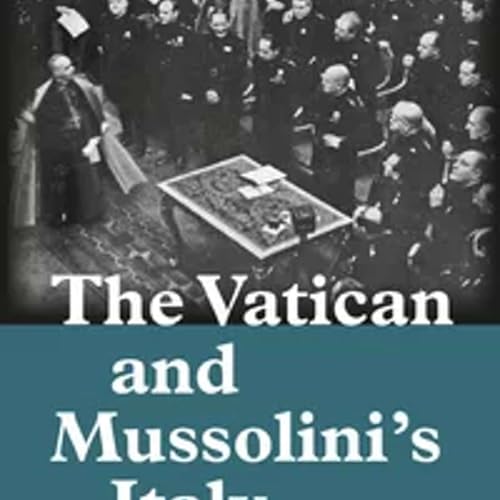
  • Lucia Ceci, *The Vatican and Mussolini's Italy*. Peter Spring, trans. Leiden: Brill, 2017.
    Feb 9 2026

    Send a text

    Lucia Ceci delves into the complex dynamics between the Catholic Church and Fascism. New insights from the Vatican Archives shed light on specific elements of this intricate relationship: Mussolini's ascent to power, the Ethiopian war, the racial legislation, and the distinctions between Pius XI and Pius XII. This book presents a detailed reconstruction of this encounter, clarifying the reasons that led Catholics to support a dictatorial, aggressive, and racist regime. In contrast to conventional historical divisions, the account begins with Mussolini's early years in the late nineteenth century and culminates with the swift collapse of his puppet regime in 1945. This perspective somewhat alters the perception of the exceptional nature of the ventennio.

    Show more Show less
    54 mins
  • Stefanie Fischer, *Jewish Cattle Traders in the German Countryside, 1919-1939: Economic Trust and Antisemitic Violence*. Jeremiah Riemer, trans. Bloomington, IN: Indiana University Press, 2024.
    Feb 4 2026

    Send a text

    This study delves into the intricate social and economic networks that this group navigated, highlighting the resilient yet informal connections between Jewish cattle traders and farmers, bonds so strong that not even relentless Nazi assaults could sever them.

    Stefanie Fischer employs a blend of social history, economic history, and sociology to confront the entrenched stereotype of the dubious Jewish cattle dealer. By emphasizing trust and social ties over mere economic trends, Fischer reveals the numerous contradictions that plagued the expulsion of Jews from Germany.

    This monograph scrutinizes the nuanced dynamics between Jews and non-Jews involved in economic and social exchanges. In doing so, Fischer reexamines prior perceptions of daily life under Nazi governance and uncovers innovative ways in which Jewish agency emerged as a pivotal force amid the exclusionary measures enacted in Hitler's Germany.

    Show more Show less
    56 mins