Dialogues in Judaic Studies Podcast By Ari Barbalat cover art

Dialogues in Judaic Studies

Dialogues in Judaic Studies

By: Ari Barbalat
Listen for free

This podcast features educational, informative and intellectually compelling conversations with authors of newly-published books and recently-released monographs on Jewish history, Jewish religion, Jewish philosophy and Jewish literature. The podcast intends to reach academic specialists, members of the reading public and beginners with entry-level curiosity.

© 2026 Dialogues in Judaic Studies
Judaism Philosophy Social Sciences Spirituality World
Episodes
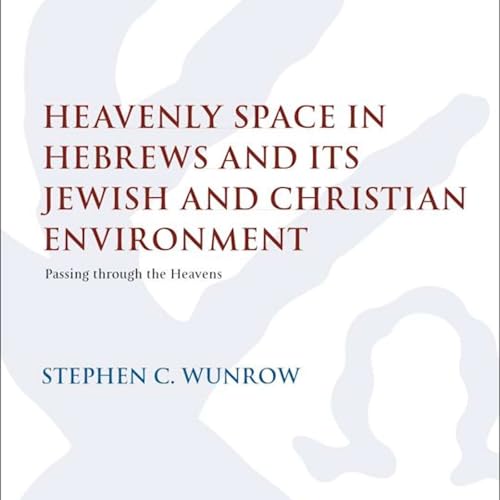
  • Stephen Wunrow, *Passing Through the Heavens: Heavenly Space in Hebrews and its Jewish and Christian Environment*. London: T&T Clark (Bloomsbury Publishers), 2025.
    Mar 29 2026

    In this study, Stephen Wunrow examines the important question of what the author of Hebrews meant when he described heaven. He believes that the author wanted people to see his references to heavenly space as real descriptions of an actual place. Wunrow argues that the language used about heaven is not just a metaphor or a description of a place outside of creation. He looks at other early Jewish and Christian texts that tell stories of people going up to heaven. Based on how heavenly space is described in these texts, Wunrow conjectures that it is likely that the authors meant for their descriptions of heaven to be taken as real.

    Wunrow examines texts like 1 and 2 Enoch, 4 Ezra, 2 and 3 Baruch, the Apocalypse of Abraham, the Testament of Levi, the Testament of Abraham, the Ascension of Isaiah, and Revelation. He investigates how other authors from around the same time described heavenly space and considers that the goals of most of these authors would not work unless their readers understood their descriptions of heaven as realistic. Then, when looking at Hebrews, Wunrow suggests that even though the letter has some unique features and goals, it also fits well with other early Jewish and Christian texts that talk about people going to heaven in a realistic way. He ends with thoughts on how this conclusion helps to explain other topics in Hebrews, like atonement and eschatology.

    Show more Show less
    1 hr and 28 mins
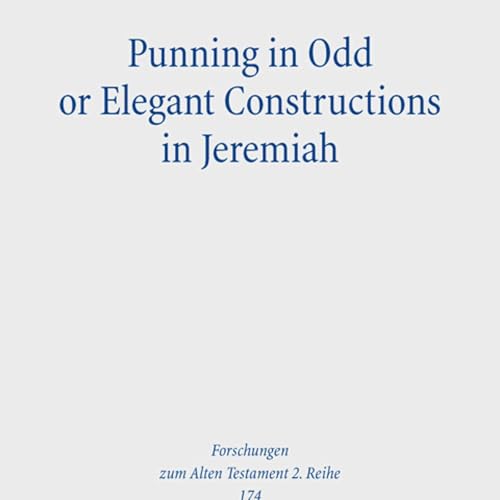
  • Josiah Peeler, *Punning in Odd Or Elegant Constructions in Jeremiah: The Convergence of Linguistics, Rhetoric, and Textuality in the Hebrew Text of Jeremiah*. Tubingen, Germany: Mohr Siebeck, 2025.
    Mar 29 2026

    From Egypt to Mesopotamia, ancient Near Eastern scribes, including the Israelite scribes of the Hebrew Bible, created both infelicitous and symmetric elements in their textual works. These elements, through their form, convey messages that go beyond the textual and semantic levels, serving rhetorical and literary purposes. The idea of 'meta-textual semantics' was a common scribal tool in the ancient world, appreciated by ancient audiences and exegetes—like rabbinic scholars, medieval Jewish and Christian interpreters, and the Masoretes. However, it is often overlooked in modern interpretations of the Hebrew Bible. In this monograph, Josiah D. Peeler delves into elements in the Hebrew text of Jeremiah that are usually seen as secondary due to their odd or well-formed characteristics, demonstrating that they exemplify a contextual theme.

    Show more Show less
    1 hr and 29 mins
  • Matthew Suriano, *A History of Death in the Hebrew Bible*. New York: Oxford University Press, 2018.
    Mar 26 2026

    In the Hebrew Bible and Old Testament, a good death was defined by burial within the family tomb, allowing one to join their ancestors in the afterlife. This afterlife, as described in biblical literature, was not about individual judgment or the concepts of heaven and hell; it was a shared experience. The Hebrew scriptures grounded the notion of postmortem existence in burial practices, conceptualizing the dead as embodied beings. Yet, this vision of the afterlife was not one of hopelessness or fatalism, relegated to the somberness of the tomb. The deceased were valued and remembered, their remains were treated with respect, and their names persisted as ancestors. This book investigates the idea of the afterlife in the Hebrew Bible by analyzing the treatment of the dead, as shown in both biblical texts and the archaeological findings from the southern Levant. The research begins with the Iron Age mortuary culture of Judah, contrasting the practice of collective burial in Judahite rock-cut bench tombs with biblical traditions of family tombs and the reunion with ancestors in death. This archaeological study, which also considers funerary inscriptions, will provide crucial insights into biblical literature on matters such as the formation of the soul in death, the nature of corpse impurity, and the concept of Sheol. Death was a transition orchestrated through ritual actions. The connections established through these actions, such as honoring ancestors, were socially significant for the living and ensured a degree of immortality for the deceased.

    Show more Show less
    1 hr and 29 mins
No reviews yet