• Nana Osei-Opare, "Socialist De-Colony: Black and Soviet Entanglements in Ghana's Cold War" (Cambridge UP, 2025)
    Mar 24 2026
    Led by the charismatic Kwame Nkrumah, Ghana won its political independence from the United Kingdom in 1957. It precipitated both the dying spiral of colonialism across the African continent and the world's first Black socialist state. Utilising materials from Ghanaian, Russian, English, and American archives, Nana Osei-Opare offers a provocative and new reading of this defining moment in world history through the eyes of workers, writers, students, technical-experts, ministers, and diplomats. Osei-Opare shows how race and Ghana-Soviet spaces influenced, enabled, and disrupted Ghana's transformational socialist, Cold War, and decolonization projects to achieve Black freedom. This title is also available as open access on Cambridge Core. Elisa Prosperetti is an Assistant Professor of African and global history at NIE/NTU in Singapore.
    Show more Show less
    48 mins
  • Alan McDougall, "Dreams and Songs to Sing: A People's History of Liverpool FC from Shankly to Klopp" (Cambridge UP, 2025)
    Mar 24 2026
    Today we are joined by Alan McDougall, Professor of History at the University of Guelph, and the author of Dreams and Songs To Sing: A People’s History of Liverpool F.C. From Shankly to Klopp (Cambridge: Cambridge University Press, 2025). In our conversation, we discussed the rise of Liverpool as a global football club, the crises that beset the club during the Heysel and Hillsborough disasters, and the necessity of inherent optimism of fandom in contemporary sports. In Dreams and Songs to Sing, McDougall writes the history of Liverpool FC from Shankly to Klopp in a register that will appeal to both popular and scholarly readers. McDougall is a lifelong Liverpool supporter, and he is careful to point out where his connections to the club and its fandom might shade his examination, but he also shows how those same affective connections allow him to a unique entry point into issues only visible to fans and that supports can be even more critical than a detached observer. This is especially true in his investigation of Heysel and Hillsborough. The book proceeds roughly chronologically. The book’s early chapters examine the club’s connection to Liverpool’s working-class district 4 and to their Anfield home ground. He pays special attention to the supporter’s end - the notorious Kop. Using oral history interviews, McDougall illustrates the exceptional pull of the stadium to both local and global fans. The heart of the book is its engaging, thick description of the club’s history during the Shankly era. McDougall shows that not only was Shankly a very successful manager, and quite funny, but that he ran the club with a sense of Liverpool’s local identity. A man who arrived at the right time – he benefitted from Liverpool’s growing global reputation; Beatlemania gave the city a sound but players and fans rubbed shoulders with comics, musicians, and poets. Shankly embodied the very local socialist, working-class attitudes of the majority of club supporters. His retirement shook the whole city. McDougall uses a family repository of letters to show how people from around the city, the country, and the world wrote to him to express sadness at him leaving and to wish him luck. McDougall’s account might be from an insider, but his analysis does not shy away from shining a light on the difficult social politics that accompanied the club’s enormous success on the field. European Cup victories sit alongside the deadly hooligan violence at Heysel. Black players like Howard Gayle and John Barnes face racism from the club’s supporters. The club first ignores and then undervalues the rise of women’s football. McDougall’s history ends in the Klopp era – perhaps a mercy to Liverpool fans! He shows how the contemporary club embodies the idea of a global club with a local heart. The international ownership of the club has successfully navigated the rise of the Premier League and the increasing commercialization of European football, but local supporters have been innovative at creating a culture of resistance to changes that could undermine the glocal identity of Liverpool. Klopp symbolized this new football club: cosmopolitan, emotional, forward, successful. Compelling and hard to put down, McDougall’s Dreams and Songs to Sing will appeal to all readers of sports history. It will be of particular interest to Liverpool supporters and football fanatics.
    Show more Show less
    1 hr and 6 mins
  • Lucia Motolinia, "Unity through Particularism: How Electoral Reforms Influence Parties and Legislative Behavior" (Cambridge UP, 2026)
    Mar 24 2026
    Why do supposedly accountability-enhancing electoral reforms often fail in young democracies? How can legislators serve their constituents when parties control the necessary resources? Unity through Particularism: How Electoral Reforms Influence Parties and Legislative Behavior (Cambridge University Press, 2026) by Dr. Lucia Motolinia sheds light on these questions and more by explaining how parties can use personal vote-seeking incentives in order to decrease intra-party dissent. Studying a unique electoral reform in Mexico, the book provides a detailed description of how institutional incentives can conflict. It draws on a variety of rich, original data sources on legislative behavior and organization in 20 Mexican states to develop a novel explanation of how electoral reforms can amplify competing institutional incentives. In settings where legislative rules and candidate selection procedures favor parties, legislators may lack the resources necessary to build voter support. If this is the case, party leaders can condition access to these resources on loyalty to the party's political agenda. This interview was conducted by Dr. Miranda Melcher whose book focuses on post-conflict military integration, understanding treaty negotiation and implementation in civil war contexts, with qualitative analysis of the Angolan and Mozambican civil wars. You can find Miranda’s interviews on New Books with Miranda Melcher, wherever you get your podcasts.
    Show more Show less
    28 mins
  • Philip C. Almond, "Noah and the Flood in Western Thought" (Cambridge UP, 2025)
    Mar 21 2026
    In a world beset by climatic emergencies, the continuing resonance of the flood story is perhaps easy to understand. Whether in the tortured alpha male intensity of Russell Crowe’s Noah, in Darren Aronofsky’s eponymous 2014 film, or other recent derivations, the biblical narrative has become a lightning rod for gathering environmental anxieties. However, Philip C. Almond’s masterful exploration of Western cultural history uncovers a far more complex Noah than is commonly recognised: not just the father of humanity but also the first shipbuilder, navigator, zookeeper, farmer, grape grower, and wine maker. Noah’s pivotal significance is revealed as much in his forgotten secular as in his religious receptions, and their major impact on such disciplines as geology, geography, biology, and zoology. While Noah’s many interpretations over two millennia might seem to offer a common message of hope, the author’s sober conclusion to Noah and the Flood in Western Thought (Cambridge UP, 2025) is that deliverance now lies not in divine but rather in human hands. Philip C. Almond is Emeritus Professor in the History of Religious Thought at The University of Queensland. A noted authority in the history of religion and of ideas, he has written many books on subjects as diverse as God, the Devil, the afterlife, witchcraft and witches, Adam and Eve, heaven and hell in Enlightenment England, and early modern demonic possession. His recent works include The Buddha: Life and Afterlife Between East and West (2024), Mary Magdalene: A Cultural History (2023), and The Antichrist: A New Biography (2020), all published by Cambridge University Press. Morteza Hajizadeh is a Ph.D. graduate in English from the University of Auckland in New Zealand. His research interests are Cultural Studies; Critical Theory; Environmental History; Medieval (Intellectual) History; Gothic Studies; 18th and 19th Century British Literature. YouTube Channel: here Twitter: here
    Show more Show less
    50 mins
  • Sidra Hamidi, "After Fission: Recognition and Contestation in the Atomic Age" (Cambridge UP, 2026)
    Mar 21 2026
    Nuclear status is typically treated as a stable feature of a state's capacity to possess, use, or build nuclear weapons. Challenging this view, After Fission: Recognition and Contestation in the Atomic Age (Cambridge University Press, 2026) by Dr. Sidra Hamidi reveals how states contest their nuclear status in the atomic age. By examining the legal structure of the Non-Proliferation Treaty, technical ambiguities surrounding nuclear testing, and debates over rights and responsibilities in the global nuclear regime, Dr. Hamidi argues that a state's nuclear status is not simply a function of technical capability. Instead, states actively contest the way they want their nuclear status to be presented to the world, and powerful states like the US, either recognize or reject these formulations. By analysing key diplomatic junctures in Indian, Israeli, Iranian, and North Korean nuclear history, this book presents a theory of when and how states contest their nuclear status which has key policy implications for negotiating with ostensible “rogues” such as Iran and North Korea. This interview was conducted by Dr. Miranda Melcher whose book focuses on post-conflict military integration, understanding treaty negotiation and implementation in civil war contexts, with qualitative analysis of the Angolan and Mozambican civil wars. You can find Miranda’s interviews on New Books with Miranda Melcher, wherever you get your podcasts.
    Show more Show less
    57 mins
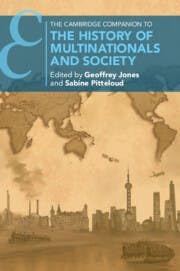
  • Geoffrey Jones and Sabine Pitteloud eds., "The Cambridge Companion to the History of Multinationals and Society" (Cambridge UP, 2026)
    Mar 10 2026
    Geoffrey Jones and Sabine Pitteloud present the latest research on the global history of multinationals and their impact on society and the environment. The Cambridge Companion to the History of Multinationals and Society (Cambridge UP, 2026) brings together leading international scholars, these essays survey key themes in our relationship with multinationals, from taxation and corruption to gender and the climate. Though often associated with large corporations like Apple or Nestlé, the contributors highlight the remarkable diversity in multinational strategies and organizational structures. They challenge the idea of an inescapable rise of multinationals by looking beyond the experience of Western countries and considering the effects of dramatic political shifts. Multinationals have often acted opportunistically, with their resilience carrying social costs through the exploitation of weak regulations, corrupt governments, inequalities, poor human rights, and environmental harm. This is an essential introduction to the historical role of multinationals for scholars and students as well as for policymakers and stakeholders navigating today's economic landscape. Presented by Paula de la Cruz-Fernández.
    Show more Show less
    36 mins
  • Leah Astbury, "Making Babies in Early Modern England" (Cambridge UP, 2025)
    Feb 26 2026
    Leah Astbury's new book, Making Babies in Early Modern England (Cambridge UP, 2025), explores the ideals and realities that governed generation in the sixteenth and seventeenth centuries. Astbury uses the family as her unit of study to understand how people approached fertility, pregnancy, preparing for birth, delivery, and the recovery process, as well as early infant care. As she argues, making babies was a family concern, one in which both women and men had a stake. Drawing on a wide range of manuscript and print sources, Making Babies is a lively read and sure to appeal to anyone interested in the history of the family, medicine, birth, or gender in early modern England. Elspeth Currie is a PhD Candidate in the Department of History at Boston College where she studies women’s intellectual history in early modern Europe. Profile here
    Show more Show less
    56 mins
  • Neilesh Bose, "Chips from a Calcutta Workshop: Comparative Religion in Nineteenth Century India" (Cambridge UP, 2025)
    Feb 19 2026
    Chips from a Calcutta Workshop: Comparative Religion in Nineteenth Century India (Cambridge University Press, 2025) explores the development and nature of comparative religion in nineteenth-century India. It focuses on the ideas and intellectual currents behind a range of thinkers who explored comparative religion in India, drawing on a variety of inspirations from Indian religions. Rather than emanate out of a European Christian set of politics as in the Western world, comparative religion emerged out of religious reform movements, including the Brāhmo Samaj in Bengal and the Arya Samaj in the Punjab. With chapters on Rammohan Roy, Debendranath Tagore, Keshab Chandra Sen, and Swami Vivekananda, the book includes a re-evaluation of familiar figures alongside lesser-known thinkers within an intellectual history of modern Indian comparative religion. Neilesh Bose is Professor of History at the University of Victoria.
    Show more Show less
    36 mins