Forging The Future with Chris Howard Podcast By Chris Howard cover art

Forging The Future with Chris Howard

Forging The Future with Chris Howard

By: Chris Howard
Listen for free

Join Chris Howard, Founder and CEO of Softeq, as he interviews knowledgeable leaders in the innovation spectrum, including CEOs, CTOs, R&D professionals, and start-up founders. Real conversations, technology, and processes of bringing new ideas to market.© 2022 All rights reserved. "Forging the Future" podcast, content, title, and logo owned by Softeq. Unauthorized use prohibited. Contact: ftf@speakerboxmedia.com. Respect our creativity. Economics
Episodes
  • What If AI Worked More Like the Human Brain? ft. Chris Eliasmith of Applied Brain Research
    Mar 19 2026
    At CES 2026, we sat down with Chris Eliasmith, CTO of Applied Brain Research, to discuss how brain-inspired AI is enabling fast, low-power voice interfaces that run directly on edge devices. Drawing on research modeling the hippocampus, his team developed new neural network architectures that significantly improve efficiency and accuracy for tasks like speech recognition and text to speech. These advances allow devices such as AR glasses, robots, and wearables to respond to voice commands in under 300 milliseconds, creating interactions that feel natural and conversational. Eliasmith also explains the tradeoffs between model size, accuracy, and power consumption, and how running AI at the edge can reduce costs and reliance on the cloud. He ultimately envisions a future where complete AI agents run locally on small devices, making technology simpler and more accessible for everyday users. 🎧 Episode Highlights: ●[01:59]: Introducing ultra-low-power voice AI at the edge ●[03:27]: Why 300ms latency is critical for natural conversations ●[09:06]: Brain-inspired neural networks modeled after the hippocampus ●[15:02]: Tiny AI chips for AR glasses, robotics, and wearables ●[20:25]: Cutting cloud costs with local speech processing ●[27:54]: The future of full AI agents running at the edge 🔑 Key Takeaways: ● By modeling neural networks after how parts of the brain like the hippocampus process time-based information, researchers can build AI systems that achieve higher accuracy with far fewer parameters. This approach allows models to process speech and other signals more efficiently, making advanced AI practical even on small, resource-constrained devices. ● For voice interfaces to feel natural, responses must happen within roughly 300 milliseconds, the same timing humans expect in conversation. Designing AI systems that meet this latency requirement changes how models are built and deployed, pushing developers to prioritize real-time performance rather than relying on slower cloud-based processing. ● Low-power AI that operates directly on devices reduces reliance on internet connectivity, lowers operational costs, and improves responsiveness. As models become efficient enough to run locally, entire AI agents could operate on wearables, robotics platforms, and AR devices, simplifying technology and making intelligent interfaces accessible to more users. 👤 Guest Spotlight: Chris Eliasmith Chris Eliasmith is the Director of the Centre for Theoretical Neuroscience at the University of Waterloo and holds the Canada Research Chair in Theoretical Neuroscience. He is also the CTO and co-founder of Applied Brain Research, where he works on low-power AI technologies for machine learning, robotics, and edge computing. Eliasmith is the co-inventor of the Neural Engineering Framework, the Nengo software platform, and the Semantic Pointer Architecture, and is the author of How to Build a Brain (Oxford University Press) and Neural Engineering (MIT Press). Stay Connected: ●https://www.softeq.com/ ●https://www.linkedin.com/in/techris/ ●https://www.linkedin.com/in/chris-eliasmith/ ●https://www.linkedin.com/company/applied-brain-research/
    Show more Show less
    30 mins
  • The Race to Ultra-Efficient, Low-Power AI with Edge Impulse and Nordic Semiconductor
    Mar 6 2026
    At CES 2026 in Las Vegas, Brandon Shibley of Edge Impulse and Thomas Soderholm of Nordic Semiconductor join Chris to explore the exciting shift of AI from the cloud to the edge. Brandon shares how streamlined, low power machine learning models are unlocking new possibilities in health wearables, industrial inspection, and agriculture by bringing fast, responsive intelligence directly onto devices. Thomas highlights how Nordic’s latest ultra low power chips with built-in neural processing are making this next wave of innovation possible. Together, they paint an optimistic picture of AI that is faster, smarter, and more accessible, running right where data is created. 🎧 Episode Highlights ●[01:02]: Why AI is moving from cloud to edge ●[08:08]: Wearables and health monitoring on-device ●[11:08]: Industrial and agricultural vision at the edge ●[22:25]: Bluetooth Low Energy and ultra low power design ●[28:02]: New Nordic chips with built-in neural processing 🔑 Key Takeaways: ●Edge AI is about efficiency, not scale for the sake of it. Smaller, purpose-built models running directly on devices can reduce latency, preserve privacy, and dramatically lower power consumption while still delivering high impact outcomes in health, agriculture, and industrial settings. ●Hardware innovation is unlocking the next wave of on-device intelligence. Ultra low power chips with integrated neural processing units and advanced Bluetooth Low Energy connectivity make it possible to run meaningful machine learning workloads on wearables and battery-driven products. ●The future of AI is distributed by design. Instead of relying entirely on massive cloud models, intelligence will live closer to where data is created, balancing performance, cost, and connectivity to create scalable and practical real world solutions. 👤 Guest Spotlight: Brandon Shibley Brandon Shibley is a Founder at Edge Delivery and Senior Staff Engineer at Edge Impulse, a Qualcomm company, where he helps developers and enterprises build and deploy machine learning models on edge devices. With a background spanning CTO, founder, and innovation leadership roles, he has led full-stack IoT and edge computing strategies across industrial, robotics, and embedded systems markets. Brandon specializes in bringing intelligent software closer to the physical world, enabling scalable, low power AI solutions that run directly on devices. Thomas Soderholm Thomas Soderholm is the Vice President of Business Development at Nordic Semiconductor, where he helps drive the company’s strategy in ultra low power wireless connectivity and edge AI. With deep roots in Bluetooth Low Energy innovation, he works at the intersection of hardware, software, and connectivity to enable smarter battery-driven devices. Thomas focuses on advancing integrated solutions that bring efficient machine learning and secure connectivity to wearables and connected products worldwide. Stay Connected: ●https://www.softeq.com/ ●https://www.linkedin.com/in/techris/ ●https://www.linkedin.com/in/shibley ●https://www.linkedin.com/company/nordic-semiconductor/ Stay inspired and ahead of the curve by subscribing to Forging the Future. Share your thoughts on this episode with the hashtag #ForgingTheFuture or tag us online!
    Show more Show less
    43 mins
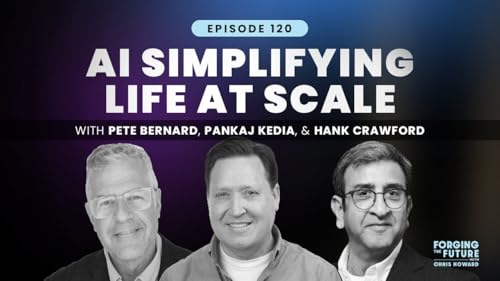
  • AI Beyond Chatbots: 3 Experts on Edge, Robotics, and Real Impact
    Feb 19 2026
    This special CES 2026 episode brings together Pete Bernard (EDGE AI FOUNDATION), Pankaj Kedia (2468 Ventures), and Hank Crawford (Blue Collar Robotics) to explore how AI is moving from theory into everyday use. From cameraless sensing to edge-powered devices that listen, measure, and respond in real time, it’s clear that AI is becoming embedded in our everyday lives. Pete, Pankaj, and Hank all share one common goal: to have AI to solve real problems and simplify life at scale. For Pete, that means building collaborative edge AI ecosystems that work reliably outside the cloud. For Pankaj, it’s unlocking applied AI that delivers real ROI in the healthcare, education, and automotive industries. And for Hank, it’s rethinking grocery shopping by using virtually controlled robotics to tackle labor shortages without replacing people. The future of AI isn’t abstract or far off, it’s already at work in the real world. 🎧 Episode Highlights ● [01:15] Why Edge AI is bigger than TinyML and how physical, generative, and agentic AI are converging ● [04:36] Cameraless AI: using signals and radio waves to sense environments without cameras ● [16:52] Why AI shouldn’t just match human performance but exceed it in safety-critical systems like self-driving and robotics ● [27:47] Applied AI as the real ROI driver across healthcare, education, and mobility ●[39:38] How human-in-the-loop robotics for grocery fulfillment provides global labor opportunities 🔑 Key Takeaways: ● The most impactful AI isn’t happening in massive data centers, it’s happening where systems can sense, interpret, and act in real time. From cameraless perception to signal-based sensing, edge AI enables intelligence in environments where latency, privacy, and connectivity matter most. ● AI must outperform humans in safety-critical systems to matter. Matching human performance isn’t enough when lives, health, or infrastructure are at stake. Whether in autonomous driving, healthcare triage, or robotics, the bar for AI is being meaningfully safer, more consistent, and more reliable than human decision-making. ● The most scalable AI systems don’t replace people, they amplify them. Human-in-the-loop robotics and applied AI models solve labor shortages, unlock global talent, and improve productivity while preserving human judgment, accountability, and trust. 👤 Guest Spotlight: Pete Bernard Pete Bernard is Executive Director of the EDGE AI FOUNDATION, advancing the development and adoption of edge AI across industries. With a background in embedded systems and machine learning, he focuses on building collaborative ecosystems that bring physical, generative, and agentic AI out of the cloud and into real-world deployment. He is known for translating complex technical shifts into practical frameworks that enable reliable, scalable AI at the edge. Pankaj Kedia Pankaj Kedia is Managing Partner at 2468 Ventures, investing in AI, robotics, autonomy, and applied technology. He backs companies delivering measurable ROI across healthcare, education, mobility, and industrial sectors, with a focus on systems that outperform humans in safety-critical and high-impact environments. Hank Crawford Hank Crawford is Founder of Blue Collar Robotics, developing human-in-the-loop robotic systems to address labor shortages. His work centers on remotely operated, task-specific robots that augment workers, beginning with grocery fulfillment and expanding into broader physical industries. Connect with Pete: Pete Bernard Connect with Pankaj: Pankaj Kedia Connect with Hank: Hank Crawford Connect with Chris: Chris Howard Explore past episodes: ftf.show Learn about Softeq: softeq.com Stay inspired and ahead of the curve by subscribing to Forging the Future. Share your thoughts on this episode with the hashtag #ForgingTheFuture or tag us online!
    Show more Show less
    1 hr and 3 mins
No reviews yet