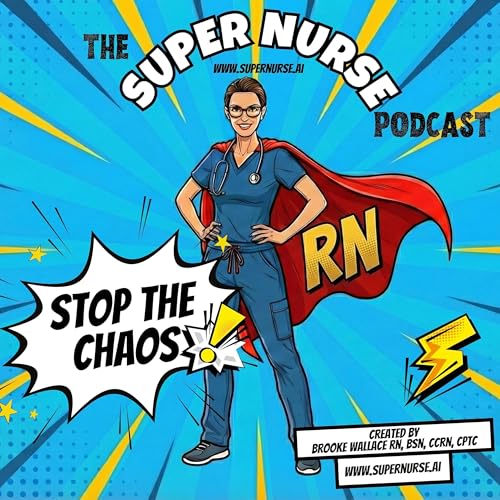
The Super Nurse Podcast Podcast By Brooke Wallace cover art

The Super Nurse Podcast

The Super Nurse Podcast

By: Brooke Wallace
Listen for free

The Super Nurse Podcast is for nursing students taking NCLEX, new graduate nurses, and working nurses who want to level up their game. This podcast helps you survive nursing school, thrive in clinicals, and step confidently into real-world practice as a Super Nurse— guided by 20-year ICU nurse Brooke Wallace, RN, BSN, CCRN, CPTC. 👉 Train smarter. Build confidence. Become a Super Nurse. Visit supernurse.ai for AI-powered tools, study support, and next-generation nursing resources. Powered by AI and real-world nursing experience, each episode delivers conversational, supportive insights based on the most common questions and challenges faced by student and new graduate nurses. Think of it as a focused study session — blending evidence-based strategies, clinical pearls, encouragement, and confidence-building guidance in a way that actually sticks. Whether you’re tackling pharmacology, preparing for clinicals, studying for the NCLEX, or learning how to manage your first 12-hour shift, The Super Nurse Podcast helps you grow stronger, sharper, and more resilient — from student nurse to confident clinician. Inspired by the real FAQs nurses ask, we answer the questions that matter most: How do I survive pharmacology? How do I speak to patients with confidence? What should I expect on my first 12-hour shift? Created by seasoned ICU nurse Brooke Wallace, each episode delivers practical study tips, NCLEX prep strategies, and real-world clinical wisdom, alongside honest conversations about the realities of nursing school and early practice. 👉 Train smarter. Build confidence. Become a Super Nurse. Visit supernurse.ai for AI-powered tools, study support, and next-generation nursing resources.2025- Present Education Hygiene & Healthy Living Physical Illness & Disease
Episodes
  • Why Your Nursing Shift Feels Out of Control (And What to Do After Report)
    Mar 26 2026

    🚨 Why Your Shift Feels Out of Control

    Most nurses don’t struggle because they lack knowledge—they struggle because they don’t have a structured way to think after report.

    The result?

    Jumping straight into tasks
    Missing early warning signs
    Feeling constantly behind
    Increased anxiety and burnout
    🧠 The 3-Minute Super Nurse Framework

    Instead of reacting, take 3 minutes after report to:

    Pause → Think → Anticipate → Act

    Build a quick mental model of your patient before entering the room.

    🔍 The 4 Critical Questions Every Nurse Should Ask

    For each body system, ask:

    What is the worst thing that could happen today?
    How could I prevent it?
    How would I recognize it early?
    What will I do if it happens?

    This primes your brain to act fast instead of freezing.

    🧠 Neuro: Catching Stroke & AMS Early
    Use B.E.F.A.S.T. (Balance, Eyes, Face, Arms, Speech, Time)
    Remember: Time = brain
    Altered mental status? Think AEIOU TIPS
    Watch for:
    Electrolyte imbalances (like hyponatremia)
    Uremia in kidney failure
    🫁 Cardiac + Respiratory: The Perfusion Puzzle
    Ask: Is this oxygenation or ventilation failure?
    Don’t miss:
    Cardiac wheeze (heart failure mimicking asthma)
    BNP to differentiate heart vs lung causes
    Be cautious:
    Bronchodilators can worsen heart failure
    🚑 Pulmonary Embolism: Think Fast
    Sudden drop in oxygen + chest pain = assume PE until proven otherwise
    Anticipate:
    Rapid escalation
    CT scan
    Heparin drip
    💧 Renal: The Most Overlooked Warning Sign
    Urine output is the earliest indicator of perfusion changes
    Decreasing output = early sign of deterioration
    Know the difference:
    Prerenal → fix with fluids
    Intrinsic → kidney damage
    🦠 Sepsis: The Silent Killer
    Use qSOFA:
    Altered mental status
    Respiratory rate ≥ 22
    Low blood pressure
    Watch for:
    Subtle early changes
    Special populations (like pregnancy)
    ⚡ The Big Takeaway

    The difference between overwhelmed nurses and confident nurses isn’t intelligence—it’s having a plan.

    Taking 3 minutes after report:

    Reduces panic
    Improves clinical judgment
    Helps you catch deterioration early
    Prevents burnout
    🎯 Final Thought

    Technology can alert you… but it can’t replace your eyes at the bedside.

    The nurse who pauses to think is the nurse who sees problems first.

    🔗 Learn More

    Visit SuperNurse.ai for:

    Visual learning tools
    Comic-style breakdowns
    Clinical judgment training
    A community of nurses becoming Super Nurses

    Need to reach out? Send an email to BrookeWallaceRN@gmail.com

    Show more Show less
    23 mins
  • Beta Blockers: Easy Pharmacology You'll Actually Understand
    Mar 23 2026

    The Metoprolol Decision Every Nurse Faces

    You walk into the room.
    Heart rate: 115
    Blood pressure: elevated
    Order: IV metoprolol

    👉 Do you push… or pause?

    This episode breaks down the real clinical thinking behind beta blocker administration—not just memorization.

    🧠 Key Takeaways for Nurses

    1. Metoprolol = “The Bouncer” of the Heart
      Blocks beta-1 receptors
      Slows heart rate + decreases contractility
      Reduces myocardial oxygen demand
      Think: taking the foot off the gas pedal
    2. Cardioselectivity Is NOT Absolute
      At higher doses → affects beta-2 receptors
      Can cause:
      Bronchospasm
      Wheezing
      Increased work of breathing

    👉 Watch asthma & COPD patients closely

    1. Tartrate vs Succinate (High-Yield NCLEX + Bedside)
      Tartrate = immediate release → acute control
      Succinate = extended release → long-term heart failure management

    🚨 NEVER crush succinate

    Destroys time-release mechanism
    Can cause sudden hypotension + shock
    4. The Apical Pulse Rule (Critical Safety Step)
    Always assess apical pulse for 1 full minute
    Hold if:
    HR < 60
    SBP < 90–100 (per protocol)

    👉 Why not radial?

    Pulse deficit = electrical vs mechanical mismatch
    You might miss true heart activity
    5. Treat the Patient, Not the Number

    HR 52 could mean:

    ✅ Stable, perfused patient
    🚨 OR crashing, hypoperfused patient

    Assess:

    Skin color
    Mentation
    Work of breathing
    6. Metoprolol Masks Hypoglycemia ⚠️
    Blocks tachycardia response
    Patients may NOT feel early warning signs

    👉 Look for:

    Diaphoresis
    Confusion
    Lethargy
    7. The Heart Failure Paradox

    Metoprolol:

    ❌ Short-term → can worsen symptoms
    ✅ Long-term → improves survival

    Why?

    Blocks toxic chronic adrenaline exposure
    Prevents cardiac remodeling
    8. What to Watch After Starting
    Lung crackles
    Weight gain
    Fluid overload
    Jugular vein distention

    👉 Symptoms may worsen BEFORE improving

    1. Orthostatic Hypotension Teaching
      Beta blockers block compensatory HR increase

    Teach patients:

    Sit → dangle → stand
    Wait 2 minutes before walking
    10. NEVER Stop Abruptly ⚠️
    Causes receptor upregulation
    Leads to:
    Severe tachycardia
    Hypertension
    Myocardial infarction

    👉 Must taper slowly

    🧠 Nursing Pearl

    Before pushing metoprolol, ask:

    👉 “Can this patient tolerate having their cardiac output slowed right now?”

    🎯 Final Thought

    This isn’t about memorizing beta blockers.

    This is about thinking like a nurse at the bedside.

    🚀 Resources & Next Steps
    Visit 👉 SuperNurse.ai
    Get visual breakdowns + downloads
    Learn clinical judgment (not memorization)

    Need to reach out? Send an email to BrookeWallaceRN@gmail.com

    Show more Show less
    27 mins
  • Bleeding vs Clotting Made Simple for Nurses: The Tightrope of Life & Death
    Mar 23 2026

    What You’ll Learn

    The difference between antiplatelets, anticoagulants, and thrombolytics

    Why “blood thinners” is a dangerous misconception

    How nurses prevent patients from tipping into bleeding vs clotting

    Real bedside management of heparin, warfarin, and tPA

    How to recognize and respond to HIT (heparin-induced thrombocytopenia)

    The role of reversal agents in life-threatening emergencies

    🩺 The Tightrope Concept (Hemostasis Made Simple)

    Nursing = balancing bleeding risk vs clotting risk

    Too far one way → hemorrhage

    Too far the other → DVT, PE, stroke

    Your job = keep the patient in the safe middle

    💊 The 3 Tiers of Clotting Medications

    1. Antiplatelets (“Water Guns”)

    Examples: aspirin, clopidogrel

    Action: prevent platelets from sticking together

    Think: prevention of clot formation

    1. Anticoagulants (“Bazookas”)

    Examples: heparin, warfarin

    Action: interrupt clotting cascade

    Key concept:
    ❗ DO NOT dissolve clots
    ✔ prevent new clots + stop existing ones from growing

    1. Thrombolytics (“Atomic Bombs”)

    Example: alteplase (tPA)

    Action: actively break down clots

    Used in emergencies: stroke, massive PE

    ⚠️ High-Yield Nursing Pearl

    👉 Only thrombolytics break clots
    👉 Anticoagulants = stabilize, not destroy

    🧪 Heparin vs Warfarin (What Nurses Must Know)
    Heparin

    Rapid onset (IV or subq)

    Monitored with PTT

    Frequent titration (often every 6 hours)

    Warfarin

    Oral, delayed onset

    Monitored with INR (goal usually 2–3)

    Requires bridging with heparin

    🔄 Bridging Explained Simply

    Heparin = immediate protection

    Warfarin = long-term control

    Transition once INR is therapeutic

    🚨 HIT (Heparin-Induced Thrombocytopenia)
    What Happens:

    Immune reaction → platelet activation → massive clotting

    Platelets DROP, but clotting risk INCREASES

    Red Flags:

    Platelet drop ≥50%

    Occurs 5–10 days after starting heparin

    Nursing Actions:

    🚫 STOP all heparin immediately

    🚫 DO NOT give platelets

    🚫 DO NOT start warfarin

    ✔ Start alternative anticoagulant (argatroban, bivalirudin)

    💉 tPA (Alteplase): High Risk, High Reward
    Key Facts:

    Breaks down fibrin → dissolves clots

    Must be given within 3–4.5 hours (stroke)

    Critical Nursing Safety:

    Use peripheral IV only (compressible site)

    NO central lines, IM injections, or unnecessary sticks

    🛑 Reversal Agents (Emergency “Brakes”)

    Heparin → Protamine sulfate

    tPA → TXA or aminocaproic acid

    👀 What Nurses Must Monitor (Real Bedside Skills)
    Signs of Bleeding:

    Dark stools

    Bleeding gums

    Pink-tinged urine

    EARLY sign (most missed):

    👉 Tachycardia before hypotension

    🧠 Clinical Judgment Takeaway

    This is not just about giving meds.

    This is about constantly asking:

    Is my patient drifting toward bleeding or clotting?

    What changed since last shift?

    What is the worst thing that could happen next?

    💬 Final Thought

    The best nurses don’t just follow orders.

    They understand the “why” behind the medication, anticipate complications, and act before disaster happens.

    That’s what makes a Super Nurse.

    👉 Want more like this?
    Visit SuperNurse.ai for:

    Comic-style learning

    AI-powered nursing tools

    A community of nurses leveling up together

    Need to reach out? Send an email to BrookeWallaceRN@gmail.com

    Show more Show less
    20 mins
No reviews yet