• Ghost Stories #98: Fixed income investing - how to move beyond cash in a balanced portfolio
    Mar 24 2026

    In this episode of Ghost Stories, we get stuck into the world of fixed income - a space that retail investors often overlook in favour of equities.

    Yusuf Wadee of Satrix concurs with The Finance Ghost's cricket analogy: fixed income returns act as the singles that keep the scoreboard ticking over. But that doesn't mean that investors should default to low-yield cash accounts.

    Veteran fixed-income portfolio manager James Turp from Ninety One explains how his funds aim to optimise returns in the sweet spot between cash and bonds. And now, with the launch of the Satrix Income Actively Managed ETF (AMETF), investors have an easy way to access this expertise.

    Topics covered in this podcast:

    • How a balanced approach to equities and fixed income helps build an innings
    • Diversification, volatility, and survivorship bias
    • How most investors fall into “lazy cash” traps
    • The structure and purpose of the Satrix Income AMETF
    • How the partnership between Satrix and Ninety One works
    • How James constructs an active fixed‑income portfolio
    • Duration, interest‑rate cycles, and inflation dynamics
    • Liquidity and accessibility of an actively managed ETF
    • Tax‑free savings considerations for fixed‑income ETFs

    Keen to learn more? Check out the Satrix Income AMETF (JSE: STXINC) here.

    Please remember that nothing you hear on Ghost Stories should be treated as advice. You must always speak to your personal financial advisor.

    Satrix Managers (RF) (Pty) Ltd a registered and approved Manager in Collective Investment Schemes in Securities. Collective investment schemes are generally medium- to long-term investments. With Unit Trusts, Exchange Traded Funds (ETFs) and Actively managed ETFs (AMETFs) the investor essentially owns a “proportionate share” (in proportion to the participatory interest held in the fund) of the underlying investments held by the fund. With Unit Trusts, the investor holds participatory units issued by the fund while in the case of an ETFs and AMETFs, the participatory interest, while issued by the fund, comprises a listed security traded on the stock exchange. ETFs and AMETF are registered as a Collective Investment and can be traded by any stockbroker on the stock exchange, LISP platforms and or via online trading platforms. ETFs and AMETFs may incur additional costs due to it being listed on the JSE. Past performance is not necessarily a guide to future performance, and the value of investments / units may go up or down. A schedule of fees and charges, and maximum commissions are available on the Minimum Disclosure Document or upon request from the Manager. Collective investments are traded at ruling prices and can engage in borrowing and scrip lending. Should the respective portfolio engage in scrip lending, the utility percentage and related counterparties can be viewed on the ETF and AMETF Minimum Disclosure Document. The index, the applicable tracking error and the portfolio performance relative to the index can be viewed on the ETF and AMETF Minimum Disclosure Document. International investments or investments in foreign securities could be accompanied by additional risks such as potential constraints on liquidity and repatriation of funds, macroeconomic risk, political risk, foreign exchange risk, tax risk, settlement risk as well as potential limitations on the availability of market information. AMETF are ETFs which are actively traded by a Portfolio Manager to adjust the AMETF holdings and asset allocation with the aim to outperform the benchmark. AMETF differ from ETFs which only track indices. The Manag...

    Show more Show less
    34 mins
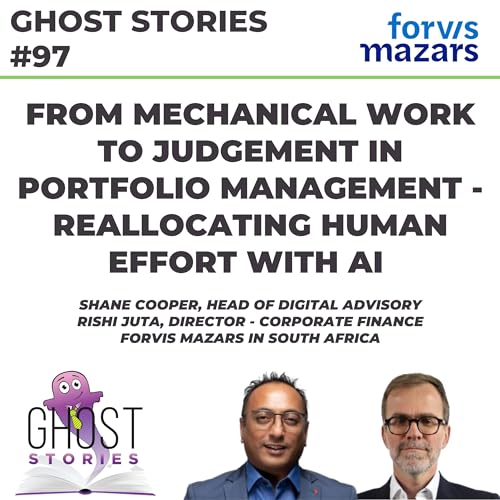
  • Ghost Stories #97: From mechanical work to judgement in portfolio management - reallocating human effort with AI
    Mar 23 2026

    At Forvis Mazars in South Africa, the team is actively working on AI-driven solutions for clients.

    Shane Cooper (Head of Digital Advisory) is spearheading this effort, with one of the applications of this technology being in the portfolio management space. Institutional investors with complex structures face multiple challenges in managing their investments. As Shane explains in this podcast, it's an operating model problem rather than a software problem - but AI can help.

    Rishi Juta (Director of Corporate Finance) joined this discussion to deliver insight into real-world applications across due diligence and risk management. It's all about transforming unstructured data and commentary into useful information for decision-making.

    This is an excellent introduction to the technology that Forvis Mazars in South Africa is developing for institutional clients.

    Topics covered in this podcast:

    • The shift from mechanical work to judgement work - and why it changes the entire process of portfolio oversight.
    • Why unstructured data (like management commentary and board‑pack narratives) often tells you more than the numbers.
    • How “intelligent ingestion” lets AI chew through PDFs, emails, scans, and commentary like a grown‑up sorting out a toddler’s plate of vegetables.
    • Early‑warning risk signals across a portfolio: covenant pressure, reporting behaviour, management tone, governance drift, sector stress and more.
    • How this tech is being built specifically for regulated environments - IFRS, GRAP, scenario planning, traceability, explainability and all the governance that institutions actually need.
    • Why large‑scale portfolios guarantee that humans will miss something - and how an AI layer can stop the rot early, while still taking advantage of having a human in the loop.

    If you would like to learn more about this technology, connect with Shane Cooper or Rishi Juta on LinkedIn. For more information on AI-specific applications, you'll find Shane's contact details on the Forvis Mazars website.

    Show more Show less
    28 mins
  • Ghost Stories #96: Public and private markets - ETFs help bridge the gap
    Mar 11 2026

    Private markets are playing a growing role in global investing. Private equity, private credit, infrastructure and private property investments are a significant part of economic activity. And with more companies remaining private for longer, investors will need to look deeper for the opportunities of tomorrow.

    These markets come with challenges related to daily price discovery, liquidity and due diligence. Although ETFs cannot solve these issues, they can act as a liqudity sleeve in situations where committed institutional capital can be invested in a liquid ETF until the private market manager calls the capital.

    The benefits of this approach include reduced cash drag, efficient cost management in transactions and more certainty over cash deployment for the parties to a transaction.

    Duma Mxenge, Head of Business & Market Development at Satrix, joined me on this podcast to explain exactly how this works.

    This discussion is aimed at institutional investors and professionals who are active in private markets.

    This podcast was first published here.

    Disclaimer:

    Satrix Investments (Pty) Ltd & Satrix Managers (RF) (Pty) Ltd is an authorised financial services provider. The information does not constitute advice as contemplated in FAIS. Use or rely on this information at your own risk. Consult your Financial Adviser before making an investment decision. While every effort has been made to ensure the reasonableness and accuracy of the information contained in this document (“the information”), the FSP’s, its shareholders, subsidiaries, clients, agents, officers and employees do not make any representations or warranties regarding the accuracy or suitability of the information and shall not be held responsible and disclaims all liability for any loss, liability and damage whatsoever suffered as a result of or which may be attributable, directly or indirectly, to any use of or reliance upon the information. For more information, visit https://satrix.co.za/products

    Show more Show less
    25 mins
  • Ghost Stories #95: Reeling in returns: Sea Harvest's best-ever performance
    Mar 6 2026

    The ocean is a mystical place that has captured our imagination as a species for as long as anyone can remember. And although there are many fish in the sea, unlocking that resource in a sustainable and profitable way really isn’t that simple.

    Sea Harvest has signed off on an incredible year that demonstrates the depth of the strategy - quite literally. The way they think about the various seafood products is fascinating, as explained by CEO Felix Ratheb on this podcast.

    With operating margin more than doubling in 2025 and headline earnings coming in 4.2x higher than the prior year, this income statement has plenty of operating leverage. This adds to the intrigue around the business model and how the group is managed, with those insights delivered by CFO Muhammad Brey in this discussion.

    Get ready to learn from Felix and Muhammad on this excellent podcast. The passion for the ocean comes through just as clearly as the numbers.

    This podcast deals with topics like:

    • The importance of hake to Sea Harvest's business
    • Diversification beyond hake - and beyond South Africa's waters as well
    • Why the Ladismith Cheese disposal makes strategic sense
    • Key features of the business model that lead to such high operating leverage
    • The approach taken to managing financial risks like fuel costs and forex movements
    • Sustainable fishing and how Sea Harvest interacts with the precious resources in our oceans
    • The financial outlook for the group, recognising the cyclicality in the model

    Sea Harvest believes strongly in the value of Ghost Mail in the South African investment ecosystem. They have sponsored this podcast for readers, but I was allowed to ask whatever I wanted to ask. Please do your own research and do not treat this podcast as an endorsement of Sea Harvest as an investment.

    Show more Show less
    50 mins
  • Ghost Stories #94: Shoprite's secret sauce: value retail culture meets omnichannel
    Mar 5 2026

    Get ready for a masterclass in retail from Pieter Engelbrecht, CEO of South Africa's largest employer. If you're ready to learn about the secrets to Shoprite's success, you're in the right place.

    It starts with the culture and commitment to delivering value to customers. You can then add the power of investment in data and systems, creating the foundation for an omnichannel model that has positioned Checkers as the biggest brand in South Africa - and not just in retail.

    With the South African retail sector having to navigate tremendous challenges, Shoprite keeps coming out on top. But how do they do it?

    This podcast deals with topics like:

    • The "secret sauce" at Shoprite and the culture in the group.
    • The importance of inflation in the retail business model and how deflation makes things much tougher.
    • The difference between Shoprite's measure of inflation and the Official Food Basket used by the SARB in making decisions.
    • The power of the Checkers brand and how Shoprite has taken it right to the top in South Africa - as anyone with a toddler on a Sixty60 bike can confirm!
    • How value retailers can achieve such strong gross margins through efficiencies.
    • The omnichannel strategy and the parallels to a global giant like Walmart.
    • The elevator pitch for why an investor should consider Shoprite.

    Shoprite believes strongly in the value of Ghost Mail in the South African investment ecosystem. They have sponsored this podcast for readers, but I was allowed to ask whatever I wanted to ask. Please do your own research and do not treat this podcast as an endorsement of Shoprite as an investment.

    Show more Show less
    38 mins
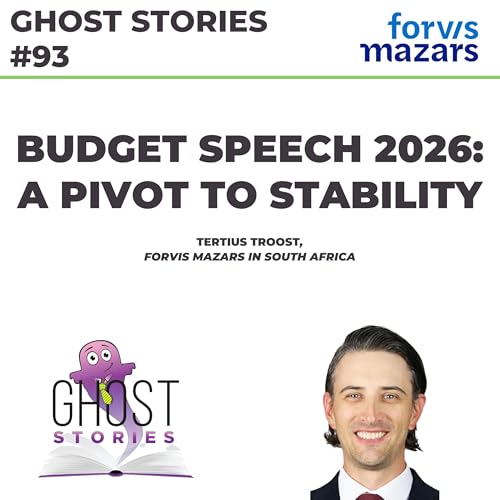
  • Ghost Stories #93: Budget Speech 2026 - a pivot to stability
    Mar 1 2026

    South Africa’s 2026 Budget Speech announced a mix of bold, interesting and ultimately positive changes - especially for small businesses and South African investors. With pro-business policies that signal economic stability, could this be a turning point for the country?

    Described affectionately by Tertius Troost (Associate Director - Tax Consulting at Forvis Mazars) as a "boring" budget, this is the first time in years that we've seen any kind of tax relief for South Africa's middle class. In his words, it's a pivot to stability - and at a time when things are really looking up for South Africa.

    He joined me on this podcast to break down the budget basics and to specifically comment on areas like:

    • How the budget addresses "bracket creep" by adjusting personal income tax brackets for inflation.
    • The increase in the VAT registration threshold and how this assists small businesses.
    • A boost for investors in the form of a higher annual limit for Tax-Free Savings Accounts (TFSA).
    • The approach taken to online gambling and whether education and regulation should precede taxes.
    • Other changes aimed at helping South Africans with retirements savings and even global investments.

    You can connect with Tertius on LinkedIn here.

    As always, please discuss the impact of the tax changes on your affairs with your personal financial advisor. Nothing you hear on this podcast should be interpreted as advice.

    Show more Show less
    26 mins
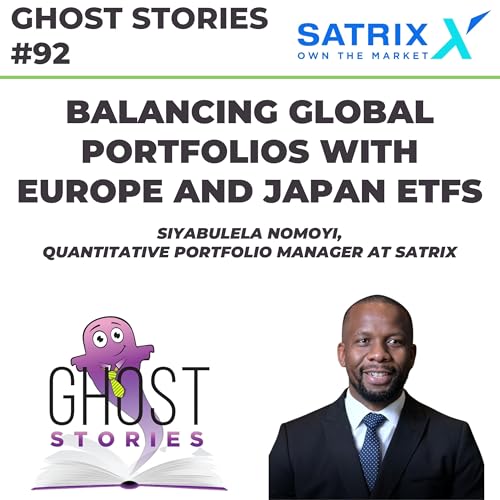
  • Ghost Stories #92: Balancing global portfolios with Europe and Japan ETFs
    Feb 10 2026

    The team at Satrix has clearly been busy. They've launched two brand new ETFs to help South Africans tweak their exposure to offshore markets.

    If you're ready to learn more about Europe and Japan, then you're in the right place.

    Why does it matter? For most South African investors, offshore exposure is really just a proxy for US tech names. It's hard to avoid this outcome, as Big Tech has been the driving force of most global indices, let alone US indices. The Magnificent Seven are everywhere.

    Well, almost everywhere.

    Diversification across both sectors and regions is important for investors. In that spirit, Satrix has launched the Satrix Stoxx Europe 600 ETF and the Satrix MSCI Japan ETF.

    Siyabulela Nomoyi of Satrix joined me to unpack these offerings. This included discussions on:

    • The macro trends in each region and how they have such different top-of-mind items at the moment
    • The nature of the underlying indices tracked by these ETFs and how they vary in terms of market depth and sector exposures
    • The investment thesis for each regions and what the drivers of returns will likely be over time
    • How both products should be seen as complementary to the global picture

    If your portfolio is a Lego structure, Satrix has just given you two new pieces.

    This podcast was first published here.

    Disclaimer:

    Satrix Investments (Pty) Ltd & Satrix Managers (RF) (Pty) Ltd is an authorised financial services provider. The information does not constitute advice as contemplated in FAIS. Use or rely on this information at your own risk. Consult your Financial Adviser before making an investment decision. While every effort has been made to ensure the reasonableness and accuracy of the information contained in this document (“the information”), the FSP’s, its shareholders, subsidiaries, clients, agents, officers and employees do not make any representations or warranties regarding the accuracy or suitability of the information and shall not be held responsible and disclaims all liability for any loss, liability and damage whatsoever suffered as a result of or which may be attributable, directly or indirectly, to any use of or reliance upon the information. For more information, visit https://satrix.co.za/products

    Show more Show less
    36 mins
  • Ghost Stories #91: Building sonar for navigating private credit
    Feb 9 2026

    Ian Norden, CEO of Intengo Market, returns to Ghost Stories to talk about the sector of the market that he is passionate about: listed and private credit.

    Corporate credit (or "debt" from the company perspective) is a key source of funding for companies and can drive higher returns for equity investors if used properly. For investors in these credit instruments, optimising yield and risk are key.

    But as we observe a world of shrinking public issuance and growing demand for yield, will private credit be able to address this imbalance and fill the gap?

    Intengo sits at the coalface of this industry, building the data and workflow systems that allow private credit markets to scale responsibly, transparently and efficiently. They are playing the crucial role of building sonar in a market where you'll find private credit sitting below the surface.

    Key themes covered:

    • Private credit vs listed credit — and why the distinction matters
    • Why credit markets are buy-and-hold by design
    • Supply–demand imbalances in South African debt markets
    • The rise of hedge funds and alternative assets
    • Data, complexity, and the future of private credit infrastructure
    • What private credit growth signals about economic growth
    Show more Show less
    31 mins