Episodes

  • EP 31: AI in Stock Prediction: The Stanford Study that outperformed 93% of Fund Managers
    Feb 22 2026

    Stanford just dropped a bombshell study: an AI analyst made 30 years of stock picks and outperformed 93% of human mutual fund managers by an average of 600 basis points—that's 6% annually. This is absolutely massive in the investment world, kicking off Inside AssembleAI's AI in Finance series with the technology that's shaking Wall Street.

    Here's what's fascinating: the AI mostly used simple variables, not the sophisticated ones everyone expected. Firm size and dollar trading volume were dominant factors, but it used complex AI techniques to squeeze maximum predictive value from simple data everyone can access. The insight isn't about finding hidden data-it's about extracting more signal from obvious data. Any investment firm could have had this data in the pre-AI era, but it was simply too costly to justify economically.

    Sam and Mac explore three main approaches institutions use today: pattern recognition for known scenarios (AI learns what fraud or manipulation looks like), anomaly detection for unknown threats (establishing what's normal and alerting on deviations), and predictive analytics for future behavior (forecasting what's likely to happen next). All happening in real time, in milliseconds-the game changer compared to legacy systems.

    The data quality issue compounds everything—garbage in, garbage out. Models require at least five years of high-quality historical data for reliable results, and even then, past performance doesn't guarantee future success. Looking ahead to 2026, expect more hedge funds adopting sophisticated AI systems, models incorporating multi-modal data like satellite imagery and social sentiment, intensifying regulatory scrutiny, and continued democratization as retail investors gain access to tools that were hedge fund exclusive just years ago.

    Show more Show less
    16 mins
  • EP 28: AI-Powered Patient Care Through Synthetic Data
    Feb 20 2026

    By 2024, synthetic data will comprise 60% of all healthcare AI training data. This episode explores how this shift is solving the industry's massive data problem while protecting patient privacy.

    Healthcare faces a critical paradox: AI needs vast patient data for accurate diagnoses and personalized treatments, but HIPAA and GDPR restrict access to real records. Synthetic data offers a breakthrough—artificially generated datasets that mimic real patient populations statistically without containing actual patient information.

    Sam and Mac explain how generative AI techniques like GANs and auto-encoders create synthetic data preserving statistical properties of real healthcare data while eliminating privacy concerns. These datasets train AI to detect diseases, predict outcomes, and recommend treatments without exposing sensitive information.

    The AI healthcare market is expected to grow from $26.6 billion in 2024 to $187.7 billion by 2030, driven by synthetic data breakthroughs. AI tools trained on synthetic datasets are automating clinical documentation, reducing clinician burnout by handling administrative tasks consuming hours daily. For rare diseases with limited real data, synthetic data enables previously impossible AI training.

    However, challenges exist. If original data contains demographic biases or reflects healthcare disparities, synthetic data perpetuates those biases. This can lead to AI performing poorly for underrepresented populations, worsening health inequities. Careful validation and bias detection are essential.

    Regulatory guidance for synthetic data generation and use is still developing. Healthcare organizations must navigate this evolving framework carefully to ensure compliance while leveraging advantages.

    Early adoption provides competitive advantages. Organizations developing expertise in high-quality synthetic datasets are positioning themselves to lead the AI-driven healthcare transformation. The future of patient care increasingly depends on AI trained on synthetic data protecting privacy while enabling innovation.

    TAGS: Synthetic Data, Healthcare AI, Patient Privacy, HIPAA, Generative AI, GANs, Rare Disease AI, Clinical Documentation, AI Bias, Patient Outcomes, Healthcare Analytics

    Show more Show less
    16 mins
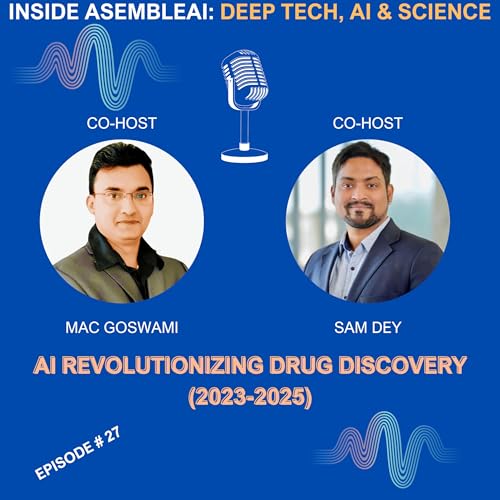
  • EP 27: AI Revolutionizing Drug Discovery (2023 - 2025)
    Feb 19 2026

    The pharmaceutical industry is experiencing its most significant transformation in decades. AI is slashing drug development timelines from 10-15 years to 18-24 months and reducing costs from $2.6 billion to tens of millions—making previously impossible treatments financially feasible.

    Sam and Mac explore how AI is fundamentally changing drug discovery. Traditional methods required screening millions of compounds through physical laboratory testing, costing billions with a 90%+ failure rate. AI transforms this by simulating molecular interactions computationally, predicting which compounds will bind effectively to target proteins, and identifying promising candidates from virtual libraries containing billions of potential molecules. What took years in wet labs now happens in days.

    The impact extends beyond economics. AI is enabling treatments for rare diseases that pharmaceutical companies traditionally ignored due to small patient populations. When development costs drop from billions to millions, diseases affecting 50,000 patients globally become economically viable to address. AI serves as a true partner to scientists—identifying patterns in biological data humans would never detect, suggesting novel molecular structures chemists wouldn't intuitively design, and predicting side effects before human testing.

    However, significant challenges remain. Data quality is the most critical obstacle—AI models are only as good as their training data, and pharmaceutical research data is often messy, incomplete, or inconsistent. The "black box" problem poses another challenge: deep learning models make predictions through complex transformations that scientists can't interpret, creating tension between efficiency and understanding. Ethical considerations around algorithmic bias, data ownership, and equitable access demand careful attention.

    The regulatory landscape adds complexity. The FDA is still developing frameworks for evaluating AI-discovered drugs, and regulatory uncertainty can slow translation from discovery to approved therapy. Despite these challenges, investment in AI drug discovery has surged to record levels, with AI-discovered drugs progressing through clinical trials and validating the technology's potential.

    The future of drug discovery will heavily rely on AI innovations, but success requires thoughtful integration with attention to data quality, algorithmic transparency, ethical practices, and regulatory compliance. The pharmaceutical industry stands at an inflection point where today's decisions about responsible AI implementation will shape healthcare outcomes for decades.

    Show more Show less
    13 mins