Episodes

  • 2.3 Leadership in Crisis
    Mar 17 2026
    Episode Summary: In this episode, Nick and Jeremy dive deep into the concept of "Leadership in Crisis," arguing that a crisis is not just a negative event but a pivotal opportunity for growth and revelation. The conversation centers on the critical role of accountability—both for the leader and the team—and how a lack of clear expectations often leads to organizational failure. They explore personal stories from law enforcement and business, identify common pitfalls like emotional reactivity, and introduce frameworks like the "Driven-Accountable-Humble" Venn diagram and the "CLEAR" decision-making model.Key Takeaways:Crisis as an Opportunity: A crisis reveals the character already present within a leader and provides a chance to strengthen team culture [02:31].The Clarity Formula: High-level leadership requires a clear role, a clear goal, clear expectations, and clear evaluation [07:39].Accountability Starts at the Top: A leader cannot hold others accountable if they do not first hold themselves to the same standard [08:37].The Three Pitfalls: Beware of emotional reactivity, analysis paralysis, and communication gaps during high-pressure situations [18:02].The CLEAR Framework: Use this acronym to navigate decisions: Clarify the mission, Locate options, Evaluate facts, Act accountably, and Relay/Review the results [34:05].Episode OutlineI. Introduction and Defining Crisis [00:24]The importance of investing in leaders to improve everyone around them.Defining "crisis" as an opportunity for action and divine intervention rather than just a negative circumstance [01:41].How crisis is an inevitable part of every life cycle and organizational journey [03:12].II. The Accountability Lesson [04:01]Jeremy’s Story: A personal account from his time in the US Marshal Service where a lack of clarity led to a "crisis" of performance [04:01].The embarrassment of being "called to account" and how it served as a major turning point for professional growth [06:15].III. Structuring for Success: Roles and Values [06:41]Hiring for core values first, then competencies, and finally skills [06:56].The "Four Clears" for every employee:Clear Role: Job description [07:39].Clear Goal: Knowing what "winning" looks like [07:47].Clear Expectations: How to perform within the team [08:07].Clear Evaluation: Regular feedback loops (14, 30, 60, 90-day reviews) [08:13].IV. Leadership Pitfalls in Crisis [18:02]Emotional Reactivity: Understanding that emotions are real but not always "true" indicators for behavior [18:14].Analysis Paralysis: The danger of stalling out when bullets (or business challenges) are flying [20:33].Communication Gaps: Why great organizations must move fast with succinct, clear communication rhythms [21:52].V. The High-Level Leader Framework [24:58]Discussion of the three-circle Venn diagram for leaders [25:05]:Driven + Accountable: High performer, but risks becoming a "bulldozer" [25:30].Driven + Humble: The "unreliable dreamer" who has ideas but no follow-through [25:43].Accountable + Humble: The "complacent teammate" who acts as an anchor but lacks forward momentum [26:05].The Ideal: A leader who is simultaneously Driven, Accountable, and Humble [26:15].VI. Character Under Pressure [27:53]Scripture Reference: James 1:2-4 – Finding joy in trials [28:01].Pressure as a "measuring tool" that reveals the character already inside a person [28:33].A personal story about a parking lot confrontation and managing self-standard under provocation [29:10].VII. The "CLEAR" Decision-Making Model [33:27]C - Clarify the mission [
    Show more Show less
    40 mins
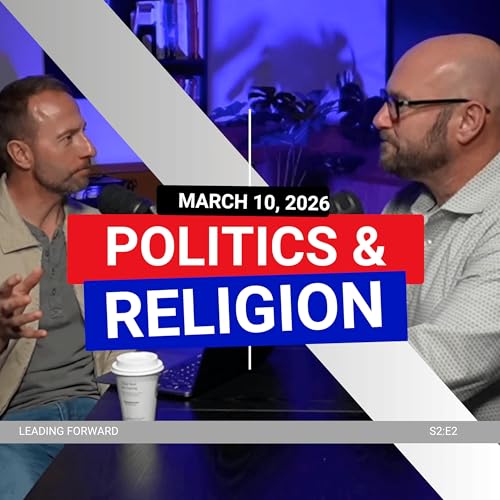
  • S2:E2 Politics and Religion
    Mar 10 2026
    2.2 Politics and Religion in LeadershipShow Notes OverviewIn this episode, Nick and Jeremy tackle the "hot and hard" topic of politics and religion in the workplace. They discuss when leaders should remain silent and when they must speak up, emphasizing that while silence can sometimes be wisdom, it can also be a sign of weakness or fear. The conversation centers on letting the Gospel be a leader's "North Star" and ensuring that core values serve as the "rails" for organizational movement.Episode OutlineI. The Dilemma of Silence[00:00:23] Introduction to the tension between politics and religion in leadership.[00:01:13] Wisdom vs. Weakness: Silence isn't always wisdom; it's often driven by fear of HR nightmares, social media backlash, or cancel culture.[00:01:43] Establishing truth as the non-negotiable "North Star".II. Faith as the Primary Influence[00:01:57] Toxic Conversations: Addressing the irony that workplaces often allow toxic nonsense but silence meaningful faith-based discussions.[00:04:12] The holistic impact of faith: How a follower of Jesus should let their faith direct every area, including how they eat, their spare time, and their politics.[00:05:01] The Gospel is inherently offensive, and leaders should not be surprised when truth causes friction.III. The Foundation of Core Values[00:09:12] Defining leadership identity based on core values.[00:10:33] The Train Station Analogy:The Destination: The Vision (where you are going).The Train: The Mission (the movement, strategies, and systems).The Rails: Core Values (if you leave these, the mission crashes).[00:11:10] The necessity of non-negotiable values that cannot be violated in business or systems.IV. Navigating Cultural and Political Extremes[00:11:41] Salt and Light: The command to bring hope and shine brightly in dark or hopeless workplaces.[00:14:31] The Idolatry of Politics: Defining both the extreme left and extreme right as forms of "idolatry" when they serve self-desire and malice over God.[00:15:13] Prioritizing the Word of God over political agendas.V. Stewardship and Accountability[00:15:43] Culture Toxicity: The warning that failing to correct values-based toxicity early leads to organizational rebellion within 18 months.[00:17:15] Inclusive leadership: You can disagree with someone's beliefs (e.g., an atheist on the team) while still showing them value, honor, and grace.[00:20:12] The responsibility of leaders to address opposing viewpoints with clarity and documented accountability.VI. Historical Context: Church and State[00:22:56] Clarifying "Separation": Addressing the common misuse of the phrase "separation of church and state".[00:23:41] Explaining Thomas Jefferson's original intent: Protecting religion from government intervention rather than removing faith from the public square.VII. Wisdom and Boundaries[00:25:31] The Gift of Discernment: The importance of praying for divine wisdom (James 1:5) to avoid responding emotionally or out of turn.[00:28:12] Case Study on Integrity: A story of a leader declining one-on-one meals with the opposite sex to protect his marriage and professional reputation.[00:31:54] Fleeing from temptation: The four things leaders are scripturally told to "flee" from, including idolatry and sexual immorality.Key Quotes"Silence can be weakness or silence can be wisdom. We've got to know the difference.""Your faith should impact every single area of your life, and that's politics, that's how we eat, that's what we do in our spare time.""The extreme left and the extreme right are both idolatry... they are serving the same god, and it’s not the one true God.""The day I wake up and don't ask for discernment from God is the day I do something stupid."Scripture and Principles MentionedJames 1:5: Praying for wisdom that God gives abundantly.Isaiah 11:2: The Spirit of the Lord providing wisdom, understanding, and counsel.Salt and Light: The responsibility of the believer to influence their environmentThe Aroma of Christ: (Corinthians) Living in a way that reflects the presence of God.
    Show more Show less
    42 mins
  • Leading Forward: Season 2.1 QUIT Playing it Safe!
    Mar 3 2026

    This video marks the beginning of season two (0:01) of the Leading Forward podcast, with hosts Nick and Jeremy focusing on what it means to be an "uncompromised leader" (0:35) through the lens of faith.

    Here's a breakdown of the key topics discussed:

    1. Peace vs. War in Leadership (1:13): The hosts emphasize that leaders cannot afford to "play it safe" (1:23) because we are in a constant "war" (1:56)—for our families, time, future, businesses, and against spiritual attacks. They introduce the phrase, "Peace is for the graveyard; leadership is for war" (1:45).
    2. Internal vs. External Peace (3:29): They clarify that while inner peace is found in Christ, external circumstances are often chaotic, and expecting constant outward peace is a "mistake" (4:01).
    3. Offensive vs. Defensive Leadership (5:37): The discussion shifts from being defensive to being "on the offensive" (5:39), actively "taking ground" (5:52) in all areas of life, as there is "no neutral territory" (5:46).
    4. Challenges for Leaders (10:00): The hosts acknowledge that leaders often feel alone, highlighting the need for accountability and support from others "in the battle" (10:39). They reference biblical concepts of individual armor (Ephesians 6) and collective formation (Philippians), where soldiers protect each other (11:01).
    5. Valuing Oneself and Being Generous (17:09): The hosts discuss the importance of valuing one's gifts and time, and not underselling oneself. They encourage leaders to have "give goals" (17:55) to be a blessing to others and multiply what they've been entrusted with (16:57).
    6. The Story of Benaiah (21:53): They share the story of Benaiah, one of David's mighty men, who chased and killed a lion in a pit on a snowy day. This serves as a metaphor for confronting challenges head-on (22:55) because "what you don't fight, your kids will have to fight" (24:04).
    7. Creating a Battle Plan (29:49): The video concludes by encouraging listeners to create a "battle plan" (30:07) for their faith, family, finances, health, and business growth, defining "intentional" as spending "time, money, and energy in a desired direction" (35:57). They also warn against indecision, stating that "indecision is a decision" (37:41) with consequences.

    Show more Show less
    39 mins
  • 2025 Strategic Review
    Dec 2 2025

    In the season finale of Leading Forward Nick and Jeremy discuss key strategies to review your year and how to use them to plan for 2026.

    #2025review

    #endofyearreview

    Show more Show less
    33 mins
  • Circle of Influence
    Nov 26 2025

    Nick and Jeremy discuss the importance of: Who is in your inner circle and how do you set boundaries for certain people in your life.

    Show more Show less
    32 mins
  • 10 Key Motivators for Leadership
    Nov 18 2025

    10 Key motivators that leaders must know and understand on Leading Forward.

    Show more Show less
    39 mins
  • Overcoming Burnout in Leadership
    Nov 10 2025

    Nick & Jeremy tells personal stories of the pain and struggle of burnout and how to overcome. This is an episode for all leaders who want to Lead Forward.

    Show more Show less
    36 mins
  • Leading Forward with Guest Jason Eddington
    Nov 4 2025

    This week on Leading Forward, Nick and Jeremy interview future candidate for Texas Senate, Jason Eddington. Find out more about Jason and his campaign at EddingtonForTexas.com

    Show more Show less
    44 mins