• Navigating the MSA for Growing Businesses
    Mar 24 2026

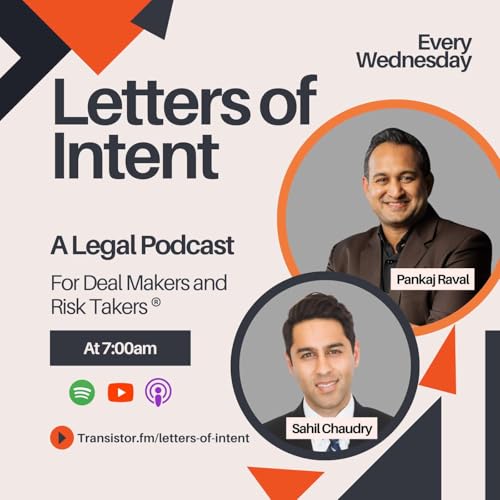
    "Management support" sounds like a collaborative and comforting phrase—until something goes wrong and nobody knows who is legally liable. In this episode of Letters of Intent, Pankaj Raval and Sahil Chaudry take a deep dive into Management Services Agreements (MSAs), specifically focusing on how they operate within the hospitality and healthcare sectors.

    They explore how small businesses and growing enterprises leverage MSAs to bring in operational expertise, from hotels utilizing third-party operators to healthcare clinics structuring "Friendly PC" models with Management Services Organizations (MSAs). Pankaj and Sahil break down the critical clauses every owner must fiercely negotiate, including decision-making authority, economic structures, regulatory compliance (like HIPAA), brand standards, and the crucial IP protections required if the relationship terminates.

    Takeaways

    • It is About Control, Not Just Support: An MSA doesn't just hire a vendor; it hands over the day-to-day operations of your business. If you do not clearly define the line between day-to-day authority and major strategic decisions, you risk losing control of your own enterprise.
    • The Franchise Risk: In hospitality, hiring a management company that is not approved by your franchisor can trigger a breach of contract, resulting in massive penalties and the potential loss of your flag.
    • The Friendly PC Model: In states like California that prohibit the corporate practice of medicine, MSAs are the critical legal bridge allowing non-physician investors to provide capital and administrative support to medical clinics through a Management Services Organization (MSO).
    • Contracts Require Controls: A beautifully drafted MSA means nothing if the ownership team becomes completely passive. Owners must actively oversee spending thresholds and operational metrics to ensure the management company isn't being loose with the purse strings.
    • Protect Your IP on Exit: When an MSA terminates, you must explicitly mandate that the management company cannot reverse-engineer your brand assets, SOPs, or customer data to use for competing clients.

    Soundbites

    • "Today we're talking about the management services agreement, which sounds helpful and collaborative until you realize it's really about control, money, liability, and whether someone quietly gave away half your business without noticing."
    • "I always talk about the importance of good contracts and good controls, and I think you have to have both for any successful business."
    • "Hospitality is where operational ambiguity becomes a Yelp review, then a claim, then a meeting everyone describes as productive, while internally everything's unraveling."
    • "If the contract doesn't clearly assign authority, responsibility, and risk, then the parties will do it later through conflict, which is almost always more expensive."
    • "Business management support is a comforting phrase right up until nobody knows who's liable."

    Keywords

    Management Services Agreement, MSA, Friendly PC Model, MSO, Hospitality Management, Healthcare Compliance, Carbon Law Group, Business Controls, Franchise Agreements.


    🔗 Learn More

    Website: carbonlg.com

    Connect with Pankaj: https://www.linkedin.com/in/pankaj-raval/

    Connect with Sahil: https://www.linkedin.com/in/sahil-chaudry-6047305/


    Click Here To Schedule A Call With Us

    Show more Show less
    29 mins
  • SPECIAL EPISODE - Structuring the Deal: Letters of Intent Explained
    Mar 20 2026

    It’s the document that inspired the name of our show, and today, we are dedicating an entire episode to it. In this episode of Letters of Intent, Pankaj Raval and Sahil Chaudhary break down the critical importance of getting your LOI right before you ever look at a Purchase and Sale Agreement (PSA).

    They explore how a well-crafted LOI acts as a "movie trailer" for a deal, surfacing major disagreements and dealbreakers before either party spends thousands of dollars on legal fees or due diligence. Whether you are buying commercial real estate, selling a growing business, or bringing on new partners, Pankaj and Sahil walk you through the 10 essential terms every LOI needs, the dangers of seller financing, and the critical difference between binding and non-binding provisions.

    Takeaways

    • Don't Negotiate on a Handshake: Proceeding with due diligence without an LOI in place leaves you completely exposed. You can spend thousands of dollars inspecting a business or property, only for the seller to walk away with zero consequences.
    • The 10 Essential Terms: Price is just one factor. Your LOI must outline the deposit, due diligence period, closing date, exclusivity, financing contingencies, deal structure (asset vs. stock), key economic terms, closing conditions, and confidentiality.
    • Binding vs. Non-Binding: While the core economic terms of an LOI are generally non-binding, you must ensure that clauses protecting your process—like exclusivity, confidentiality, and breakup fees—are strictly binding.
    • Beware of Seller Financing: If a buyer is asking for seller financing, it often means a bank won't lend to them. Unless you are fully prepared to act as a bank and navigate a complex foreclosure process, proceed with extreme caution.
    • Bring Counsel in Early: The biggest mistake business owners make is handing their attorney an already-signed LOI. By bringing counsel in before signing, you can identify blind spots, secure leverage, and avoid being locked into unfavorable terms.

    Soundbites

    • "Three weeks of momentum and $8,000 gone, an LOI would have cost them an afternoon."
    • "Is an LOI kind of like a movie trailer? It gives you the highlights. It tells you, do you want to watch this movie?"
    • "Unless you're prepared to be the bank and try to foreclose and try to deal with the property and take back the property, you do not want that headache."
    • "The price is only one factor of a deal and you have to weigh that against many other factors."
    • "If there's one takeaway... you can't read the other person's mind. The biggest protection you have against making assumptions is the LOI."

    Keywords

    Letter of Intent, LOI, Mergers and Acquisitions, Commercial Real Estate, Business Acquisition, Term Sheet, Exclusivity, Due Diligence, Seller Financing, Carbon Law Group

    Show more Show less
    27 mins
  • The 100 to 100 Campaign: Carbon Law Group's New Initiative
    Mar 18 2026

    Carbon Law Group is on a mission: to help 100 entrepreneurs and growing businesses reach the $100 million mark. Whether that means a $100 million exit, reaching a $100 million valuation, or generating $100 million in revenue, Pankaj Raval and Sahil Chaudry are dedicating this episode to unveiling the firm's ambitious new initiative.

    In this episode of Letters of Intent, Pankaj and Sahil discuss the legal barriers that often prevent small businesses from reaching "escape velocity." They break down why airtight contracts and rigorous controls are the non-negotiables of scaling. They also pull back the curtain on how Carbon Law Group is heavily investing in AI tools (like Lexis AI and Claude) to provide the strategic firepower of a 10-person legal team with unprecedented economic efficiency.

    Takeaways

    • The 100 to 100 Mission: Carbon Law Group is actively looking for hungry, coachable founders of growing businesses currently valued between $1M and $10M who want to scale to $100 million.
    • Contracts and Controls: To scale successfully, you need the proper legal infrastructure. This means having bulletproof Master Service Agreements (MSAs), Statements of Work (SOWs), and registered Intellectual Property to ensure you don't accumulate deal-killing liabilities as you grow.
    • AI is a Tool, Not a Lawyer: While tools like ChatGPT are incredibly powerful, they cannot replace a lawyer's trained ability to spot hidden risks, navigate complex human personalities in a negotiation, and map legal strategies to real-world business goals.
    • The Economic Efficiency of AI: By investing heavily in R&D and tools like Lexis AI, Claude, and Prompteteer, Carbon Law Group eliminates the bloated billing of traditional big law firms, doing the work of 10 lawyers with a highly efficient, technology-enabled team.
    • Entrepreneur-to-Entrepreneur: The best legal advice doesn't come from an academic vacuum. Pankaj and Sahil leverage their own experiences of managing employees and meeting sales targets to provide pragmatic, actionable counsel.

    Soundbites

    • "We want to make sure that you have the legal backbone and legal backing to make the right decisions, eliminate risk and get to that hundred million."
    • "You got to have great contracts, and you got to have great controls scaling your business."
    • "Honestly, if you have Chat GPT and you feel like that's your best lawyer, good luck. But the reality is, there's a lot more that goes into it than just what the AI can tell you."
    • "What would take 10 lawyers maybe three years ago, we can do with two to three."
    • "We know what it feels like to set targets and set sales targets and have to come up with the money to meet your expenses every month while chasing that big exit."

    Keywords

    SpaceX, xAI, Elon Musk, Section 368, Tax-Free Reorganization, Mergers and Acquisitions, Entire Fairness Rule, Corporate Governance, Fiduciary Duty, Pre-IPO Cleanup, Small Business Strategy, Carbon Law Group

    🔗 Learn More

    Website: carbonlg.com

    Connect with Pankaj: https://www.linkedin.com/in/pankaj-raval/

    Connect with Sahil: https://www.linkedin.com/in/sahil-chaudry-6047305/


    Click Here To Schedule A Call With Us

    Show more Show less
    16 mins
  • The $1.25 Trillion Gymnastics: Why Elon Musk Merged SpaceX and xAI
    Mar 11 2026

    When Elon Musk merged SpaceX and xAI into a reported $1.25 trillion enterprise, the headlines focused on rockets and artificial intelligence. But underneath the surface, this deal was a masterclass in corporate governance, valuation engineering, and tax structuring. In this episode of Letters of Intent, Pankaj Raval and Sahil Chaudhary break down the legal and financial mechanics behind the massive all-stock transaction.

    They explore how Section 368 of the Internal Revenue Code allows for tax-free reorganizations, why using stock as currency prevents immediate tax drags, and the intense fiduciary scrutiny (Delaware's "Entire Fairness Rule") that applies when a founder negotiates with themselves. Whether you are dealing with billions of dollars or running a growing small to mid-sized business, this episode reveals how to effectively consolidate entities and prepare for future financing.

    Takeaways

    • Beware "Related Party" Valuations: When a transaction is an all-stock exchange between two entities controlled by the same person, internal valuations (like xAI's reported $250 billion) should be viewed with skepticism.
    • Section 368 Reorganizations: By structuring an acquisition as a "Type B" stock-for-stock exchange, companies can treat their stock as currency, allowing shareholders to merge entities without recognizing immediate capital gains taxes.
    • The Pre-IPO Cleanup: This strategy isn't just for tech titans. Founders of small to mid-sized businesses frequently use tax-free reorganizations to cleanly consolidate separate IP holding companies and operating entities before raising capital or selling.
    • The Entire Fairness Rule: If you are a controlling shareholder on both sides of a merger, Delaware law holds you to a high fiduciary standard. You must prove both the process and the price were completely fair to minority shareholders to avoid self-dealing liabilities.
    • Documentation is Everything: To secure tax-free status from the IRS and satisfy fiduciary duties, complex reorganizations require immaculate documentation—from board approvals and stockholder consent to independent legal review.


    Soundbites

    • "Grain of salt, especially whenever you hear all stock transaction, your corporate antenna should go up."
    • "So the same way you can trade currencies, you can trade stock. And so you don't actually need cash to make an acquisition."
    • "In a Delaware law, when a controlling shareholder causes a company to acquire another entity he also controls, the courts will apply something called the entire fairness rule."
    • "This is incredibly common in pre-IPO cleanups and in private equity roll-ups."
    • "The moral of the story is that when you negotiate with yourself... governance, valuation, discipline, and tax structuring must align."


    Keywords

    SpaceX, xAI, Elon Musk, Section 368, Tax-Free Reorganization, Mergers and Acquisitions, Entire Fairness Rule, Corporate Governance, Fiduciary Duty, Pre-IPO Cleanup, Small Business Strategy, Carbon Law Group

    🔗 Learn More

    Website: carbonlg.com

    Connect with Pankaj: https://www.linkedin.com/in/pankaj-raval/

    Connect with Sahil: https://www.linkedin.com/in/sahil-chaudry-6047305/


    Click Here To Schedule A Call With Us
    Show more Show less
    10 mins
  • Bad Bunny's IP Masterclass
    Mar 4 2026

    When Bad Bunny took the stage for the Super Bowl halftime show, he put on an incredible display of Puerto Rican culture, musical talent, and local pride. But underneath the lights and the music was a massive, highly strategic business transaction. In this special episode of Letters of Intent, Pankaj Raval and Sahil Chaudhary put on their "deal lawyer glasses" to break down the mechanics behind the world's most-watched performance.

    They explore the paradox of why mega-stars perform at the Super Bowl for free, breaking down the concepts of value arbitrage and the attention economy. They also deconstruct the complex web of intellectual property rights, explaining how broadcast rights, sync rights, and creative control are negotiated. Finally, Pankaj and Sahil discuss the cultural significance of the performance, highlighting how small businesses and diverse communities are the true engine of the American Dream.

    Takeaways

    • Value Arbitrage: The Super Bowl halftime show is the ultimate example of giving up short-term cash for long-term amplification. Headliners trade a direct performance fee for an audience of 128+ million, resulting in massive spikes in streaming and touring revenue.
    • It's an IP Deal, Not a Service Contract: An artist isn't just providing a service; they are negotiating a complex bundle of intellectual property rights. Knowing how to leverage Name, Image, and Likeness (NIL), sync rights, and public performance rights is crucial.
    • The Importance of Creative Control: By retaining creative control, Bad Bunny was able to center Puerto Rican history, highlight power outages, and elevate local small businesses on a global platform.
    • The American Dream is Built on Small Businesses: Showcasing local barbershops and boxing gyms reinforced the reality that growing businesses are the cultural and economic lifeblood of our communities.


    Soundbites

    • "This is really a kind of value arbitrage where the artist is giving up short-term cash for a much longer term play and that play is amplification."
    • "This is less like a contract for services and this is more of an IP deal."
    • "The fact that these small businesses support their families, support others building businesses is really just paramount to what our American dream is all about."
    • "Not only is it local, he's talked about a lot of small businesses, but he's also brought the global mindset to the local."


    Keywords

    Carbon Law Group, Intellectual Property, Business Strategy, Small Business, Attention Economy


    Resources Mentioned

    • Concepts: Value Arbitrage, Attention Economy, Intellectual Property (Sync Rights, Master Recording Rights, Name Image & Likeness), Broadcast Rights.
    Show more Show less
    12 mins
  • Commercial Leasing 101: SNDAs, TIs, and Personal Guarantees
    Feb 25 2026

    Most business owners look at a commercial lease and see rent and square footage. Robby Pinnamaneni sees a credit instrument that can make or break your company. In this episode of Letters of Intent, Pankaj and Sahil sit down with Robby, a seasoned real estate attorney and founder of The Leasing Lawyers, to dismantle the myths of commercial leasing.

    They discuss why the term "boilerplate" is a trap used to rush bad deals, why Tenant Improvement (TI) allowances are actually high-risk loans, and why the 2026 debt maturity wall means you need to audit your landlord's finances before you sign. Plus, Robby shares a sophisticated strategy for investors to acquire distressed properties for cents on the dollar using "mezzanine debt."

    Takeaways

    • Lease = Loan: A commercial lease is a credit instrument. You are taking on a massive financial obligation. Treat the negotiation with the same seriousness you would a bank loan.
    • The SNDA Essential: If your landlord defaults on their mortgage, the bank can kick you out—unless you have a Subordination, Non-Disturbance, and Attornment (SNDA) agreement. In 2026's distressed market, this is non-negotiable.
    • Diligence Both Ways: Stop trying to impress the landlord. In a market with high vacancy and distressed debt, you need to audit their balance sheet. Can they afford to fix the HVAC? are they about to be foreclosed on?
    • The "Boilerplate" Trap: Brokers often label risky clauses as "standard" or "boilerplate" to close deals fast. Never accept "it's market" as a valid legal explanation.
    • Mezzanine Debt Strategy: Robby explains how savvy investors are buying mezzanine debt to foreclose on the entity owning a property (UCC foreclosure) in 60-90 days, bypassing the year-long judicial foreclosure process.


    Soundbites

    • "A lot of times people think the landlord's being generous with Tenant Improvements. They're not. It's effectively a loan."
    • "I hate the term 'boilerplate.' Brokers use it to instill a mantra so they can close the deal and get their commission."
    • "It's no longer a beauty contest of the tenant trying to impress the landlord. The landlord also has to impress the tenant."
    • "If you don't have an SNDA and the landlord defaults, the lender can just kick you out. Your goodwill, your build-out, it all goes out the window."
    • "You gotta start thinking optionality. What if I want to sell? What if I need less space? The lease governs your exit."


    Keywords

    Commercial Real Estate, Leasing, Robby Pinnamaneni, Tenant Rights, SNDA, Mezzanine Debt, Distressed Real Estate, Business Law, Entrepreneurship, Due Diligence, Carbon Law Group


    Guest: Robby Pinnamaneni (The Leasing Lawyers)

    • Website: TheLeasingLawyers.com
    • Instagram: @theleasinglawyers_


    🔗 Learn More

    Website: carbonlg.com

    Connect with Pankaj: https://www.linkedin.com/in/pankaj-raval/

    Connect with Sahil: https://www.linkedin.com/in/sahil-chaudry-6047305/


    Click Here To Schedule A Call With Us

    Show more Show less
    27 mins
  • SPECIAL EPISODE - IP-Maxxing: The Trademark Potential of the Looksmaxxing Trend
    Feb 21 2026

    Pankaj and Sahil dive into the viral internet subculture of "looksmaxxing" and its leading influencer, Clavicular. While the trend prioritizes extreme physical appearance over everything else, there's a massive, overlooked business angle: Intellectual Property. They investigate whether the term "looksmaxxing" is trademarked, uncover an abandoned filing, and explain why the next generation of creators and small businesses must "IP-maxx" to protect their brands and assets before they get "frame-mogged" by competitors.

    Takeaways

    • The Creator Economy is Serious Business: Viral internet figures are building massive personal brands that function like modern small businesses. Securing the intellectual property behind these brands is crucial.
    • The Trademark Void: Despite the massive popularity of "looksmaxxing," the trademark remains largely unclaimed for key categories (like cosmetics or grooming), leaving a huge monetization opportunity on the table.
    • Sword vs. Shield: Relying solely on common law trademark rights (using the name in commerce) is just a "shield." A federal trademark registration acts as a "sword," giving you nationwide protection and the power to enforce your rights in federal court.
    • IP-Maxx Your Brand: If you're building a brand—even an unconventional internet persona—secure your intellectual property and corporate governance early. Don't wait until someone else capitalizes on your viral success.


    Soundbites

    • "These are the next generation of entrepreneurs, these creators who are building personal brands, and they're going to have assets... that can be licensed."
    • "It is a sword and a shield because the trademark is both defensive and offensive. You have the right to file lawsuits... that you wouldn't have without a federal trademark."
    • "Always better to have a trademark than not to have a trademark."
    • "I think it's fair to say if you want to IP-maxx and you don't want to get frame-mogged by some other IP attorney, you need to call Carbon Law Group."


    Keywords
    Intellectual Property, Trademark Law, Looksmaxxing, Creator Economy, Personal Branding, Clavicular, Small Businesses, Brand Licensing, Carbon Law Group

    🔗 Learn More

    Website: carbonlg.com

    Connect with Pankaj: https://www.linkedin.com/in/pankaj-raval/

    Connect with Sahil: https://www.linkedin.com/in/sahil-chaudry-6047305/


    Click Here To Schedule A Call With Us

    Show more Show less
    11 mins
  • Rainmaking for Lawyers: Building Transferable Value Beyond the Founder
    Feb 18 2026

    For many lawyers and professional service providers, the "exit plan" is simply to die at their desk. But building a practice that relies 100% on you isn't a business—it's a job. In this episode of Letters of Intent, Pankaj and Sahil sit down with Gideon Grunfeld, founder of Rainmaking For Lawyers, to discuss the complex psychology and mechanics of succession planning.

    They explore why "goodwill" is often worthless in a sale, how to build transferable value through SOPs (Standard Operating Procedures), and why the legal industry is shifting away from the "Mom & Pop" model toward Private Equity-backed structures. If you want your life's work to outlast you, this conversation is the blueprint.

    Takeaways

    • The Identity Trap: The biggest barrier to succession planning isn't financial—it's psychological. Founders fear becoming irrelevant. Gideon explains that stepping back isn't an "on-off switch," but a transition where you can still add value.
    • Systems > Charisma: Buyers do not pay for your personality. They pay for systems, databases, and Standard Operating Procedures (SOPs) that ensure revenue continues when you leave.
    • The Power of the LOI: A Letter of Intent is critical in succession deals. It signifies the shift from "dating" to "moving in together," allowing you to share sensitive data (like client lists) for due diligence while protecting confidentiality.
    • Don't Be an "Article II" Lawyer: Defining your expertise too narrowly makes your business fragile. You must define yourself by the problems you solve for clients, not the specific code section you litigate.
    • The MSO Revolution: Private Equity is entering the legal space through Management Service Organizations (MSOs). This shift means the future of law belongs to scaled, professionally managed firms, not isolated solo practitioners.


    Soundbites

    • "Succession planning is only relevant if you've gotten something big enough... that it's not dependent on you doing exactly the same thing you've done for the last 30 years."
    • "If the entire firm is just you and your name and your charisma... The answer is I'm going to pay you 10% because I don't think I could remotely replicate what you do."
    • "Unemployed people don't have a ton of money. No work equals no money."
    • "My dream is to die at my desk and to hit my head on the treatise I'm reading. I've heard that a million times."
    • "We're no longer a mom and pop business economy... The days of being like a young solo and thinking you're gonna replicate what the prior generation did is vanishingly unlikely."


    Keywords

    Succession Planning, Law Firm Valuation, Exit Strategy, Gideon Grunfeld, MSO, Private Equity in Law, Standard Operating Procedures, Business Growth, Carbon Law Group

    Guest: Gideon Grunfeld (Rainmaking For Lawyers)

    • Website: rainmakingforlawyers.com
    • LinkedIn: Gideon Grunfeld


    🔗 Learn More

    Website: carbonlg.com

    Connect with Pankaj: https://www.linkedin.com/in/pankaj-raval/

    Connect with Sahil: https://www.linkedin.com/in/sahil-chaudry-6047305/


    Click Here To Schedule A Call With Us

    Show more Show less
    49 mins