• Resistance vs Discord in Motivational Interviewing: How to Handle “Resistant” Clients
    Mar 24 2026

    In this episode of MI For Change, we explore one of the most misunderstood concepts in therapy and behavior change: resistance.

    What if your client isn’t actually resistant?

    In Motivational Interviewing, what we often label as “resistance” can be better understood as:

    • Sustained talk (arguments against change)
    • Discord (a breakdown in the relationship or communication)

    And that distinction can completely transform your sessions.

    In this episode, you’ll learn:
    • The difference between resistance, sustained talk, and discord
    • Why labeling clients as “resistant” can be harmful to the therapeutic process
    • How to recognize early signs of discord in sessions
    • Practical Motivational Interviewing questions to reduce defensiveness
    • How to shift from confrontation to collaboration
    • How to bring conversations back to trust, curiosity, and partnership

    If you’re a:
    • BCBA
    • Therapist
    • Psychologist
    • Counselor
    • Educator
    • Or anyone working with behavior change

    This episode will give you practical tools to improve communication, increase client buy-in, and create more effective sessions.

    Remember:
    It’s not about controlling the client…
    It’s about guiding the conversation.

    Learn more about Motivational Interviewing and explore on-demand courses at www.drmonicagilbert.com

    Join the MI Academy for practical training and resources — and enjoy an exclusive 15% off with code MIFORCHANGE at checkout.

    📲 Connect with me on Instagram: @drmonicagilbert


    Show more Show less
    17 mins
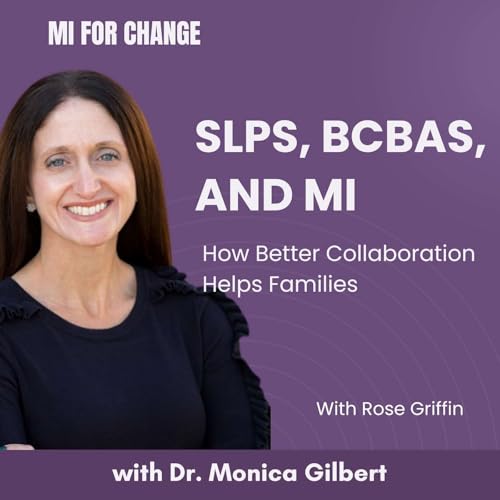
  • SLPs, BCBAs, and MI: How Better Collaboration Helps Families
    Mar 17 2026

    What happens when two professionals want the same outcome for a child… but speak completely different languages?

    In this episode of MI for Change, I’m joined by Rose Griffin, a speech therapist and BCBA, to talk about one of the biggest challenges in our field: collaboration between SLPs and BCBAs.

    We talk about where miscommunication happens, why jargon creates unnecessary walls, and how Motivational Interviewing can help us approach these conversations with more curiosity, less defensiveness, and better outcomes for families.

    In this conversation, we cover:

    • Where collaboration between SLPs and BCBAs often breaks down
    • Why jargon and assumptions create so much friction
    • How social media has shaped perceptions of ABA
    • What clinicians can do to enter difficult conversations with more curiosity
    • Why parents should never be stuck in the middle of professional disagreements
    • Small communication shifts that can strengthen collaboration immediately

    This episode is for BCBAs, SLPs, OTs, psychologists, educators, and anyone who wants to work better across disciplines.

    Because at the end of the day, we all want the same thing:
    better outcomes for the child and less stress for the family.

    Learn more about Motivational Interviewing and explore on-demand courses at www.drmonicagilbert.com

    Join the MI Academy for practical training and resources — and enjoy an exclusive 15% off with code MIFORCHANGE at checkout.

    📲 Connect with me on Instagram: @drmonicagilbert


    Show more Show less
    35 mins
  • When Helping Too Much Backfires: Prompt Dependency in Therapy
    Mar 10 2026

    Helping your clients sounds like the right thing to do.

    But sometimes… helping too much actually creates the opposite of what we want.

    In this episode of MI for Change, we talk about prompt dependency — a concept familiar in ABA, but one that shows up in therapy, parent coaching, and leadership as well.

    Prompt dependency happens when clients begin to rely on the therapist for answers, direction, or solutions… instead of developing the confidence to problem-solve on their own.

    And often, it happens with the best intentions.

    In this episode we explore:

    • What prompt dependency actually looks like in therapy
    • Why over-helping feels good to the therapist (even when it backfires)
    • How giving answers too quickly blocks autonomy and confidence
    • Why silence can be one of the most powerful clinical tools
    • How Motivational Interviewing shifts us from directing to evoking

    Because the real goal of therapy isn’t to be needed forever.

    It’s to help clients realize they don’t need us as much as they thought.

    Learn more about Motivational Interviewing and explore on-demand courses at www.drmonicagilbert.com

    Join the MI Academy for practical training and resources — and enjoy an exclusive 15% off with code MIFORCHANGE at checkout.

    📲 Connect with me on Instagram: @drmonicagilbert


    Show more Show less
    20 mins
  • The Difference Between Rapport and Buy-In
    Mar 3 2026

    You can have great rapport…
    and still have clients cancel, avoid homework, or “agree” without following through.

    So what’s missing?

    In this episode of MI for Change, I break down the difference between rapport and buy-in — and why they are not the same thing.

    Rapport means your client trusts you.
    Buy-in means they see the value and own the change.

    We’ll talk about:

    • Why compliance is not the goal
    • How to tell when a parent truly has buy-in
    • The mistake clinicians make when they move too quickly into “fixing”
    • Why curiosity is your most powerful clinical tool
    • How to explore both the benefits and costs of change (yes, both sides)

    If you’ve ever thought:
    “But they like me… so why aren’t they doing it?”

    This episode is for you.

    Learn more about Motivational Interviewing and explore on-demand courses at www.drmonicagilbert.com

    Join the MI Academy for practical training and resources — and enjoy an exclusive 15% off with code MIFORCHANGE at checkout.

    📲 Connect with me on Instagram: @drmonicagilbert


    Show more Show less
    15 mins
  • MI for Neurodiversity: What Works for Autism, ADHD & PDA (Without Pressure)
    Feb 24 2026

    If you’ve ever felt like traditional “motivation” strategies don’t land with neurodivergent clients… you’re not imagining it.

    In this episode, I break down how to use Motivational Interviewing (MI) in a way that actually fits autism, ADHD, and PDA profiles—without overwhelming, pressuring, or accidentally triggering shutdown.

    We talk about the practical stuff clinicians often miss:

    Why social approval isn’t always the motivator (and what to focus on instead)

    How processing speed + sensory load changes the way we should communicate

    Why short, concrete reflections often work better than long summaries

    What changes when demands feel threatening (PDA), even when your intentions are good

    The simplest shift you can make today: replacing “What’s your goal?” with “What feels important right now?”

    You’ll leave with language you can use immediately—especially if you work with teens, adults, or verbal kids who want change… just not at the cost of feeling controlled.

    🎧 Listen now, and tell me: what neurodivergent profile do you work with most?

    Learn more about Motivational Interviewing and explore on-demand courses at www.drmonicagilbert.com

    Join the MI Academy for practical training and resources — and enjoy an exclusive 15% off with code MIFORCHANGE at checkout.

    📲 Connect with me on Instagram: @drmonicagilbert


    Show more Show less
    19 mins
  • Why People Don’t Change—Even When the Help Is “Good” with Dr. Paul Gavoni
    Feb 17 2026

    Most professionals don’t struggle because they don’t care.

    They struggle because the people they’re trying to help… don’t see what’s in it for them.

    In this episode of MI for Change, I had the pleasure to sit down with Dr. Paulie to talk about why telling people what to do rarely leads to real change—even when the advice is solid and well-intentioned.

    Together, we explore:

    * Why “resistance” is often a signal—not a problem
    * How values drive behavior more than information ever will
    * What happens when professionals unintentionally impose their own values
    * Why consent, buy-in, and engagement are skills—not personality traits
    * How Motivational Interviewing helps people change without pressure or coercion

    This conversation is for clinicians, educators, leaders, and helpers who’ve ever thought: “Why isn’t this working?”

    If you work with parents, staff, clients, or teams—and change feels harder than it should—this episode will help you see why.

    Learn More about Dr Paul Gavoni: https://thebehavioraltoolbox.com/

    Learn more about Motivational Interviewing and explore on-demand courses at www.drmonicagilbert.com

    Join the MI Academy for practical training and resources — and enjoy an exclusive 15% off with code MIFORCHANGE at checkout.

    📲 Connect with me on Instagram: @drmonicagilbert


    Show more Show less
    47 mins
  • Trauma-Informed Care Isn’t What You Think — How MI Restores Choice, Voice, and Agency
    Feb 10 2026

    with clients.

    You’ll learn why trauma is fundamentally about loss of control, and how MI restores what trauma takes away: choice, voice, and agency — without removing accountability or direction.

    This episode breaks down:

    • Why “trauma-informed” has become a buzzword (and how it’s often misunderstood)
    • How MI prevents re-traumatization by supporting autonomy
    • The difference between trauma-informed care and permissive therapy
    • Why avoiding discomfort isn’t the same as providing safety
    • How MI helps re-engage clients who feel “therapied out”
    • How to balance compassion and movement in clinical conversations

    Whether you’re a therapist, clinician, or someone who wants to communicate more ethically and effectively, this episode will help you rethink what trauma-informed care really looks like in action.

    Learn more about Motivational Interviewing and explore on-demand courses at www.drmonicagilbert.com

    Join the MI Academy for practical training and resources — and enjoy an exclusive 15% off with code MIFORCHANGE at checkout.

    📲 Connect with me on Instagram: @drmonicagilbert


    Show more Show less
    17 mins
  • Giving Assessment Feedback Without Triggering Defensiveness (Using Motivational Interviewing)
    Feb 3 2026

    Giving assessment results to parents can be one of the most emotionally charged moments in clinical work.

    In this episode of MI for Change, Dr. Monica Gilbert explores how Motivational Interviewing (MI) can help clinicians deliver psychological and educational assessment feedback in a way that feels supportive, collaborative, and empowering—instead of overwhelming or defensive.

    You’ll learn why even technically accurate feedback can miss the mark emotionally, how fear and grief often show up as “defensiveness,” and what to say (and not say) when sharing difficult results like an autism diagnosis or learning challenges.

    Whether you’re a psychologist, behavior analyst, therapist, school professional, or parent-facing clinician, this episode will help you transform feedback sessions into conversations that foster understanding and forward movement.

    In This Episode, You’ll Learn:

    • Why parents may shut down during assessment feedback—even when you’re “doing everything right”
    • How MI helps reduce defensiveness and emotional overwhelm
    • Questions that invite collaboration instead of resistance
    • How to evoke next steps without pressuring families
    • Ways to balance clinical clarity with empathy and partnership

    🎧 Listen now and learn how how you communicate results can change what happens next.

    Learn more about Motivational Interviewing and explore on-demand courses at www.drmonicagilbert.com

    Join the MI Academy for practical training and resources — and enjoy an exclusive 15% off with code MIFORCHANGE at checkout.

    📲 Connect with me on Instagram: @drmonicagilbert


    Show more Show less
    18 mins