Radical Candor: Communication at Work Podcast By Kim Scott Jason Rosoff & Amy Sandler cover art

Radical Candor: Communication at Work

Radical Candor: Communication at Work

By: Kim Scott Jason Rosoff & Amy Sandler
Listen for free

Ready to love your job, crush your career goals, and become the kind of leader everyone actually wants to work with? Welcome to the Radical Candor podcast, where you'll learn how to kick ass at work without losing your humanity. Host Amy Sandler and Radical Candor co-founders Kim Scott and Jason Rosoff to break down how you can Care Personally and Challenge Directly — the deceptively simple but powerful formula for building stronger teams, giving (and getting) better feedback, and leading with heart and clarity. Each episode is packed with real talk, relatable stories, and actionable tips to help you do the best work of your life while building the best relationships of your career. Whether you’re a manager, a team player, or dreaming bigger for your future, this is the podcast that will change how you show up at work — and in life. P.S. Don’t forget to check out Kim Scott’s New York Times and Wall Street Journal bestseller, Radical Candor: Be a Kick-Ass Boss Without Losing Your Humanity! Want even more Radical Candor? Join the Radical Candor Community — free forever.Copyright Radical Candor 2025 Career Success Economics Relationships Social Sciences
Episodes
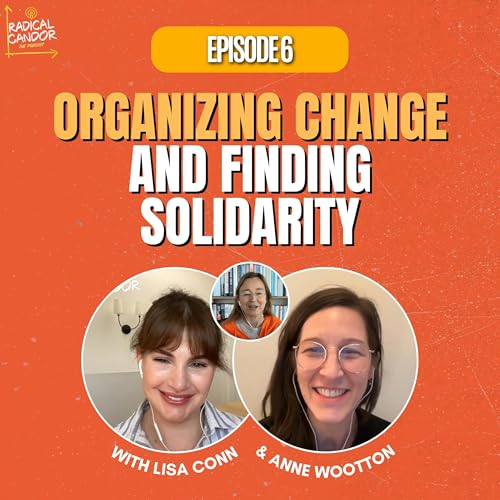
  • How Tech Employees Can Organize for Change with Lisa Conn and Anne Wootton 8 | 6
    Mar 18 2026
    When tech is at its best, it is a group of people working together to solve hard problems in a way that makes the world a better place. That goal is what motivated so many folks in Silicon Valley to come here. How then did we cede the microphone to a small number of people who espouse an authoritarian, rich get richer algorithm? How can people working inside tech companies grab the bullhorn away from the authoritarians to describe the world we want to create? How we can take action to advocate for our vision of a better future? One recent manifestation of this is the ⁠ICEout.tech⁠ movement. In this episode, Kim speaks with Lisa Conn, founder of Gatheround and former Meta employee, and Anne Wootton, co-founder of Pop Up Archive and current senior engineering manager at Apple, about why they signed the pledge and what they hope it can accomplish. Kim, Lisa and Anne also discuss more generally ideas for people who are frustrated with the state of affairs at their companies or in tech more broadly, but are not sure where to start and how to find a community of similarly civic-minded people to take action. They discuss ways to host meetups for your like-minded co-workers while still working hard at your day job and staying within your company’s policies. They also talk about how important it is to speak respectfully with people who disagree with you. A good goal is to deepen your own thinking, not to change a person's mind. You probably won’t change their mind, and you probably won’t change yours. That doesn’t mean you’re wasting your breath. When you invite discussion about your beliefs with people who disagree, two good things can happen. One, you get to know them a bit better. Two, you challenge yourself to think more deeply. JS Mill said that belief without discussion can give way to prejudice. Background on ICEout.tech: ⁠⁠ICEout.tech⁠⁠, started by and for people in tech, wants the tech industry to use its influential position in our economy to stop ICE. The pledge, which was started after Renee Good was murdered in Minneapolis, has more than 2,000 verified signatures from people across major companies including NVIDIA, Anthropic, OpenAI, Google, Microsoft, Amazon, Meta, and dozens more. The call to speak up against ICE in tech gained momentum after Border Patrol agents killed Alex Pretti, an ICU nurse, and has drawn public support from leaders like Dario and Daniela Amodei (Anthropic), Reid Hoffman, and Vinod Khosla. Tech professionals want their CEOs to join them in this effort, to protect our neighbors and communities and stop ICE's terror. Resources: ⁠⁠ICEout.tech⁠⁠ information and how to get involved. Resist and Unsubscribe Resist and Unsubscribe - movement by Prof. Scott Galloway to encourage individuals to use their economic power by unsubscribing from big tech web services as a way to press these leaders to push for government reforms. CHAPTERS: (00:00) Introduction to iceOut.tech Movement (02:00) Understanding the Pledge and Its Impact (04:59) Navigating Ethical Dilemmas in Tech (10:02) The Role of Affluence and Courage (15:20) Building Solidarity and Taking Action (20:04) Employee Power and Organizing for Change (22:53) The Role of Technology in Society (26:10) Tactics for Influencing Corporate Decisions (29:51) Building Internal Solidarity and Communication (34:04) Navigating Polarization and Finding Common Ground (39:03) Self-Care and Community Engagement Connect with the Radical Candor team: ⁠⁠⁠⁠⁠⁠Website⁠⁠⁠⁠⁠⁠ ⁠⁠⁠⁠⁠⁠Instagram⁠⁠⁠⁠⁠⁠ ⁠⁠⁠⁠⁠⁠TikTok⁠⁠⁠⁠⁠⁠ ⁠⁠⁠⁠⁠⁠LinkedIn⁠⁠⁠⁠⁠⁠ ⁠⁠⁠⁠⁠⁠YouTube⁠⁠⁠ ⁠⁠⁠⁠⁠⁠⁠⁠⁠⁠⁠⁠⁠⁠Bluesky⁠⁠⁠⁠ Learn more about your ad choices. Visit megaphone.fm/adchoices
    Show more Show less
    41 mins
  • Rethinking Authenticity and What to Do Instead with Dr. Tomas Chamorro-Premuzic 8|5
    Mar 11 2026
    “Be yourself.” “Bring your whole self to work.” “Don’t worry what people think.” These phrases sound empowering—but in real workplaces, they can create confusion, conflict, and even harm. In this episode of The Radical Candor Podcast, Kim Scott and Amy Sandler sit down with organizational psychologist Tomas Chamorro-Premuzic—Chief Science Officer at Russell Reynolds Associates, professor of business psychology at University College London and Columbia University, and author of Don’t Be Yourself: Why Authenticity Is Overrated and What to Do Instead. They start with a moment of actual Radical Candor: Kim reached out after Tomas and Amy Edmondson accidentally conflated Radical Candor with “brutal honesty.” Instead of stewing, she did the hard (and human) thing—she talked to him. That conversation sets the tone for a bigger question: What does it really mean to be “authentic” at work? Tomas breaks down four “authenticity traps” that sound like wisdom but often backfire: Always be honest with yourself and others Don’t worry what people think of you Always stay true to your values, no matter what Bring your whole self to work Together, they explore what replaces these traps: self-complexity, emotional intelligence, feedback you can absorb without defensiveness, and the discipline to regulate your impulses so you can build trust and safety—without turning the workplace into either chaos or conformity. If you’ve ever felt stuck between being “real” and being effective, this episode offers a more useful frame: your right to be you should never override your obligation to others. ⁠⁠⁠Website⁠⁠⁠ ⁠⁠⁠Instagram⁠⁠⁠ ⁠⁠⁠TikTok⁠⁠⁠ ⁠⁠⁠LinkedIn⁠⁠⁠ ⁠⁠⁠YouTube⁠⁠⁠ ⁠⁠Bluesky Resources: Fast Company: To create psychological safety, don't bring your whole self to work TEDx Talk: Why Do So Many Incompetent Men Become Leaders? Next Big Idea Club: The Surprising Science of Why Being Authentic Can Hold You Back HBR Podcast: Why Are We Still Promoting Incompetent Men? Why Do So Many Incompetent Men Become Leaders? (And How To Fix It) [book] Don't Be Yourself: Why Authenticity Is Overrated and What to Do Instead [book] I, Human: AI, Automation, and the Quest to Reclaim What Makes Us Unique [book] Dr. Tomas Chamorro-Premuzic [website] Mentioned on the podcast: Infantilised: How Our Culture Killed Adulthood [book] Seinfeld episode: Life Hack “Do the opposite” [YouTube short] The Best Leaders are Great Followers HBR article by Tomas Chamorro-Premuzic and Amy C. Edmondson Chapters: (00:00) IntroductionKim and Amy welcome Tomas Chamorro-Premuzic and reflect on how this conversation began with Radical Candor. (03:10) Radical Candor vs. “Brutal Honesty”How a misinterpretation sparked a real conversation about kindness, nuance, and impact. (07:20) Why “Don’t Be Yourself”The meaning behind the provocative title and why authenticity advice often backfires at work. (14:10) The Four Authenticity TrapsAlways be honest, don’t care what people think, never compromise your values, and bring your whole self to work. (19:30) Confidence, Competence, and FeedbackWhy developing skill comes first—and how confidence is often about timing and delivery. (27:30) Staying True to Values Without Becoming DogmaticWhy uncompromising values can divide teams and what leadership actually requires. (30:10) Authenticity as PrivilegeWhy complete self-expression is often a luxury of the powerful, not a universal standard. (36:15) Psychological Safety Isn’t ComfortWhy safety should enable productive discomfort, not chaos or bullying. (41:55) Emotional Intelligence vs. Unfiltered AuthenticityWhy adapting to others is a strength, not a lack of integrity. (49:10) Regulating Impulses as a LeaderHow filtering behavior builds trust without sacrificing humanity. (01:03:50) Conclusion Connect:Resources for show notes: Learn more about your ad choices. Visit megaphone.fm/adchoices
    Show more Show less
    1 hr and 5 mins
  • Why We Don’t Do What We Know We Should: Beliefs, Habits, and AI Practice with Nir Eyal 8|4
    Mar 4 2026
    What if the reason you don’t give feedback, follow through, or change your habits… isn’t willpower? What if it’s a belief? In this episode of The Radical Candor Podcast, Kim Scott talks with Nir Eyal — author of Hooked, Indistractable, and his new book Beyond Belief — about the hidden force behind motivation: the stories we tell ourselves. They explore: Why AI can’t replace human relationships — but can help us practice hard conversations The limiting belief that keeps people silent at work Why knowing what to do isn’t enough How pain (not pleasure) drives behavior The difference between addiction and habit Why “time management is pain management.” How to reinterpret anxiety as readiness And why beliefs are tools — not truths If you’ve ever struggled to speak up, follow through, or break a bad habit — this conversation will help you see what’s really getting in the way.Chapters (00:00) Introduction Kim welcomes Nir Eyal and introduces AI portraits and scaling human insight. (04:30) Can AI Replace Relationships? Why AI can’t replace human connection — but may be the safest place to practice hard conversations. (10:15) Refining AI Voice & Identity What it means to “scale yourself” without losing your humanity. (16:40) The Limiting Belief That Keeps You Silent “If you don’t have anything nice to say…” — and why that belief causes harm. (23:10) Beliefs Are Tools, Not Truths Nir explains the core thesis of Beyond Belief. (29:30) Placebos, Pain, and Perception What belief can change — and what it can’t. (36:20) Stage Fright vs. Readiness Reinterpreting anxiety as oxygen for performance. (43:10) Time Management Is Pain Management Why distraction is about escaping discomfort. (50:40) Addiction vs. Habit Why addiction is about escaping pain — not seeking pleasure. (57:00) Why We Don’t Do What We Know The missing link between knowledge and action. (01:04:00) Radical Candor and the “Nice” Trap The story of Bob — and why staying silent isn’t kind. (01:10:00) If It’s Yellow, Let It Mellow Marriage, feedback, and choosing what truly matters. (01:13:00) Conclusion Learn more about your ad choices. Visit megaphone.fm/adchoices
    Show more Show less
    50 mins
No reviews yet