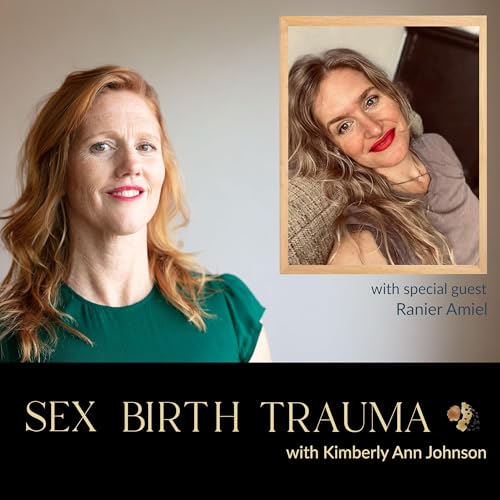
Sex Birth Trauma with Kimberly Ann Johnson Podcast By Kimberly Ann Johnson: Author Vaginapractor Trauma Educator cover art

Sex Birth Trauma with Kimberly Ann Johnson

Sex Birth Trauma with Kimberly Ann Johnson

By: Kimberly Ann Johnson: Author Vaginapractor Trauma Educator
Listen for free

Cutting-edge, pioneering conversations on holistic women's health, including sex, birth, motherhood, womanhood, intimacy and trauma with doula, certified Sexological Bodyworker, Somatic Experiencing practitioner, and author of Call of the Wild and the Fourth Trimester, Kimberly Ann Johnson.Magamama 2017 Alternative & Complementary Medicine Hygiene & Healthy Living
Episodes
  • EP 240: Hunting and Making God – Motherhood, Creativity, and Building a Church of Her Own with Ranier Amiel
    Mar 16 2026

    In this episode, the third in the Santa Fe trilogy, Kimberly speaks with Ranier Amiel, an artist, bodyworker, and single mother who is restoring a century-old church in Truchas, New Mexico, and turning it into a home, studio, and eventually a space of community and sacred inquiry. Recorded inside the church itself, their conversation moves between the balance of motherhood and creativity, the grounding power of physical labor, and what it means to hunt for and make God after losing faith in the spiritual community you were raised in. Ranier shares her vulva portraiture work, including its two-year run inside an immersive theater project in Amsterdam, and the stark contrast she witnessed between American and Dutch women's relationships to their bodies. They discuss the trauma orientation as a cultural overcorrection that can become avoidant of self-expression, the obsession with self-definition versus actually embodying who you are, and the need for hierarchy, tradition, and compression alongside the essential self. The conversation closes with reflections on the layers between: body and soul, survival and art, the seen and the unseen.

    Bio

    Ranier Amiel is an artist, bodyworker, movement teacher, and painter based in Truchas, New Mexico, where she is restoring a century-old church into a home, studio, and community space. Born in Santa Fe and raised deeply inside a spiritual community, she has spent the last two decades on what she calls a path of hunting and making God—seeking the sacred through the body, art, and radical vulnerability. She is known for her vulva portraiture and witnessing work, which she has practiced for over twelve years, including a two-year collaboration with an immersive theater company in Amsterdam. A single mother to her son Ollie, Ranier's life and work sit at the intersection of art, motherhood, bodywork, and the creation of sacred space. She envisions the church as a place of deeper meaning, community inquiry, and a different perspective on spiritual truth—guided by a board of priestesses.

    What She Shares:

    – The wrestle of motherhood and creativity as a single parent

    – Restoring a century-old church in Truchas as her biggest art project

    – How physical labor, trenching, building, moving rock, became the most grounding thing she's ever done

    – Hunting and making God after spiritual disillusionment at 19

    – Her vulva portraiture work and what it reveals beyond trauma

    – The night-and-day contrast between American and Dutch women's body relationships

    – A vision for the church as sacred community space led by a board of priestesses

    What You'll Hear:

    – Motherhood and creativity: the wrestle of being a full-time single mom and a wild artist

    – Defining for herself what a good mom looks like and what she's willing to let go of

    – The history of the church in Truchas and how she found it on Zillow

    – Desperation and audacity: taking on a property with no plumbing and no heat

    – How building her own home with her hands healed her nervous system

    – Being a white woman in a historically Hispano community and being welcomed

    – The church's journey from services to gallery to bedroom to future sacred space

    – Growing up in a spiritual community that fell apart and watching people cling harder to beliefs

    – What church means to her: hunting and making God, creating sacred space

    – Removing the patriarchy from people's bodies through bodywork, movement, and painting

    – The vulva witnessing work: reclamation paintings, celebration paintings, and touching the place beyond the trauma

    – Two years of live witnessing inside an immersive theater project in Amsterdam

    – American versus Dutch women: puritanical repression versus healthy embodiment

    – Kimberly's reflections on writing Erotic Seasons and holding both wounding and alchemical power

    – The trauma orientation as avoidance of self-expression and a block to maturation

    – Watching her teenage son self-diagnose and the cultural swing from denial to over-identification

    – The geranium and the jungle plant: helping people find the conditions they need to thrive

    – Uniqueness tangled with individualism and the obsession with self-definition

    – The loss of hierarchy, tradition, and roles—and why compression helps us find essence

    – The body as the physical form of the soul, not a separate sack of flesh

    – The layers between as that which actually makes everything separate and not

    – Kimberly on occupying a between space in the culture and cultivating trustworthiness over customer satisfaction

    Resources

    Location: Truchas, New Mexico

    Website: https://ranieramiel.com/

    IG: @ranieramiel

    Show more Show less
    1 hr and 4 mins
  • EP 239: The Image of the Wound – Emergent Teaching, Art as Alchemy, and Living Between Languages with Dr. Chanti Tacoronte-Perez
    Mar 8 2026

    In this episode, Kimberly speaks with Dr. Chanti Tacoronte-Perez, an artist, educator, and depth psychologist based in Santa Fe, New Mexico, and the designer of the cover of Kimberly's upcoming book Erotic Seasons. Part of Kimberly's Santa Fe trilogy, this conversation explores what it means to teach and live emergently: responding to what's present rather than what's planned. Chanti shares her doctoral work on the wound of homelandlessness as a Cuban American, and how she developed a practice of creating and living with the image of one's wound as a daily, evolving relationship rather than something to fix or overcome. They discuss the difference between revisiting and rumination, the ancient link between art and therapy, and why images hold meaning differently than words; allowing wounds to keep shifting rather than becoming rigid stories. The conversation also touches on the Cuban concept of resolver, what it takes to be a student of one's own creative impulse, and how imperfection and planned spontaneity become doorways to aliveness.

    Bio

    Dr. Chanti Tacoronte-Perez is a Cuban-American artist-author, ritualist, and non-clinical depth psychologist. She believes that images speak a profound language; her life's work is a translator of the unseen and an advocate for the imaginal. She holds two master's degrees in Engaged Humanities and Depth Psychology from Pacifica Graduate Institute. In 2023 she completed her doctoral dissertation Navegando Liminal: Rituals to Translate the Image of the Wound. Her work and teaching follows and welcomes, imagination, creativity, dreaming, and deep rest.

    She teaches workshops, and collaborative training focused on creativity, yantra painting, dreaming, intuitive movement, myth, restorative yoga, and yoga nidra. Her passion and aim are to inspire all to rediscover their creative self by weaving the blessings with the wounds while honoring the land and ancestors.

    Dr. Chanti also works individually with clients using a transdisciplinary approach through creative therapeutics. Learn more.

    What She Shares:

    – Chanti's doctoral work on the wound of homelandlessness

    – The practice of creating and living with the image of one's wound

    – How emergence is like an emergency—the urgency of being present

    – The toolbox of an emergent teacher: listening, trust, and tolerance for tension

    – Why images hold meaning differently than words

    – The Cuban concept of resolver—figuring things out with what you have

    – How she navigated a PhD program as an image-based thinker

    – The link between art and therapy as the oldest form of alchemy

    What You'll Hear:

    – What emergent teaching actually requires: listening, trust, and a good ear for the pulse of the space

    – The tension of being the leader who says "I don't know"

    – Chanti's wound of homelandlessness: ni de aquí, ni de allá

    – Growing up being told "you belong over there"—and arriving in Cuba as a foreigner

    – Creating the image of the wound and living with it as an altar

    – The word estúpida on the image—and reclaiming what was once shame

    – Pursuing a PhD in Jungian Archetypal Studies as an image-based thinker

    – The project-based dissertation: two books, one of words and one of images

    – Wound and blessing: the etymology of bless as bleed in French and Old English

    – The difference between revisiting a wound and ruminating on it

    – How fixed meaning stops a wound from continuing to grow and change

    – Choiceless choice: when creative impulses announce themselves

    – The incubation period—how long to sit with a bubbling before it overflows

    – Art as something that overflows from you and becomes something else

    – Kimberly's experience writing her book with a co-editor through word games and play

    – Exhaustion, rest culture, and the shadow side of Yin

    – Creativity as living in the third space between social and sympathetic nervous systems

    – Working with dreams through images and movement

    – Mutual seed planting: how flamenco and imagery crossed between them

    – Imperfection as doorway: planned spontaneity, blindfolds, dice, and letting things fall

    – The layers between words and images, cultures, and belonging

    Resources

    Website: https://www.yantrawisdom.com/

    Kimberly's Next Course: https://kimberlyannjohnson.com/STANDUP/

    Show more Show less
    56 mins
  • EP 238: The Body Innate – Yin Warriorship, Communal Eros, and Leading Atmospheres with Jaye Marolla
    Mar 2 2026

    In this episode, Kimberly speaks with Jaye Marolla, a bodyworker, martial artist, Qigong teacher, and founder of The Body Innate and the Yin Dojo in Santa Fe, New Mexico. They explore the integration of martial arts, bodywork, and Qigong as a path of healing and sovereignty, and what Jaye calls "yin warriorship:" a reclamation of the warrior archetype rooted in surrender, Eros, and facing one's own mortality rather than competition or heroism. They discuss how Jaye came to open her home as a dojo, the ancient tradition of merging practice space with living space, and the energetic responsibility that requires. The conversation moves through the role of Eros and sexuality in training spaces, the difference between safety and emergence, the trauma frame versus a vitality frame, and what it means to lead atmospheres rather than follow scripts. They also explore queerness as a state of questioning, the tension between sovereignty and individualism, and the concept of couples dojos as somatic spaces for partnership.

    Bio

    Jaye Marolla is a bodyworker, martial artist, and Qigong practitioner based in Santa Fe, New Mexico, where she runs the Yin Dojo. She is the founder of The Body Innate and has trained extensively in multiple martial arts traditions including Aikido and Jiu Jitsu, as well as Thai bodywork, which she studied for three years with a master teacher in Thailand. A former Division 1 basketball player, Jaye integrates decades of physical training with Taoist philosophy, somatic practice, and community-based teaching. Her work sits at the intersection of yin warriorship, Eros, and embodied leadership, and she teaches martial arts, Qigong, bodywork, and leadership through emergent, atmosphere-based practice. She also leads couples dojos and collaborates with practitioners including Stephen Jackson on retreats exploring death, embodiment, and communal practice.

    What She Shares:

    – How the Yin Dojo came to be in her home in Santa Fe

    – The ancient tradition of integrating bodywork and martial arts under one roof

    – Yin warriorship as a response to cultural chaos and the call of the body

    – Vitality and animism versus the pathological medicine frame

    – The role of Eros, eroticism, and sexuality in training spaces

    – Her journey from D1 basketball to Thai bodywork to martial arts teaching

    – Couples dojos as somatic, embodied spaces for partnership

    – Queerness as a state of questioning and healthy boundary transgression

    What You'll Hear:

    – Kimberly's introduction to Jaye's work and their collaboration at Ghost Ranch

    – Creating a home-based dojo and the energetic configuration of practice, treatment, and living space

    – The interplay of healing and combat knowledge across traditions

    – Why body workers need to train their own bodies

    – Sovereignty versus taking on others' energy in bodywork

    – Transitioning from an all-women's dojo to an all-gender space

    – The "toxic masculinity" conversation and the abandonment of the masculine

    – Leadership as emergent, atmosphere-based, and rooted in physical training

    – The creation of atmospheres: moving away from comparative gaze toward cooperative gaze

    – Warriorship as a dying art rooted in death awareness, not competition

    – Frames beyond trauma: warriorship, vitality, eroticism

    – Training for three years in Thailand and the gray space of becoming a practitioner

    – The necessity of being in the flesh in a technological age

    – Eros in training spaces: the puritanical bind of encouraging then discouraging the body's response

    – Self-modulation and erotic sovereignty as a resource

    – Sovereignty versus individualism: belonging and exile

    – The trauma orientation as a cultural and capitalist hindrance

    – Simple ceremony and self-reverent practice

    – Yin and Yang: growing capacity in both simultaneously

    – Emergent teaching versus deterministic scripts in group spaces

    – Safety as a placation of wildness versus supportive disorientation

    – Queerness as living off the main path and transgressing boundaries healthily

    – What "the layers between" means: space, Yin, and limitless possibility

    – Couples dojos: somatic conversations beyond the sexual context

    Resources

    Business: The Body Innate

    Location: Santa Fe, New Mexico

    Website: https://www.thebodyinnate.com/

    IG: @thebodyinnate

    Show more Show less
    1 hr and 29 mins
No reviews yet