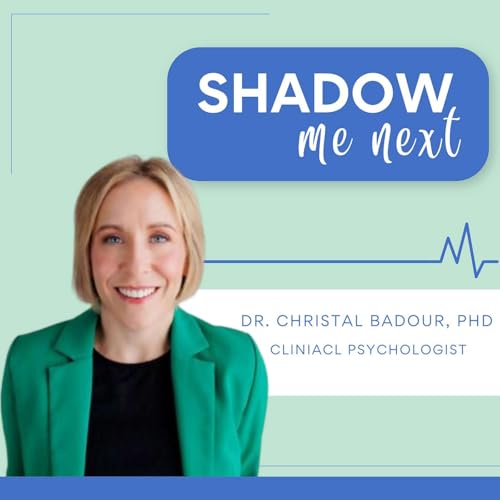
Shadow Me Next! Podcast By Ashley Love cover art

Shadow Me Next!

Shadow Me Next!

By: Ashley Love
Listen for free

Shadow Me Next! is a podcast where we take you behind the scenes of the medical world. I'm Ashley Love, a Physician Assistant, and I will be sharing my journey in medicine and exploring the lives of various healthcare professionals. Each episode, I'll interview doctors, NPs, PAs, nurses, and allied health workers, uncovering their unique stories, the joys and challenges they face, and what drives them in their careers. Whether you're a pre-med student or simply curious about the healthcare field, we invite you to join us as we take a conversational and personal look into the lives and minds of leaders in Medicine. Access you want, stories you need. You're always invited to Shadow Me Next!


Want to be a guest on Shadow Me Next!? Send Ashley Love a message on PodMatch, here: https://www.podmatch.com/hostdetailpreview/175073392605879105bc831fc© 2026 Shadow Me Next!
Biographies & Memoirs Hygiene & Healthy Living Physical Illness & Disease Social Sciences
Episodes
  • A Clear Map Of Careers In Psychology From Therapy To Policy | Dr. Christal Badour, PhD
    Apr 6 2026

    Most people hear “psych” and picture two options: talk therapy or life-altering medication. Whar so many of us miss is an entire world of careers. I sit down with licensed clinical psychologist Dr. Christal Badour to make the landscape of psychology finally feel clear, practical, and real, including what psychologists do, what psychiatrists do, and why that difference matters for patients.

    We get specific about scientific psychology and evidence based mental health care. Dr. Badour walks us through what psychology research can look like, from brain MRI studies and genetics to applied studies on risk factors, PTSD, panic disorder, and which treatment approaches help the most people. We talk about the less visible but high impact work too: implementation science, training clinicians to use proven tools, and translating findings into policy so insurance reimbursement supports the best care instead of blocking access. If research has ever felt intimidating, this conversation reframes it as a skill you can learn and a space where curiosity matters more than perfection.

    Then we shift into trauma psychology, trauma informed care, and what surprises her across survivors of different kinds of violence, including systemic trauma and war related experiences seen through telehealth. We explore the common emotional thread of self blame, guilt, and shame, and why the first response from a healthcare provider can shape recovery. Dr. Badour also explains forensic psychology, including assessments for personal injury, disability, sentencing mitigation, and immigration or asylum cases, plus what inspired her public education platform ScienceForSurvivors.com.

    Subscribe for more conversations on the human side of medicine, share this with someone choosing a career in mental health, and leave a review so more listeners can find the show.

    To connect with Dr. Christal Badour: Instagram | Website

    Support the show

    Please connect and say hello >>> Email me!

    Support shadow me next >>> Thank you!

    Want to be a guest? >>> Click here!

    Virtual shadowing is an important tool to use when planning your medical career. Whether as a doctor, a physician assistant, a therapist or nurse, here Shadow Me Next! we want to provide you with the resources you need to find your role in healthcare and understand your place in medicine.


    Show more Show less
    31 mins
  • What Do Patients Need When The Cancer Prognosis Changes? | Michele Neskey, PA-C
    Mar 30 2026

    You can study medicine for years and still feel unprepared for the moment you deliver news that changes someone’s life, then immediately have to walk into the next room and do it all again. That emotional handoff is one of the most invisible skills in healthcare, and it’s exactly what we unpack with Michelle Nesky, The Posh PA, who has spent more than 20 years as a physician assistant in oncology.

    We get practical about what oncology care really looks like: the difference between medical oncology, surgical oncology, and radiation oncology, and why treatment goals can range from cure to recurrence prevention to long-term control of metastatic disease. Michelle shares how she “resets” between patient encounters, why you have to process hard moments instead of stuffing them down, and how relationship-heavy cancer care changes the way you communicate. We also talk about the game-changing shift toward immunotherapy, biomarker testing, and personalized cancer treatment, plus a reality check on chemotherapy side effects and how far supportive care has come.

    Then we pivot to the other side of her work: helping future PAs get accepted. Applying to PA school through CASPA can be uniquely stressful because prerequisites and requirements vary across programs, and a small mistake can cost you an interview. Michelle breaks down what strong applicants do differently with essays, strategy, and interview prep, including the kind of “emotional reset” question that separates good candidates from unforgettable ones.

    If this helped you, subscribe, share it with a friend who needs it, and leave a review so more pre-PA students and healthcare learners can find Shadow Me Next.

    Youtube @theposhpa

    Instagram @michele.theposhpa

    TikTok @michele.theposhpa

    LinkedIn | Website

    Support the show

    Please connect and say hello >>> Email me!

    Support shadow me next >>> Thank you!

    Want to be a guest? >>> Click here!

    Virtual shadowing is an important tool to use when planning your medical career. Whether as a doctor, a physician assistant, a therapist or nurse, here Shadow Me Next! we want to provide you with the resources you need to find your role in healthcare and understand your place in medicine.


    Show more Show less
    26 mins
  • How A Critical Care PA Learns To Think And Speak Under Pressure | Jordan Kestler, PA-C
    Mar 23 2026

    Not knowing is not the problem. Hiding it is.

    Jordan Kessler works as a critical care PA in a neuro ICU, where the alarms are loud, the decisions are fast, and uncertainty is constant. We talk about the skill nobody grades you on in PA school or pre-med tracks: how to communicate clearly when you are not sure yet. That single habit shapes patient safety, team trust, and how quickly you grow from “new grad” to steady clinician.

    We also take a look at the real ICU ecosystem, including the clinicians people forget to mention, and how Jordan’s early career in trauma shifted into intensive care during COVID. From pressors and procedures to three-hour rounds, we break down what an ICU day actually looks like and why the best teams rely on repeatable frameworks like a strong one-liner and SBAR style communication. Jordan shares why mentorship can be excellent in critical care and still feel inconsistent day to day, plus how she is building practical tools through ICU Clinician’s Compass to close the gap between knowing the medicine and fitting into ICU culture with confidence.

    If you are a pre-health student, PA student, or new clinician considering critical care, we also talk through what post-graduate critical care fellowships typically include and who they can help most. Listen, share this with a friend who is stepping into a new clinical role, and then subscribe, leave a review, and tell us: what do you say when you do not know yet?

    Connect with the guest: LinkedIn | Website

    Support the show

    Please connect and say hello >>> Email me!

    Support shadow me next >>> Thank you!

    Want to be a guest? >>> Click here!

    Virtual shadowing is an important tool to use when planning your medical career. Whether as a doctor, a physician assistant, a therapist or nurse, here Shadow Me Next! we want to provide you with the resources you need to find your role in healthcare and understand your place in medicine.


    Show more Show less
    30 mins
No reviews yet