• Success Leaves Clues Ep. 287 - Redefining Leadership, Operations, and Culture with Michelle Brooks, Chief People Officer & Head of Operations at Security Compass
    Mar 26 2026

    What if the Chief People Officer is no longer just responsible for people… but for how the entire business operates?


    In this episode of Success Leaves Clues, Robin and Al welcome back Michelle Brooks, Chief People Officer & Head of Operations at Security Compass, to explore one of the most important shifts happening inside modern organizations.


    The role of HR is evolving fast. What was once seen as a support function is now becoming central to how businesses scale, operate, and perform.


    Michelle shares how the CPO role is expanding into operations and even technology, why organizations are moving from departments to workflows, and how leaders can rethink structure, decision-making, and culture in a rapidly changing environment.


    The conversation also dives into a surprising redefinition of burnout, why it’s no longer about working too much, but about working inefficiently, and how removing friction inside organizations can unlock both performance and engagement.


    If you are a CEO, founder, HR leader, or operator navigating growth, complexity, and change, this episode offers a clear lens on where leadership and organizational design are heading next.


    You’ll hear about:

    • Why the Chief People Officer role is expanding into operations and technology
    • How organizations are shifting from departments to workflow-based thinking
    • The concept of the CPO as an “organizational architect”
    • Why HR and operations are no longer separate functions
    • How COVID accelerated the strategic importance of people leadership
    • The real reason burnout is rising, and why it’s not about hours worked
    • How inefficient processes and bottlenecks create modern burnout
    • Why removing friction is the fastest path to productivity and performance
    • The balance between empowerment and structure inside organizations
    • How clarity of mission drives better decision-making across teams
    • Why decision-making should live closest to the information
    • How strong leadership creates ripple effects across entire organizations
    • Why the future of business is less about hierarchy and more about flow


    We talk about:

    • 00:00 Introduction to Michelle Brooks and her evolving leadership role
    • 02:00 Why the CPO role is expanding into operations and technology
    • 04:00 The shift toward organizational design and workflow thinking
    • 05:30 How COVID accelerated the evolution of HR leadership
    • 07:00 Breaking down silos and creating more efficient workflows
    • 08:30 Benefits and challenges of blending people and operations roles
    • 10:00 Reframing HR and operations as business enablers, not cost centers
    • 12:30 When companies should bring in HR and operational leadership
    • 14:00 How burnout has changed, from overwork to inefficiency
    • 16:00 The impact of processes, bottlenecks, and friction on teams
    • 19:30 Why clarity of mission is foundational to performance
    • 23:00 Connecting individual work to company-wide impact
    • 24:30 Why siloed organizations are becoming outdated
    • 25:30 The shift toward workflow-based operating systems
    • 27:00 Adapting organizational design to a rapidly changing environment
    • 30:00 The ripple effect of strong leadership across teams and organizations


    Connect with Michelle

    • LinkedIn: https://www.linkedin.com/in/michelle-brooks-1747b924
    • Website: https://www.securitycompass.com/

    Connect with Us

    • LinkedIn: Robin Bailey and Al McDonald
    • Website: Aria Benefits and Life & Legacy Advisory Group


    Show more Show less
    31 mins
  • Success Leaves Clues Ep. 286 - Inclusive Leadership Isn’t What You Think with Stewart Whittingham, Director of Culture and Belonging at Miller Thomson
    Mar 19 2026

    In this episode of Success Leaves Clues, Robin and Al sit down with Stewart Whittingham, Director of Culture and Belonging at Miller Thomson, to explore one of the most overlooked challenges in leadership today: the gap between the culture leaders believe they are creating and what employees actually experience.


    With nearly 30 years of experience in leadership, talent strategy, and inclusion, Stewart brings a thoughtful and practical perspective to the conversation, grounded in both strategy and lived experience.


    The discussion reveals a critical truth: many organizations are committed to inclusion, yet struggle to translate that commitment into consistent, everyday experiences for their people.


    Stewart explains how gaps in awareness, psychological safety, and leadership behavior can quietly undermine culture, even in organizations with strong values and clear intentions. He also highlights how belonging drives engagement, performance, and better decision-making across teams.


    If you are a CEO, HR leader, executive, or business owner responsible for culture and performance, this episode offers a clear and practical lens on what it takes to build environments where people and organizations can truly thrive.


    You’ll hear about:

    • Why inclusive leadership directly impacts business performance, not just people strategy
    • The real cost of exclusion, including missed ideas, turnover, and stalled innovation
    • How belonging drives engagement, retention, productivity, and results
    • The hidden gap between the culture leaders think they create and what employees actually experience
    • Why silence in organizations often signals fear, not agreement
    • How cognitive overload and complexity prevent leaders from making intentional decisions
    • The role of bias awareness and how it shapes everyday leadership decisions
    • Why psychological safety is the foundation of high-performing teams
    • The difference between inclusive intentions and inclusive conditions
    • How leaders can identify whose voices are missing and why it matters


    We talk about:

    • 00:00 Introduction to Stewart Whittingham and his leadership background
    • 02:00 How lived experiences shape leadership and inclusion
    • 04:00 Why inclusion improves decision-making and innovation
    • 06:00 The cost of exclusion in organizations
    • 08:00 Belonging as a driver of performance and retention
    • 10:00 Bias awareness and the “who comes to mind” exercise
    • 12:30 Identifying who is missing from the table
    • 14:00 Why inclusion is an awareness game, not a blame game
    • 16:00 The gap between leadership intention and employee experience
    • 18:00 Psychological safety and speaking up at work
    • 20:00 The danger of silence and misinterpreted feedback
    • 22:00 Inclusive intentions vs inclusive conditions
    • 24:00 Leadership barriers, clarity, mindset, and competing commitments
    • 26:00 Cognitive overload and why leaders struggle to pause
    • 27:30 The power of “Stop, Pause, Reflect” in leadership
    • 28:30 The legacy leaders create through culture and people


    Connect with Stewart

    • LinkedIn: https://www.linkedin.com/in/stewart-whittingham-43bb5612/
    • Website: https://www.stewartwhittingham.com/

    Connect with Us

    • LinkedIn: Robin Bailey and Al McDonald
    • Website: Aria Benefits and Life & Legacy Advisory Group


    Show more Show less
    29 mins
  • Success Leaves Clues Ep. 285 - Fixing Access, Awareness, and Benefits Plan Design with Vincent Ng, Director of Group Health Solutions at RBC Insurance
    Mar 12 2026
    In this episode of Success Leaves Clues, Robin and Al sit down with Vincent Ng, Director of Group Health Solutions at RBC Insurance, to explore one of the most misunderstood challenges in employee benefits today: why employees often don’t use the benefits available to them. With more than 25 years of experience across healthcare, pharmacy, and insurance, Vincent brings a rare perspective to the conversation. As a licensed pharmacist and health benefits leader, he sits at the intersection of clinical care, digital transformation, and employer-sponsored health strategy. The discussion reveals a surprising truth: many benefit plans look rich on paper, yet employees struggle to access them in practice. Vincent explains why awareness gaps, fragmented platforms, and overly complex plan designs often prevent employees from engaging with their benefits until a crisis occurs. The conversation explores how employers and advisors can rethink plan communication, simplify access, and organize benefits around real human problems instead of administrative categories. If you are a CEO, HR leader, benefits advisor, or business owner responsible for employee wellbeing, this episode offers a strategic look at how benefits plans are evolving and what organizations can do today to ensure employees actually use the support available to them. You’ll hear about: Why many employees don’t understand the benefits available to them The concept of “cognitive overload” in complex benefit plans Why rich benefit plans often remain underutilized How multiple platforms and logins create friction for employees Why benefits should be organized around problems, not providers How employers can increase awareness and engagement with benefit plans The growing normalization of mental health support in the workplace How digital mental health tools are expanding access to care Why chronic condition management will shape future benefit plans The role of navigation and care pathways in modern healthcare How new medications and treatments are changing health outcomes Why access to care remains the biggest challenge in the Canadian system We talk about: 00:00 Introduction and Vincent Ng’s background in healthcare and benefits 02:30 Why rich benefit plans are often underutilized 04:00 Cognitive overload and lack of awareness among employees 05:30 Decision paralysis created by complex benefit ecosystems 07:00 Why employees often engage with benefits only during crises 08:30 The importance of ongoing communication with employees 10:30 Reducing friction through better technology and integrated platforms 12:30 Designing benefits around employee problems and needs 14:00 Using industry data to better understand employee expectations 15:00 Mental health benefits and proactive wellbeing support 17:00 Integrating mental health into broader health management 19:00 The growing normalization of therapy and mental health care 21:00 The evolution of digital mental health tools and support 23:00 Future trends in group benefits and personalized care pathways 24:30 Chronic condition management and integrated care models 26:00 The strategic role of health and wellness spending accounts 28:00 The importance of medications in improving health outcomes 30:00 Balancing innovation and sustainability in drug coverage 31:30 Fixing healthcare access in Canada’s fragmented system 34:00 Vincent’s mission to make healthy choices easier for Canadians Connect with Vincent LinkedIn: https://www.linkedin.com/in/vincentng5/ Website: Connect with Us LinkedIn: Robin Bailey and Al McDonald Website: Aria Benefits and Life & Legacy Advisory Group
    Show more Show less
    30 mins
  • Success Leaves Clues Ep. 284 - Special Roundtable - Trust, Flexibility, and Performance: The Real Return to Work Conversation
    Feb 26 2026

    In this special roundtable episode of Success Leaves Clues, Robin and Al bring together three experienced leaders for a candid, practitioner-level conversation on one of the most emotionally charged leadership topics today: return to work vs remote work.


    Featuring: Amanda Small, Head of People & Culture; Cerys Goodall, Operations Leader; and Elizabeth Lynch, HR Consultant and Culture Advisor, this discussion moves beyond headlines and into real-world leadership tension.


    Is return to office about location? Or is it about trust, accountability, and clarity of outcomes? If you are a CEO, founder, HR leader, executive, or manager navigating return to office mandates, hybrid models, or remote work performance, this episode offers grounded insight from leaders living this reality every day.


    The panel explores:

    • Why “bums in seats” does not equal performance
    • The difference between visibility and accountability
    • How unclear outcomes create disengagement
    • Why intentional workplace design matters more than policy
    • Generational shifts in how trust is built
    • The role of flexibility in retention and employee wellbeing
    • Why leaders must be considerate without catering
    • How culture either lives in daily behavior or dies in policy


    You’ll hear about:

    • Is return to work a trust issue or a management capability issue?
    • Why accountability must be tied to outcomes, not visibility
    • The difference between listening to employees and catering to them
    • “Considerate without catering” as a leadership philosophy
    • Why the office should function as a teammate, not just a location
    • How poor policy design creates disengagement
    • Coffee badging and what it signals about culture
    • The loneliness epidemic and the hidden cost of remote work
    • Why clarity of outcomes drives performance more than presence
    • How intentional design improves culture and business results


    We talk about:

    • 00:00 Introduction to the Return to Work Roundtable
    • 01:00 Panelist introductions and leadership lenses
    • 04:30 Is return to work about trust or accountability?
    • 07:00 Visibility vs measurable outcomes
    • 10:00 Real estate pressure and office utilization
    • 14:00 How much flexibility should employees realistically have?
    • 17:00 Listening vs catering to employees
    • 21:00 “Considerate without catering” leadership
    • 26:00 When employees should choose to leave
    • 30:00 Operational rigor and remote performance success
    • 37:00 Why clarity of outcomes drives engagement
    • 44:00 Does autonomy improve performance?
    • 52:00 What actually drives performance? Visibility or outcomes?
    • 59:00 The office as a teammate
    • 1:07:00 Loneliness, culture, and human connection
    • 1:11:00 Designing work intentionally


    Connect with

    • LinkedIn: Amanda Small
    • LinkedIn: Cerys Goodall
    • LinkedIn: Elizabeth Lynch

    Connect with Us

    • LinkedIn: Robin Bailey and Al McDonald
    • Website: Aria Benefits and Life & Legacy Advisory Group


    Show more Show less
    1 hr and 6 mins
  • Success Leaves Clues: Ep283 - The Truth About “People First” Leadership with guest HR and People & Culture Leader Dunja Vujovic
    Feb 19 2026

    In this episode of Success Leaves Clues, Robin Bailey and Al McDonald sit down with senior HR and People & Culture leader Dunja Vujovic for a candid conversation about what “people first leadership” actually means, and why most organizations get it wrong.


    Dunja shares why simply declaring your company “people first” is not enough, and how values must show up in real decisions, especially when budgets tighten and pressure rises. She explains why her team shifted from saying “people first” to “do right by people,” and how that subtle change drives clearer accountability, stronger performance conversations, and healthier cultures.


    The conversation explores vulnerable leadership, why leaders do not need to have all the answers, and how raising your hand first to admit mistakes builds real trust. Dunja challenges traditional leadership models that reward ego and certainty, and instead advocates for hiring people smarter than you, investing in middle management, and normalizing hard conversations early.


    Robin and Al also unpack how leadership expectations have evolved, why assumption is the enemy of communication, and how culture either lives in daily behavior or dies on the office wall.


    This episode is a practical and grounded guide to culture transformation, accountability, and building a workplace where people thrive without lowering performance standards.


    You’ll hear about:

    • What “people first leadership” really means in practice
    • Why cutting benefits first is a cultural red flag
    • The difference between “people first” and “do right by people”
    • Why accountability and hard conversations are part of empowerment
    • Vulnerable leadership and admitting mistakes as a strength
    • Hiring people smarter than you and overcoming leadership ego
    • Why middle management is where strategy lives or dies
    • How values must be operationalized, not just displayed
    • Assumption as the biggest communication breakdown in leadership
    • Creating psychological safety without lowering standards


    We talk about:

    • 00:00 Introduction and welcome
    • 01:00 What “thought leadership” really means in practice
    • 03:00 Vulnerability versus traditional leadership models
    • 05:00 Testing whether a company is truly people first
    • 06:30 What happens when budgets tighten
    • 08:30 Why benefits matter to employee performance and focus
    • 11:00 Accountability inside people first cultures
    • 12:30 Why values often fail in organizations
    • 14:00 The values bootcamp and operationalizing culture
    • 17:00 Assumptions as the enemy of leadership clarity
    • 18:00 Generational shifts and communication challenges
    • 20:00 Redefining leadership expectations
    • 23:00 Admitting mistakes and building trust
    • 26:00 Hiring people smarter than you
    • 28:00 Why middle management is critical to culture
    • 30:00 Planting trees for future generations of leaders


    Connect with Dunja

    • LinkedIn: https://www.linkedin.com/in/dvujovic/
    • Website: https://dunjavujovic.com/


    Connect with Us

    • LinkedIn: Robin Bailey and Al McDonald
    • Website: Aria Benefits and Life & Legacy Advisory Group


    Show more Show less
    30 mins
  • Success Leaves Clues: Ep282 with executive leadership coach Christine Farrugia
    Feb 12 2026

    In this episode of Success Leaves Clues, hosts Robin and Al sit down with executive leadership coach and strategic advisor Christine Farrugia for a deeply grounded conversation about success, fulfillment, and decision-making in complex leadership roles.


    Christine shares why so many high performers feel empty despite doing “everything right” on paper, and how chasing inherited definitions of success quietly erodes energy, confidence, and clarity. The conversation explores the powerful concept of “the gap versus the gain,” why comparison steals momentum, and how leaders can reconnect with progress by recognizing daily wins instead of endlessly moving goalposts.


    Robin, Al, and Christine also unpack how leaders make decisions when data is incomplete, stakes feel high, and ambiguity is unavoidable. Christine offers practical insight into trusting intuition, distinguishing reversible versus irreversible decisions, and stepping out of fear-based paralysis.


    The episode weaves together leadership, values, customer-centricity, and personal growth, emphasizing that clarity comes from alignment, not achievement alone. Christine also shares how leaders can identify misalignment between personal values and organizational culture, and why many perceived conflicts are stories worth examining more closely.


    You’ll hear about:

    • Why high performers often feel unfulfilled despite outward success
    • The difference between chasing success and defining it for yourself
    • The “gap versus the gain” framework and how it changes motivation
    • How comparison quietly drains confidence and joy
    • Daily wins as a leadership discipline, not a productivity trick
    • Making decisions when data is incomplete and pressure is high
    • Reversible versus irreversible leadership decisions
    • Trusting intuition without abandoning logic
    • What customer-centricity really looks like beyond metrics
    • Values alignment, culture, and leadership integrity
    • Navigating perceived misalignment between personal and company values
    • Strategic influence as a leadership superpower


    We talk about:

    • 00:00 Introduction and welcome
    • 01:00 Christine’s leadership background and coaching work
    • 02:30 Why success often feels empty for high performers
    • 04:30 Defining success for yourself at different life stages
    • 06:30 The gap versus the gain and how comparison steals momentum
    • 09:00 Recognizing progress and celebrating daily wins
    • 11:30 Gratitude, habits, and leadership energy
    • 14:00 Decision-making in ambiguity and high-stakes environments
    • 17:00 Reversible versus irreversible leadership decisions
    • 20:00 Trusting intuition when data is incomplete
    • 23:00 Customer-centricity beyond dashboards and metrics
    • 26:00 Values, culture, and perceived misalignment at work
    • 29:00 Strategic influence and getting things done through others
    • 32:00 Leadership growth through self-awareness and inner work
    • 35:00 The signature question, planting trees for the future


    Connect with Christine

    • LinkedIn: https://www.linkedin.com/in/christinefarrugia/
    • Instagram: https://www.instagram.com/coachwithchristine/
    • Website: https://www.christinefarrugia.com/


    Connect with Us

    • LinkedIn: Robin Bailey and Al McDonald
    • Website: Aria Benefits and Life & Legacy Advisory Group

    Show more Show less
    35 mins
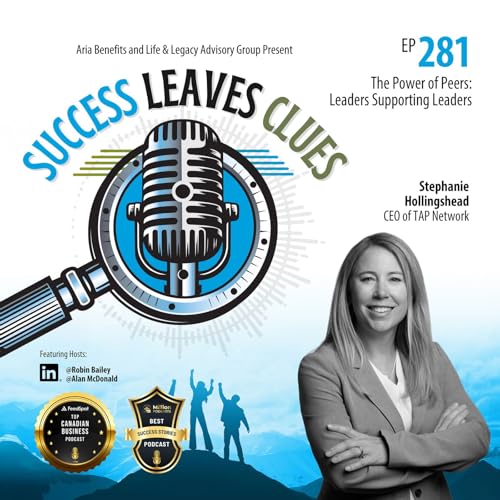
  • Success Leaves Clues: Ep281 with guest Stephanie Hollingshead, CEO of TAP Network
    Feb 5 2026
    In this episode of Success Leaves Clues, host Robin Bailey and Al McDonald sit down with Stephanie Hollingshead, CEO of TAP Network, for a candid conversation about leadership, burnout, and the power of collaboration in Canada’s tech sector. Stephanie shares how TAP Network has evolved from a small group of competing tech companies into a national community and infrastructure for people and culture leaders. What began as a conversation about competing for scarce talent has become a model for how collaboration, trust, and shared learning can strengthen an entire industry. The conversation dives into the often-unspoken reality of leadership roles, particularly for people and culture professionals who sit in the uncomfortable middle of organizations. Stephanie speaks openly about burnout, isolation, and the emotional weight of roles that require balancing advocacy, execution, and trust from all sides. Robin, Al, and Stephanie explore why collaboration works even among direct competitors, how trust is built over time, and why peer communities provide critical support when leaders are navigating layoffs, uncertainty, and rapid change. Stephanie also reflects on stepping into the CEO role, what surprised her about the broader leadership ecosystem, and why support and mentorship are far more available than many leaders realize. The episode closes with a reflection on long-term impact, leadership responsibility, and the importance of building systems and communities that future leaders can rely on when navigating pressure, change, and complexity. You’ll hear about: Why TAP Network is more than a professional network, it’s industry infrastructure Collaboration versus competition in the tech sector How trust is built among peers and direct competitors Burnout and isolation in people and culture leadership roles Sitting in the uncomfortable middle of organizations Why peer community matters during layoffs and organizational change What surprised Stephanie most after becoming a CEO Leadership support systems many people overlook Where Canadian tech does people and culture well Where equity, diversity, and inclusion still need bold change Why small efforts aren’t moving the needle Building leadership systems that outlast individuals We talk about: 00:00 Introduction and welcome 01:00 Stephanie’s background and leadership journey 03:00 What TAP Network is and why it exists 05:00 Collaboration as the foundation of the community 07:00 Choosing leaders and facilitators who energize the sector 09:00 Collaboration versus competition in tech 11:00 Building trust among peers and competitors 13:00 Burnout and the emotional weight of people and culture roles 15:00 Sitting in the uncomfortable middle of leadership 18:00 Community as protection against isolation and disengagement 20:00 Stepping into the CEO role and seeing the ecosystem differently 23:00 Mentorship, generosity, and leadership support 25:00 What tech companies get right about people and culture 27:00 Where equity, diversity, and inclusion still fall short 30:00 Why bold change is required to move the needle 33:00 Staying anchored through listening and connection 35:00 The signature question, planting trees for the future 37:00 How to connect with Stephanie and TAP Network Connect with Stephanie LinkedIn: https://www.linkedin.com/in/stephaniehollingshead Website: https://tapnetwork.ca/ Connect with Us LinkedIn: Robin Bailey and Al McDonald Website: Aria Benefits and Life & Legacy Advisory Group
    Show more Show less
    33 mins
  • Success Leaves Clues: Ep 280 - Power, Trust, and Leadership with Dean Benard, Founder and CEO of Benard & Associates
    Jan 29 2026
    In this episode of Success Leaves Clues, host Robin Bailey and co-host Al McDonald welcome back returning guest Dean Benard, Founder and CEO of Benard & Associates, for an in-depth conversation on workplace investigations, leadership accountability, and organizational culture. With more than 30 years of experience in regulatory and workplace investigations, mediation, and conflict resolution, Dean offers a rare inside look at how investigations really work, and why independence, fairness, and process matter more than speed or optics. He explains how power dynamics show up in investigations, from titles and tenure to fear of retaliation, and why investigations can act as a great equalizer when handled correctly. The conversation explores what trauma-informed investigations actually mean, why they should apply to every participant, and how dignity and psychological safety improve accuracy rather than dilute outcomes. Dean also shares where leaders unintentionally undermine investigations, how rushing the process creates long-term risk, and why one complaint is often a signal of deeper cultural issues beneath the surface. The episode closes with a powerful reflection on legacy, building systems that outlast us, and Dean’s vision for creating safer, fairer workplaces through education, innovation, and leadership responsibility. You’ll hear about: What workplace investigations really involve, beyond the stereotypes How power dynamics influence truth-seeking and trust Why investigator independence is non-negotiable Trauma-informed investigations and why they apply to everyone Common leadership mistakes that undermine investigations Speed versus quality and the hidden cost of rushing What makes a strong investigator, skill sets over credentials When one complaint reveals broader cultural problems Using investigations as an opportunity for organizational learning Building systems that create long-term workplace fairness We talk about: 00:00 Introduction and returning to the conversation 01:00 Dean’s background and the work of Benard & Associates 03:00 Power dynamics and the role of independence in investigations 06:00 Treating everyone with dignity and respect in the process 08:00 Trauma-informed investigations and psychological safety 11:00 How leaders unintentionally interfere or undermine trust 14:00 Speed versus quality and why rushing creates risk 17:00 The skill sets that make a great investigator 20:00 When investigations reveal deeper cultural issues 22:00 Management insights and learning beyond the complaint 25:00 What’s next for Benard & Associates and the Bernard Group 28:00 Working with a spouse and building a business together 30:00 The signature question, planting trees for the future 33:00 How to connect with Dean Connect with Dean Personal LinkedIn: https://www.linkedin.com/in/deanbenard/ Company LinkedIn: https://www.linkedin.com/company/benard-associates/ Facebook: https://www.facebook.com/BenardInc Instagram: https://www.instagram.com/benardinc/ YouTube: https://www.youtube.com/BenardAssociates Website: https://www.benardinc.com/ Connect with Us LinkedIn: Robin Bailey and Al McDonald Website: Aria Benefits and Life & Legacy Advisory Group
    Show more Show less
    30 mins