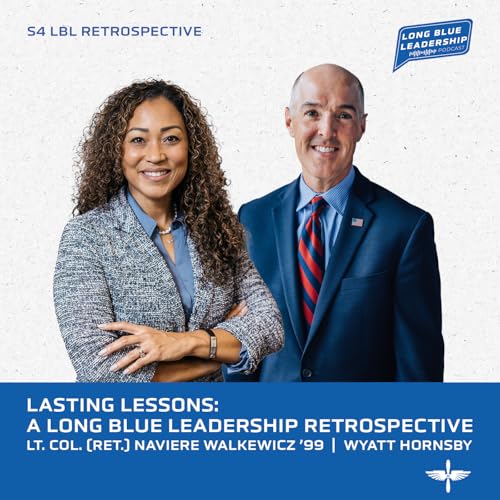
THE LONG BLUE LEADERSHIP PODCAST Podcast By U.S. Air Force Academy Association & Foundation cover art

THE LONG BLUE LEADERSHIP PODCAST

THE LONG BLUE LEADERSHIP PODCAST

By: U.S. Air Force Academy Association & Foundation
Listen for free

Leadership stories told by the leaders who live them.© 2025-2026 | U.S. Air Force Academy Association & Foundation | All Rights Reserved Personal Development Personal Success
Episodes
  • Lasting Lessons: A Long Blue Leadership Retrospective
    Feb 24 2026
    In our Season 4 retrospective, Lt. Col. (Ret.) Naviere Walkewicz ’99 and Wyatt Hornsby, the Association & Foundation’s senior vice president of marketing and communications, revisit the clips that stuck with them. - “Mind. Body. Spirit.” - “What can I do for others?” - “Be humble. Be credible. Be approachable.” These aren’t just soundbites. They’re leadership gold. This episode will remind you why these conversations matter. TOP 10 LEADERSHIP TAKEAWAYS FROM THIS EPISODE Lead from mind, body, and spirit Sustainable leadership requires caring for mental clarity, physical stamina, and spiritual/emotional grounding. Leadership is a daily practice, not a position Being a leader shows up in consistent habits and choices, not just in moments when you have the spotlight or a title. Mental health fuels clarity and creativity Protecting your mindset and mental health enables focus, problem-solving, and innovation. Physical readiness underpins reliability Long hours and high-demand environments require physical energy and stamina so you can show up for others when it counts. Spiritual/emotional health anchors your “why” Knowing your purpose and values helps you make grounded decisions and stay steady in pressure or uncertainty. Shift from “Why me?” to “What can I do for others?” Transform challenges by asking how you can serve your team and community, rather than focusing on personal hardship. Selfless leadership unlocks others’ potential When you lead by example and create opportunities for others to excel, people gain confidence and stretch toward their own “superhero” potential. Humility, credibility, and approachability are core leadership traits Effective leaders are humble about their limits, credible in what they say and do, and approachable enough that others feel safe coming to them. Trust and respect are earned, not assumed Especially with large teams and many colleagues, you must earn trust and respect through consistent behavior, not rely on rank or title. Leadership is ongoing presence and intention Leadership “doesn’t start with a title”; it’s about showing up with intention and care, being present when it matters, and putting others first over the long term. CHAPTERS 0:00:07 Introduction & Episode Setup 0:00:54 Intro – Leadership as Daily Practice (Tanji Johnson Bridgeman) 0:01:19 Mind, Body, Spirit in Leadership 0:02:06 Reflection on Intentional, Holistic Leadership 0:02:39Intro – Selfless Leadership & Inspiring Others (Dave Harden) 0:02:59 Transforming Challenges & Leading Selflessly 0:03:26 Reflection on Timeless, Presence-Based Leadership 0:04:03 Intro – Humble, Credible, Approachable (Rep. August Pfluger) 0:04:30 Core Leadership Tenets in Public Service 0:05:37 Reflection on Trust, Respect, and Credibility 0:06:13 Season Four Recap & Invitation to Explore Past Episodes 0:06:57 New Biweekly, Year-Round Schedule Announcement 0:07:45 Closing – Core Leadership Themes & Thank-Yous ALL PAST LBL EPISODES | ALL LBLPN PRODUCTIONS AVAILABLE ON ALL MAJOR PODCAST PLATFORMS FULL TRANSCRIPT Naviere Walkewicz 0:00 Welcome to Long Blue Leadership. I'm Naviere Walkewicz. Wyatt Hornsby: 0:10 And I'm Wyatt Hornsby, and today we're hitting pause for a moment and we're going to look back. Naviere Walkewicz 0:14 Yes, this episode is our Season 4 retrospective. We're revisiting some of the leadership moments that really stayed with us long after the microphones were turned off. Wyatt Hornsby 0:25 We went back through the season and selected three clips among many amazing ones, each from a guest who brought a different perspective on leadership, but all with a common thread: responsibility to people. Naviere Walkewicz 0:36 Absolutely. We're going to play each clip, Wyatt and I will react to it and talk about why those still matter. Wyatt Hornsby 0:43 And at the end of the show, we'll also look ahead. We've got upcoming guests to share and a couple of important changes and exciting changes to how Long Blue Leadership will be published going forward. Naviere Walkewicz 0:54 Absolutely. So let's get started. All right. Our first clip comes from Tanji Johnson Bridgeman, Class of ’97. Her episode stood out because of how she directly spoke about leadership being a daily practice. Now as you listen, pay close attention to how she talks about the health of your mind, body and spirit, and how those together form the foundation of great leaders. Tanji Johnson Bridgeman 1:19 Mind, body, spirit. Why is that important? Because in anything, any philosophies that we adopt, we have to really see where it's important. So when you think of what is an officer — what is a leader going to have to do with their mind? This is where they have to have clarity. It's going to help with focus, creativity, to innovate new solutions. And so we need to be able to prioritize our mindset and our mental health. And then there's ...
    Show more Show less
    9 mins
  • Lt. Col. Nichole Ayers ’11 - When Dreams Take Flight
    Mar 17 2026
    From combat missions in the F-22 Raptor to more than five months aboard the International Space Station, Lt. Col. Nichole “Vapor” Ayers ’11 has seen it all. SUMMARY In this episode of Long Blue Leadership, Col. Ayers reflects on mentorship, teamwork and building the next generation of warriors and astronauts. SHARE THIS EPISODE LINKEDIN | FACEBOOK TOP 10 TAKEAWAYS 1. Leadership is fluid: sometimes you lead, sometimes you follow. On Dragon and the ISS, command shifted between Anne McClain and Takuya Onishi. Everyone alternated between being commander and flight engineer, showing that strong teams normalize moving between leading and supporting roles. 2. Team care starts with self‑care. Vapor repeatedly links sleep, rest, hydration, and health to leadership performance. You can’t be present for others if you’re exhausted or burned out; taking care of yourself is a leadership duty, not a luxury. 3. People first, mission second (to enable mission success). Whether on deployment with 300 personnel or in space with 7, she focuses on taking care of the human—family issues, logistics, burnout, and emotions—trusting that performance and mission execution follow from that. 4. Trust is built long before the crisis. ISS emergency training with all seven crew, plus years of joint training in multiple countries, builds shared understanding and trust. When emergencies happen, the crew isn’t figuring each other out for the first time. 5. Quiet, thoughtful leadership can be incredibly powerful. Takuya Onishi’s style—observant, calm, speaks only when it matters, and brings thoughtful items for others—shows that you don’t need to be loud to command respect. When he spoke, everyone listened. 6. Leadership means being fully present, especially on others’ hard days. In both combat and space, you can’t “hide” when someone’s struggling. Being reachable, attentive, and emotionally available is a core leadership behavior, not a soft add‑on. 7. Normalize mistakes and share lessons learned. From F‑22 sorties to NASA operations, it’s expected that you openly admit errors and pass on lessons so others don’t repeat them. A culture where “experience is what you get right after you need it” only works if people share that experience. 8. Plan for “seasons” of intensity, not permanent balance. She frames life as seasons: some are sprints (deployments, intense training, big trips); others are for recovery. Wise leaders anticipate these cycles, push hard when needed, then deliberately create room to reset afterward. 9. Model the behavior you want your team to adopt. If the commander is always first in, last out, everyone else feels pressure to match that. By visibly protecting her own rest and home life, she gives permission for others to do the same and avoid burnout. 10. Lean on—and be—a support system. Her twin sister, long‑term friends, and professional peers form a lifelong support network she turns to when she fails, doubts herself, or hits something “insurmountable.” Great leaders both rely on and serve as those trusted people for others. CHAPTERS 0:00:00 – Introduction & Vapor’s Journey (Academy, F‑22, NASA) 0:00:38 – Launch Scrub, Second Attempt & What a Rocket Launch Feels Like 0:03:33 – First Moments in Space, Floating & Seeing Earth (Overview Effect) 0:06:11 – Leadership & Teamwork in Space: Roles, Trust, and Small-Crew Dynamics 0:10:19 – Multinational Crews & Leadership Lessons from Other Cultures 0:14:47 – No‑Notice F‑22 Deployment & Leading a Squadron in Combat 0:18:14 – Managing Burnout: Scheduling, Human Factors & “Crew‑10 Can Do Hard Things” 0:19:46 – Self‑Care as Team Care: Seasons of Life, Rest, and Being Present 0:26:02 – Family, Being an Aunt, and Balancing a Demanding Career 0:28:14 – Life After Space: Mentoring New Astronauts & Evolving as a Leader ABOUT NICHOLE BIO U.S. Air Force Lt. Col. Nichole "Vapor" Ayers is a trailblazing pilot, leader and astronaut whose journey began at the United States Air Force Academy, where she graduated in 2011 with a degree in mathematics. An accomplished F-22 Raptor pilot, Ayers is one of the few women ever to fly the world’s most advanced stealth fighter — and she’s one of even fewer to command them in formation for combat training missions. Col. Ayers earned her wings through years of training and operational excellence, logging over 200 flight hours in combat and playing a critical role in advancing tactical aviation. Her exceptional performance led to her selection in 2021 by NASA as a member of Astronaut Group 23, an elite class of 10 chosen from among 12,000 applicants. As a NASA astronaut candidate, Col. Ayers completed intensive training at Johnson Space Center, which included spacewalk preparation, robotics, survival training, systems operations and Russian language. Now qualified for spaceflight, she stands on the threshold of a new chapter ...
    Show more Show less
    37 mins
  • Courage to Lead: NCLS Marks 33 Years at USAFA
    Mar 3 2026

    What does courage look like under fire? In captivity? In command? In service?

    This edition of Long Blue Leadership was recorded on location at the U.S. Air Force Academy’s 33rd National Character and Leadership Symposium. We've explored these questions with our guests and captured the conversations for you.

    This special episode features voices shaped by combat, crises and lifelong service. Their message to cadets is clear: Leadership is earned through character, and character is forged in hard moments.

    - Seg. 1: Lt. Col. Mark George and C1C Jaime Snyder, officer and NCLS cadet director, respectively, set the stage for this year's NCLS and for the podcast.

    - Seg. 2: Senior Master Sgt. (Ret.) Israel "DT" Del Toro on courage in times of crisis. - Seg. 3: Task Force Hope developer and facilitator Maj. Tara Holmes on preparing future leaders to handle crisis before it happens. - Seg. 4: Former POW Maj. Gen. (Ret.) Edward Mechenbier ’64, on leading in circumstances out of your control. - Seg. 5: Annapolis grad and Vietnam-era aviator, Capt. (Ret.) J. Charles Plumb on how character breeds courage.

    All of our guest’s lives and careers reflect the reality of this year’s theme through combat, crisis and service.

    CONNECT WITH THE LONG BLUE LINE PODCAST NETWORK TEAM

    Ted Robertson | Producer and Editor: Ted.Robertson@USAFA.org

    Send your feedback or nominate a guest: socialmedia@usafa.org

    <--->

    Ryan Hall | Director: Ryan.Hall@USAFA.org

    Bryan Grossman | Copy Editor: Bryan.Grossman@USAFA.org

    Wyatt Hornsby | Executive Producer: Wyatt.Hornsby@USAFA.org

    ALL PAST LBL EPISODES | ALL LBLPN PRODUCTIONS

    AVAILABLE ON ALL MAJOR PODCAST PLATFORMS

    The Long Blue Line Podcast Network is presented by the U.S. Air Force Academy Association & Foundation

    Show more Show less
    1 hr and 2 mins
No reviews yet