• Gender is Not Between the Legs, It’s in the Heart and Mind
    Mar 24 2026

    n an interview to explain the deep and serious concerns India’s transgender community has with the recently introduced Transgender Persons Amendment Bill, Prof. Aqsa Shaikh, Professor of Community Medicine at Jamia Hamdard University, points out that the key error the government has made in the amendment bill is to assume that gender lies between the legs of an individual whereas, in fact, it lies in the hearts and minds of individuals. As Prof. Shaikh puts it: “Gender cannot be reduced to anatomy or verified through physical examination: it is a deeply felt sense of self.”

    Prof. Shaikh points out that the amendment bill, which was introduced in the Lok Sabha on the 13th of March, is “a fundamental shift that undermines the core of what it means to be a transgender person in law. Under this formulation, tens of thousands of individuals who currently identify, and are legally recognized, as transgender may find themselves excluded. Their identities would not merely be ignored; they would be erased.”

    Show more Show less
    29 mins
  • Iran’s New Supreme Leader Injured and Could Have Survived a Second Israeli Attempt to Kill Him
    Mar 24 2026

    In an interview to The Wire, Prof. Foad Izadi, Associate Professor of American Studies at Tehran University, who spoke from Tehran, says that Iran’s new supreme leader is injured and he cited reports to that effect from within Iran. Prof. Izadi also said it could be the case that BBC reports that the new supreme leader has survived a second attempt by Israel to kill him whilst he was in hospital could be correct. However, Prof. Izadi confirms that the new supreme leader is alive.

    Show more Show less
    23 mins
  • Mid-East War: Indian Foreign Policy Confused; We’re Not as Influential as We Used to Be: Former NSA
    Mar 19 2026

    In strong and outspoken criticism of Indian foreign policy, a former National Security Advisor, M. K. Narayanan, has said that Indian foreign policy is confused and argues that we are not as influential as we once were. India may be internally and economically a more powerful country than it has ever been but our capacity to influence events around the world and win respect for our views is not as great as it was 20-30 or 40 years ago.

    Mr. Narayanan said: “I think we are confused. I think India’s foreign policy has been confused for a very long time. I think this is one more instance of that kind. Somewhere down the line India still believes we are, or we have the ability, the capacity, to sort out the problems of other nations … I think this is part of the Indian belief that we are leaders of the global south, we are in a position to mediate, we have the authority or even the influence or the ability to sort out other people’s problems, etc. I think there is this misplaced understanding of where we stand in the world today … I certainly think that we are poorer in the eyes of the world today than we were when we were economically weaker … I think this is the quandary that we are in. We still stick to the idea that the world looks upon us as an important power broker. I think we need to get out of that comfortable area that we are in and realize that we are probably just one of the other countries in the world and no longer one that other countries look up to … if you really look at it you are not even a power to reckon with even in the region in which you are located. How then can you speak for the rest of the world? So we have problems ... That’s what I am trying to say: what India does does not seem to matter today to the same extent that it did when we were much weaker economically and militarily … At one stage India was the leader of the non-alignment movement. We are now talking of multipolarity, of this and that. Nobody is quite clear where India stands. Nobody is quite clear how India reacts to situations … I think that (once) people saw there was an intrinsic strength that India possessed and they were willing to listen. We still possess that intrinsic strength and probably have much more of it but you are not able to make people see how we stand and where we have the weight to pull … Internally perhaps today we are stronger than we have ever been, economically we are stronger than we have ever been. The question is we have not been able to transmit that to the world at large that we are now in a position to do things elsewhere.”

    Show more Show less
    40 mins
  • “Trump is Netanyahu’s poodle, he plays him like a fiddle”: Avi Shlaim
    Mar 19 2026

    Israeli professor of history and international relations Avi Shlaim says that Donald Trump is “Netanyahu’s poodle”, adding that Netanyahu “plays him like a fiddle”. Prof. Shlaim says that Donald Trump is the only American President who is gullible enough to become part of Netanyahu’s plan for regime change in Iran. However, Prof. Shlaim believes that regime change is almost impossible to achieve from the air and what is far more likely is that the regime will survive and if Mojtaba Khamenei remains the supreme leader he is likely to be more ruthless and a hardliner. Prof. Shlaim also believes that the regime only needs to survive to, in effect, win, whereas America if it doesn’t win has, in effect, lost.

    Show more Show less
    56 mins
  • "Delusional, Unhinged, Sociopath” Trump Underestimated Iran; He Could Even Consider Nukes
    Mar 18 2026

    Kanwal Sibal, a former Foreign Secretary and former Ambassador to Russia and France and now Chancellor of Jawaharlal Nehru University, and Manoj Joshi, a Senior Fellow at the Observer Research Foundation and a highly regarded Strategic Affairs Analyst, discuss whether Donald Trump and Benjamin Netanyahu have underestimated Iran’s resilience and its capacity to retaliate and fight on. In particular, they analyze President Trump and his behaviour, the things he has said as well as the things he claims have taken him by surprise. For instance, Trump has claimed he didn’t realize Iran would retaliate by hitting American bases in the Gulf nor did he realize Iran would seek to block the Strait of Hormuz. But Iran had made it clear that if attacked it would retaliate on American bases in the Gulf and had been saying so for weeks before the war began. This is also what the Gulf countries feared. Trump’s own former Advisor, Nate Swanson, had written in February that if attacked Iran would block the Strait of Hormuz. So how come Trump didn’t know this? What does it tell us about him? His planning? The advice he gets? And his understanding of the Middle East?

    Show more Show less
    39 mins
  • India on the Side of Aggressors in Mid-East War & It’s Damaged Our Credibility as a Partner
    Mar 17 2026

    The well-known historian, author and strategic affairs analyst Srinath Raghavan says “India is objectively on the side of the aggressors in this war”. He says what matters is not what India says but what it does and how its actions are perceived by others and, in this instance, India is perceived to be on the side of the aggressors. Speaking of the Prime Minister’s visit to Israel, 36 hours before the war began, Mr. Raghavan says: “The timing … was extraordinary … there was no substantive reason to go to Israel on the eve of the war … and it’s inconceivable that the Indian government was unaware of the impending attack.” This was the first clear sign that India was aligning itself with Israel and against Iran.

    Show more Show less
    30 mins
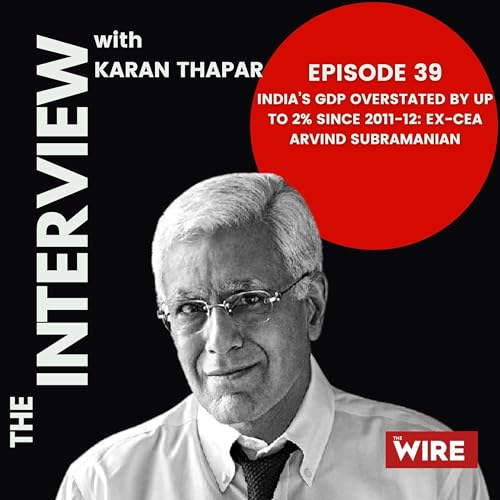
  • India’s GDP Overstated by Up to 2% Since 2011-12: Ex-CEA Arvind Subramanian
    Mar 16 2026

    Whilst as yet it’s too early to say how good or how inadequate is the new methodology for calculating GDP, which came into operation last month, India’s former Chief Economic Advisor, Arvind Subramanian, has pointed out that the old methodology, which came into operation in 2015, overstated GDP growth between 2011-12 and 2023-24 by 1.5-2 percentage points and between 2004-05 and 2011-12 it underestimated growth by 1-1.5 percentage points. He has identified two principal reasons for this. The first is errors and inadequacies in the way growth in the informal sector, which in this period was pretty close to 45% of the economy, was estimated. The second is the deflator. The old methodology used the wholesale price index which understated inflation and didn’t really capture prices in the services sector. So when economists would try to find answers to puzzles such as if growth is strong why is private investment so weak, why is FDI declining, why is capacity utilization, wage growth and employment growth so tepid, the real answer is that growth was not as strong as we thought. This also means that for most of the UPA years growth was underestimated whilst for the NDA years, starting 2014, it was overestimated.

    Show more Show less
    21 mins
  • Sky-high Aspirations After Elections In Nepal Need Best Talent In Country To Deliver: Ranjit Rae
    Mar 12 2026

    India’s former Ambassador to Nepal Ranjit Rae has called the performance of Balendra Shah and his Rashtriya Swatantra Party in Nepal’s recently held elections “an astounding victory”, the scale of which has taken everyone by surprise. He says Balendra Shah in his person bridged the traditional divide in Nepal between the hills and the plains. He presented himself in the Terai as the son of the soil, often speaking in Maithili, and, of course, was very familiar to the hills because he has served as a remarkably successful Mayor of Kathmandu. However, with his huge majority expectations are sky-high. The RSP has committed itself to creating 1.2 million jobs, doubling national income and starting a health insurance for all. Ambassador Rae says the RSP has “very competent leaders” which he called the best talent available in the country. They will need this to deliver on their commitments.

    Show more Show less
    34 mins