• Episode 1: "Amy"
    Mar 24 2026

    On March 24, 1998, 23-year-old Amy Lynn Bradley disappeared from a Royal Caribbean cruise ship in the Caribbean. For 28 years, her name has been inseparable from that disappearance — defined by theories, timelines, and unanswered questions.

    This episode changes that.

    "Amy" is not about what happened on the ship. It's not about a timeline or an investigation. It's about the person at the center of it all — told through the voices of the people who knew her best.

    Through interviews with Amy's parents Ron and Iva, her brother Brad, and close friends, this episode explores:

    • The family and neighborhood that shaped her childhood
    • The athletic drive that defined her adolescence — five varsity letters, a fierce competitor, and a natural leader on the court
    • The compassion and social confidence that drew people to her
    • The independence and identity she was building as a young adult
    • What 28 years of absence has meant to the people who loved her

    This is the episode the series needed to begin with. Because before the investigation, before the sightings, before the theories — there was a life in motion. A daughter who showed up. A sister who was present. A friend who made people feel seen.

    If we don't start here, everything that follows risks becoming abstract.

    The Midnight Mystery Archive Investigates: The Disappearance of Amy Lynn Bradley is a 12-part investigative series produced in cooperation with Amy's family and launched on March 24, 2026 — the 28th anniversary of her disappearance. New episodes release weekly.

    During the full run of this series, 100% of commissions earned through our Invisawear personal safety partnership will be donated to the Bradley family's GoFundMe, supporting their ongoing investigation to find Amy.

    Links: amybradleyismissing.com | Amy Alerts petition | Invisawear (10% off with our link) | Bradley family GoFundMe

    #AmyBradley #AmyLynnBradley #AmyBradleyIsMissing #MissingPersons #InvestigativePodcast #TrueCrimePodcast #MidnightMysteryArchive #DocumentarySeries #LongformAudio #PodcastSeries #ColdCase #MissingPersonsAwareness #CruiseShipSafety #UnsolvdCases #InvisaWear #PersonalSafety #PodcastLaunch #TrueCrimeDocumentary #CruiseShipDisappearance #RoyalCaribbean

    Show more Show less
    29 mins
  • Amy Bradley Trailer #2
    Mar 23 2026

    On March 24, 1998, 23-year-old Amy Lynn Bradley was last seen aboard a cruise ship in the Caribbean. Twenty-eight years later, her case remains one of the most widely discussed missing person cases of the modern era.

    This Tuesday, Midnight Mystery Archive launches a 12-part investigative series examining Amy's disappearance — beginning not with a mystery, but with a person. Episode 1, "Amy," focuses on who she was as a daughter, sister, and friend before she was ever reduced to a case file.

    This series was developed in cooperation with Amy's family and is grounded in documented records, family testimony, and expert analysis.

    During the full 12-episode run, 100% of commissions earned through our Invisawear partnership will be donated to the Bradley family's GoFundMe, supporting their ongoing investigation to find Amy. Get 10% off your first order through the link in the show notes.

    Episode 1 drops Tuesday, March 24. New episodes weekly.

    Links: amybradleyismissing.com | Amy Alerts petition | Invisawear | Bradley family GoFundMe

    #AmyBradley #AmyLynnBradley #MissingPersons #AmyBradleyIsMissing #InvestigativePodcast #TrueCrimePodcast #MidnightMysteryArchive #DocumentarySeries #LongformAudio #PodcastSeries #ColdCase #MissingPersonsAwareness #CruiseShipSafety #UnsolvdCases #InvisaWear #PersonalSafety #PodcastLaunch #NewPodcast

    Show more Show less
    2 mins
  • Episode 68-The Mayfield Siblings - 1985
    Mar 20 2026

    1985 was supposed to be the turning point. The National Center for Missing and Exploited Children had just been founded. Milk cartons were putting missing kids' faces on breakfast tables across America. For the first time, there was a real system.

    And on January 10, 1985, six-year-old Michael Mayfield and five-year-old Pamela Mayfield walked out of Betsy Ross Elementary School in northeast Houston and never came home.

    The children lived with their grandmother, Lily Mayfield. Their family was investigated thoroughly and cleared — the detective on the case said publicly these were loved, well-cared-for children. Witnesses saw them playing in a park after school, then getting into a green vehicle with an unidentified man. Willingly. No force. No struggle. They knew whoever was driving.

    Their faces went on milk cartons. They appeared on national news and the Adam Walsh broadcast. The FBI entered their case. Hundreds of tips came in from across the country. Every one led nowhere.

    Four months later, an unidentified man called Houston police. He said the children were fine — living with their grandmother near 75th Street in Los Angeles. When asked how he knew, he said: "I know." And hung up. The FBI checked. The family did have relatives in L.A. None of them had the children.

    This episode concludes a three-part arc across Season 2 — Kenneth Hager (1947), Alva Parris (1960), and the Mayfield siblings (1985) — tracing the evolution of missing-children response across decades. Three eras. Three cases. The same outcome.

    Michael would be 47 today. Pamela would be 46. If you have information, contact HPD at 713-884-3131 or NCMEC at 1-800-THE-LOST (case #603358).

    RESOURCES & LINKS: midnightmysteryarchive.com — to stream episodes, submit a case, or find us on social media. Midnight Mystery Archive Facebook Group — thoughtful case discussion. Follow on Substack for behind-the-scenes research.

    Supported by Invisawear — discreet wearable safety devices. invisawear.com/MidnightMysteryArchive. Thanks to Scrivener — the software I use to organize episodes and write my first novel, Echo 1953. Support the show through our Amazon affiliate link — same price for you, direct support for the Archive.

    A rating on Apple Podcasts or Spotify helps other listeners find us.

    #TrueCrime #TrueCrimePodcast #TrueCrimeCommunity #ColdCase #UnsolvedMysteries #MissingPerson #Mystery #Podcast #TrueCrimeAddict #TrueCrimeJunkie #Unsolved #CrimePodcast #HistoricalTrueCrime #ColdCaseFiles #UnsolvedDisappearances #MissingPersonCase #TrueCrimeHistory #EvidenceFirst #TrueCrimeResearch #MidnightMysteryArchive #MayfieldSiblings #MichaelMayfield #PamelaMayfield #HoustonColdCase #HoustonMissing #MissingChildrenHistory #MilkCartonKids #MissingChildren1985 #MMASeasonTwo #BeforeTheSystem #WhoWasDrivingTheGreenCar

    Show more Show less
    20 mins
  • Interview with Author Stuart Mullins
    Mar 18 2026

    On Australia Day 1966, three children — Jane, Arnna, and Grant Beaumont — were dropped off at Glenelg Beach in Adelaide, South Australia. Their mother expected them home by noon. They never arrived. No trace of the three children has ever been found. Nearly sixty years later, it remains one of Australia's most devastating unsolved cases.

    Earlier this season, Midnight Mystery Archive released a two-part deep dive on the Beaumont children. This special interview episode is the next piece of the puzzle.

    We sit down with Stuart Mullins, co-author of Unmasking the Killer of the Missing Beaumont Children, written alongside former South Australian police detective Bill Hayes. Stuart was born in Glenelg, the same community where the children vanished, and has spent years building an evidence-based case against suspect Harry Phipps, a man of wealth and influence whose mansion sat just 190 meters from where the children were last seen. The book presents over ten pieces of circumstantial evidence, explores a potential link to the 1973 Adelaide Oval abduction, and reveals conversations with Phipps's eldest son. The latest edition includes three new chapters covering the 2025 forensic dig at the Castalloy factory site where the authors believe the answer may lie buried.

    We discuss the case, the research, what it means to pursue a theory with rigor, and what happens when decades of evidence still isn't enough to close the book.

    FEATURED BOOK: Unmasking the Killer of the Missing Beaumont Children by Stuart Mullins and Bill Hayes.

    RESOURCES & LINKS: For full episodes, social media links, and to submit a case please visit us at midnightmysteryarchive.com. Join the Midnight Mystery Archive Facebook Group to discuss the evidence thoughtfully and responsibly. Follow the show on Substack for behind-the-scenes research and long-form analysis.

    This episode is supported by Invisawear — discreet, wearable safety devices that let you send an emergency alert with your real-time location at the press of a button. True crime exists because real people face real risk, and Invisawear is about getting ahead of it. Learn more at invisawear.com/MidnightMysteryArchive.

    Thanks also to Scrivener, the writing software I use to organize research, timelines, and long-form scripts for this show.

    You can also support the show by using our Amazon affiliate link. Anytime you're shopping on Amazon, clicking through that link first sends a small percentage back to the Archive. Same price for you, direct support for the show.

    And if you find value in evidence-first true crime, consider leaving a rating on Apple Podcasts or Spotify — it helps independent shows reach listeners who care about accuracy over speculation.

    #TrueCrime #TrueCrimePodcast #TrueCrimeCommunity #ColdCase #UnsolvedMysteries #MissingPerson #Mystery #Podcast #TrueCrimeAddict #TrueCrimeJunkie #Unsolved #CrimePodcast #HistoricalTrueCrime #ColdCaseFiles #UnsolvedDisappearances #MissingPersonCase #TrueCrimeHistory #EvidenceFirst #TrueCrimeResearch #HistoricalMystery #DisappearanceCase #ColdCasePodcast #TrueCrimeStorytelling #InvestigativePodcast #MidnightMysteryArchive #BeaumontChildren #BeaumontChildrenCase #JaneBeaumont #ArnnaBeaumont #GrantBeaumont #HarryPhipps #StuartMullins #UnmaskingTheKiller #AdelaideColdCase #GlenelgBeach #AustralianTrueCrime #Castalloy #MissingChildrenAustralia #MMAInterview #TrueCrimeBooks

    Show more Show less
    1 hr
  • When the System Arrived and Still Fell Short
    Mar 16 2026
    Three decades. Three cases. And the same question running through all of them like a fault line. In 1947, Kenneth Hager walked out of his Baltimore home and the world had no mechanism to find him. No alerts. No databases. No coordinated protocols. His case dissolved because there was nothing in place to hold it together. In 1960, Alva Parris vanished from a neighborhood in Essex, Maryland, and the emerging system — more organized police, newspaper coverage, neighborhood searches — still couldn't close the gap between disappearance and response fast enough to make a difference. By 1985, everything was supposed to be different. The National Center for Missing and Exploited Children had just been founded. The Missing Children Milk Carton Program was putting faces on breakfast tables across America. The Adam Walsh broadcast had turned missing children into a national cause. For the first time in history, there was a real system with national reach, federal databases, and a public that was paying attention. And on January 10, 1985, six-year-old Michael Mayfield and five-year-old Pamela Mayfield walked out of Betsy Ross Elementary School in northeast Houston, got into a green car with a man they appeared to know, and were never seen again. Their faces were on the milk cartons. They were on national television. The FBI had their case. Hundreds of tips came in from across the country. Four months later, an unidentified man called Houston police to say the children were safe and living with family in Los Angeles. The FBI checked. The family did have relatives in L.A. None of them had the children. Forty-one years later, Michael and Pamela Mayfield are still missing. This mini episode is the bridge between the Kenneth Hager episode and the upcoming full-length episode on the Mayfield siblings. It connects the threads that run through this entire season arc — not individual failures, but the structural distance between a child going missing and a world capable of responding. And it confronts the hardest version of that question: what happens when the system finally arrives and it still isn't enough? This is the third entry in a three-part arc across Season 2 of Midnight Mystery Archive examining missing children across different decades of American history: 1947 — Kenneth Hager: a boy disappears before the system exists at all. 1960 — Alva Parris: a girl vanishes as the system is barely beginning to form. 1985 — Michael and Pamela Mayfield: two siblings are taken at the exact moment the modern infrastructure is being born — and it still can't bring them home. WHAT TO EXPECT IN THE NEXT EPISODE: The full story of Michael and Pamela Mayfield — the family, the investigation, the mysterious phone call, and the paradox at the center of the case: two children who clearly knew their abductor, in a family where every member was investigated and cleared. Dropping Friday, March 20. AND COMING MARCH 24: The launch of a 12-episode series on the disappearance of Amy Bradley — the 28th anniversary of the day she vanished. Episode one is finished. It starts with Amy. Not theories. Not timelines. The person. Twelve episodes. One case. No shortcuts. RESOURCES & LINKS: Full episode timelines, source material, and research notes available at midnightmysteryarchive.com. Join the Midnight Mystery Archive Facebook Group to discuss the evidence thoughtfully and responsibly. Follow the show on Substack for behind-the-scenes research and long-form analysis. This mini episode is supported by Invisawear — discreet, wearable safety devices that let you send an emergency alert with your real-time location at the press of a button. True crime exists because real people face real risk, and Invisawear is about getting ahead of it. Learn more at invisawear.com/MidnightMysteryArchive. Thanks also to Scrivener, the writing software I use to organize research, timelines, and long-form scripts for this show. You can also support the show at no extra cost by using our Amazon affiliate link — it's in the show notes and on the website. Anytime you're shopping on Amazon, clicking through that link first sends a small percentage back to the Archive. Same price for you, direct support for the show. And if you find value in evidence-first true crime, consider leaving a rating on Apple Podcasts or Spotify — it helps independent shows reach listeners who care about accuracy over speculation. #TrueCrime #TrueCrimePodcast #TrueCrimeCommunity #ColdCase #UnsolvedMysteries #MissingPerson #Mystery #Podcast #TrueCrimeAddict #TrueCrimeJunkie #Unsolved #CrimePodcast #HistoricalTrueCrime #ColdCaseFiles #UnsolvedDisappearances #MissingPersonCase #TrueCrimeHistory #EvidenceFirst #TrueCrimeResearch #HistoricalMystery #DisappearanceCase #ColdCasePodcast #TrueCrimeStorytelling #InvestigativePodcast #MidnightMysteryArchive #KennethHager #MayfieldSiblings #MichaelMayfield #PamelaMayfield #HoustonColdCase #MissingChildrenHistory #MilkCartonKids #...
    Show more Show less
    9 mins
  • Episode 67-The Disappearance of Kenneth Hager, 1947
    Mar 13 2026
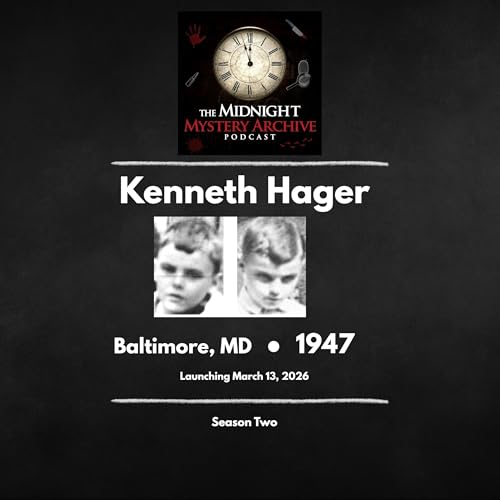
    There's a kind of case that haunts differently than the rest. Not because of what happened — but because of how little is left to tell you what happened at all. In April 1947, an eleven-year-old boy named Kenneth Hager left his home in Baltimore, Maryland. He was doing something routine — the kind of everyday errand that wouldn't make anyone look twice. He didn't come back. And what followed wasn't a dramatic manhunt or a high-profile investigation. It was something quieter and, in many ways, worse. A slow fade. A case that slipped through the cracks — not because nobody cared, but because the cracks were all there was. In this full-length episode of Midnight Mystery Archive, we reconstruct what can be known about Kenneth Hager's disappearance from the limited historical record that survives. We walk through the family's delayed alarm — not from negligence, but from the completely rational assumptions of the era. We examine the police response in a city where there were no regional alerts, no standardized missing-child procedures, no way to push information beyond the neighborhood unless a newspaper editor decided it was worth printing. We sit with the reality that witness memory — the only investigative tool available — was already degrading before anyone understood what had happened. And we confront the hardest part: the silence that followed. Kenneth's case didn't end with a discovery, a confession, or even a definitive theory. The search tapered off. The newspaper coverage thinned. The leads dried up. And an eleven-year-old boy's disappearance was absorbed into the background noise of a city already moving on to the next day's problems. This episode is about more than one missing child. It's about what happens when a kid vanishes at a moment in history when the infrastructure for responding simply doesn't exist. No DNA testing. No searchable databases. No cold case units to pick up the file decades later. No institutional memory designed to hold onto unsolved disappearances and revisit them. The case didn't go cold — it dissolved. The materials that might have given it a second life never made it through the years. This is the first episode in a three-part arc across Season 2, tracing the evolution of missing-children response across decades of American history: 1947 — Kenneth Hager: a boy disappears before the system exists at all. 1960 — Alva Parris: a girl vanishes as the system is barely beginning to form. 1985 — Michael and Pamela Mayfield: two siblings are taken at the exact moment the modern infrastructure is being born — milk cartons, national broadcasts, FBI databases — and it still isn't enough. Each case is a window into a different era of the same structural reality. And together, they tell a story that no single episode can hold. RESOURCES & LINKS: To stream episodes, submit a case, or follow us on social media, find all of them at midnightmysteryarchive.com. Join the Midnight Mystery Archive Facebook Group to discuss the evidence thoughtfully and responsibly. Follow the show on Substack for behind-the-scenes research and long-form analysis. This episode is supported by Invisawear — discreet, wearable safety devices that let you send an emergency alert with your real-time location at the press of a button. True crime exists because real people face real risk, and Invisawear is about getting ahead of it. Learn more at invisawear.com/MidnightMysteryArchive. Thanks also to Scrivener, the writing software I use to organize research, timelines, and long-form scripts for this show. My affiliate link is in the show notes. And if you find value in evidence-first true crime, consider leaving a rating on Apple Podcasts or Spotify — it helps independent shows reach listeners who care about accuracy over speculation. #TrueCrime #TrueCrimePodcast #TrueCrimeCommunity #ColdCase #UnsolvedMysteries #MissingPerson #Mystery #Podcast #TrueCrimeAddict #TrueCrimeJunkie #Unsolved #CrimePodcast #HistoricalTrueCrime #ColdCaseFiles #UnsolvedDisappearances #MissingPersonCase #TrueCrimeHistory #EvidenceFirst #TrueCrimeResearch #HistoricalMystery #DisappearanceCase #ColdCasePodcast #TrueCrimeStorytelling #InvestigativePodcast #MidnightMysteryArchive #KennethHager #Baltimore1947 #MissingChild1947 #BaltimoreColdCase #MissingChildrenHistory #PreAmberAlert #MidCenturyColdCase #MMASeasonTwo #BeforeTheSystem
    Show more Show less
    23 mins
  • Two Cases Hindered by Their Era
    Mar 9 2026
    Some patterns only become visible when you stop moving forward and look at what's already behind you. In the last episode, we told the story of Alva Parris — a nine-year-old girl who walked out her front door in Essex, Maryland, in 1960 and never arrived at her aunt's house. The search was real. The community responded. But by the time foul play was treated as certain, the golden hours had already closed. Evidence had degraded. Memories had softened. And the case drifted into a silence it has never come out of. In the next episode, we'll go further back — to 1947 Baltimore, where an eleven-year-old boy named Kenneth Hager left home on a routine errand and never returned. A city with no alert systems, no centralized records, no coordinated protocols for missing children. A case that didn't go cold so much as dissolve, because the world wasn't yet built to hold onto it. This mini episode is the bridge between those two stories. And the question at its center isn't what went wrong — it's what didn't exist yet. Both children disappeared in eras when kids moved freely through their neighborhoods, and no one thought twice about it. Both cases depended almost entirely on witness memory and physical searches that started too late and spread too thin. Both investigations reached the same dead end: not enough evidence, not enough infrastructure, not enough time. The systems we rely on today — Amber Alerts, rapid-response protocols, centralized databases, coordinated multi-agency searches — were built because of cases exactly like these. Because too many children vanished quietly. And too often, the only record left behind is a name and a date. This is the second entry in a three-part arc across Season 2 of Midnight Mystery Archive, tracing the evolution of missing-children response across decades of American history: 1960 — Alva Parris: a child vanishes as the system is barely beginning to form. 1947 — Kenneth Hager: a boy disappears before the system exists at all. 1985 — Michael and Pamela Mayfield: two siblings are taken at the exact moment the modern infrastructure is being born — and it still isn't enough. Together, these cases tell a story that no single episode can hold. Not a story about individual failure, but about what it costs when the distance between a child going missing and a world capable of responding is measured in decades. RESOURCES & LINKS: To stream episodes, submit a case, or find us on social media, visit midnightmysteryarchive.com. Join the Midnight Mystery Archive Facebook Group to discuss the evidence thoughtfully and responsibly. Follow the show on Substack for additional analysis and updates on the podcast and other projects in the works. This mini episode is supported by Invisawear — discreet, wearable safety devices that let you send an emergency alert with your real-time location at the press of a button. True crime exists because real people face real risk, and Invisawear is about getting ahead of it. Learn more at invisawear.com/MidnightMysteryArchive. Thanks also to Scrivener, the writing software I use to organize research, timelines, and long-form scripts for this show. And if you find value in careful, evidence-first storytelling, consider leaving a rating on Apple Podcasts or Spotify — it helps independent shows reach listeners who care about accuracy over speculation. #TrueCrime #TrueCrimePodcast #TrueCrimeCommunity #ColdCase #UnsolvedMysteries #MissingPerson #Mystery #Podcast #TrueCrimeAddict #TrueCrimeJunkie #Unsolved #CrimePodcast #HistoricalTrueCrime #ColdCaseFiles #UnsolvedDisappearances #MissingPersonCase #TrueCrimeHistory #EvidenceFirst #TrueCrimeResearch #HistoricalMystery #DisappearanceCase #ColdCasePodcast #TrueCrimeStorytelling #InvestigativePodcast #MidnightMysteryArchive #AlvaParris #KennethHager #MissingChildren #MissingChildrenHistory #BaltimoreColdCase #EssexMaryland #PreAmberAlert #MidCenturyColdCase #MMASeasonTwo #MMAMiniEpisode #BeforeTheSystem
    Show more Show less
    5 mins
  • Episode 66: The Disappearance of Alva Parris-1960
    Mar 6 2026
    Some cases announce themselves — with headlines, with suspects, with details that burn into public memory the moment they break. This isn't one of those cases. The disappearance of Alva Parris begins with the most ordinary thing in the world: a child walking to a relative's house on a summer day, in a neighborhood where everyone knew everyone, on a route she could have traced with her eyes closed. Essex, Maryland, 1960. Working-class and Tight knit. The kind of place where kids moved freely and nobody thought twice about it. She left. She was seen heading in the right direction. And then — nothing. No witness who could say what happened between the moment she was there and the moment she wasn't. In this episode of Midnight Mystery Archive, we trace every documented stage of the Alva Parris case — from the initial delay before alarm, through the expanding search that shifted from hopeful to desperate, to the discovery of personal items in a wooded area off her known route, and the investigation that slowly, quietly, went cold without producing a single viable suspect. We examine the structural reality of missing persons investigations in 1960 — an era without rapid-response protocols, without forensic technology, without any mechanism to push information beyond the immediate neighborhood at speed. An era where witness memory was the primary investigative tool, and where that memory was already degrading by the time anyone understood what had happened. And we sit with what's left when the record goes silent. Because Alva's case didn't end with a resolution. It didn't end at all. It faded — into the space between closed and This is the first episode in a three-part arc across Season 2 examining missing children across different decades of American history — each case revealing what the systems of the time could and couldn't do, and what was lost in the gap. 1960 — Alva Parris: a girl vanishes when the system is beginning to form but the gaps remain enormous. 1947 — Kenneth Hager: a boy disappears in Baltimore before the infrastructure for finding missing children exists at all. 1985 — Michael and Pamela Mayfield: two siblings disappear in Houston at the exact moment the modern missing-children movement is being born — milk cartons, national broadcasts, FBI databases — and it still isn't enough. Together, these three cases tell a larger story: not about individual failure, but about what happens when the distance between a child going missing and a system capable of responding is measured in decades. WHAT TO EXPECT NEXT: The full story of Kenneth Hager — an eleven-year-old boy who left his home in Baltimore in April 1947 and never came back. A case that didn't go cold so much as dissolve, because the world wasn't yet built to hold onto it. RESOURCES & LINKS: Full episode timelines, source material, and research notes available at midnightmysteryarchive.com. Join our Substack and receive podcast updates and teasers for upcoming projects and news about the Show! Join the Midnight Mystery Archive Facebook Group to discuss the evidence thoughtfully and responsibly. Follow the show on Substack for behind-the-scenes research and long-form analysis. Safety partner: Invisawear — invisawear.com/MidnightMysteryArchive Writing tool: Scrivener And if you find value in evidence-first true crime, consider leaving a rating on Apple Podcasts or Spotify — it helps independent shows reach listeners who care about accuracy over speculation. #TrueCrime #TrueCrimePodcast #TrueCrimeCommunity #ColdCase #UnsolvedMysteries #MissingPerson #Mystery #Podcast #TrueCrimeAddict #TrueCrimeJunkie #Unsolved #CrimePodcast #HistoricalTrueCrime #ColdCaseFiles #UnsolvedDisappearances #MissingPersonCase #TrueCrimeHistory #EvidenceFirst #TrueCrimeResearch #HistoricalMystery #DisappearanceCase #ColdCasePodcast #TrueCrimeStorytelling #InvestigativePodcast #MidnightMysteryArchive #AlvaParris #EssexMaryland #MissingChild1960 #BaltimoreColdCase #MissingChildrenHistory #PreAmberAlert #MidCenturyColdCase #MMASeasonTwo #AcrossTheYears
    Show more Show less
    17 mins