• AIxMultilateralism: "A Dangerous Master" Revisited - Wendell Wallach on AI, Ethics and Governance
    Mar 20 2026

    This is AI x Multilateralism, a playlist of at the UN Library & Archives Geneva where we’re joined by experts who help us unpack the many ideas and issues at the nexus of AI and international cooperation. In this episode, we're joined by Wendell Wallach, a bioethicist who's been working on the ethics and governance of emerging technologies for decades. He’s the author of two books – A Dangerous Master, and Moral Machines – and until 2024, co-led the Carnegie Council’s AI and Equality Initiative. He’s also senior advisor to The Hastings Center, and a scholar at Yale University’s Interdisciplinary Center for Bioethics, where for 11 years he chaired Technology and Ethics studies. For this episode, we’re sharing excerpts from a wide-ranging conversation where he shares his view on the ethics and governance of AI, the continued relevance of his books on robots and technologies many years after they were first published, what we can learn from bioethics, and the urgent need for oversight to align technology with human and environmental interests. Resources:

    • Read "A Framework for the International Governance of AI" - Carnegie Council's AI & Equality Initiative.
    • Read the new preface to "A Dangerous Master - How to Keep Technology from Slipping Beyond Our Control" by Wendell Wallach.
    • Visit Wendell Wallach's website.
    • Learn about the UN Global Dialogue on AI Governance and the Independent International Scientific Panel on AI.

    Production:

    Guest: Wendell Wallach Host, production and editing: Natalie Alexander Julien Editorial assistance: Amy Smith and Wouter Schallier

    Podcast Music credits:

    Music from #Uppbeat (free for Creators!): https://uppbeat.io/t/img/sequence License code: 18P7IHFDKCA4SHFM

    Recorded & produced at the Commons, United Nations Library & Archives Geneva #AI #Multilateralism #AIEthics #AIGovernance

    Show more Show less
    27 mins
  • Start Close In: Diplomacy, Technology, and the Ground Beneath Our Feet
    Mar 6 2026

    Start Close In: Diplomacy, Technology, and the Ground Beneath Our Feet In this episode of The Next Page, we talk with Anja Kaspersen — an IEEE director and former director of the United Nations Office for Disarmament Affairs in Geneva and Deputy Secretary General of the Conference on Disarmament — about having more confident discussions on technology, and how poetry, attention, and disciplined perception can guide diplomacy in an age of emerging technologies.

    Anja argues that the ground for engagement is not technical mastery but institutional literacy. She explains why diplomats should remain at the table, ask architectural questions, and translate between technical and policy worlds.

    The conversation covers science diplomacy, the changing nature of arms control and dual-use technologies, the importance of redundancy, resilience, and interoperability, and the need for anticipatory governance rather than reactive responses.

    Takeaways include strengthening discernment, preserving archives and institutional memory, resisting binary framings, and investing in human skills to govern technology responsibly.

    Resources: Ask a Librarian!

    David Whyte: https://davidwhyte.com/ Maria Popova: https://www.themarginalian.org/

    Where to listen to this episode

    • Apple podcasts: https://podcasts.apple.com/us/podcast/the-next-page/id1469021154
    • Spotify: https://open.spotify.com/show/10fp8ROoVdve0el88KyFLy
    • YouTube: https://youtu.be/w4L1S0nhCoo

    Content

    Guest: Anja Kaspersen

    Hosts: Amy Smith and Wouter Schallier Production and editing: Amy Smith

    Recorded & produced at the United Nations Library & Archives Geneva

    Show more Show less
    59 mins
  • The state of multilateralism: crisis or renaissance?
    Feb 20 2026

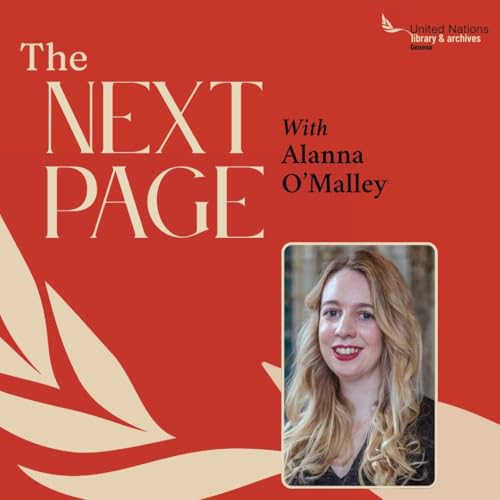
    Historian Alanna O'Malley explores how Global South actors have shaped the United Nations, arguing we should view today's challenges as an opportunity for a UN 'renaissance' rather than a collapse. She highlights invisible histories, multi-alignment strategies, regional and minilateral developments, and the need for Charter reform, greater legitimacy, accountability and public engagement to renew multilateralism.

    Professor O'Malley reflects from a historical point of view on the upcoming process of selection and appointment of the next Secretary-General highlighting the importance that broad global perspective and public traction need to play and urges recognizing the UN as a flexible, multipurpose institution that must be retooled and better resourced to protect sovereignty, human rights and equal representation.

    Resources: Ask a Librarian!

    https://www.eur.nl/en/people/alanna-sylver-omalley

    Where to listen to this episode

    • Apple podcasts: https://podcasts.apple.com/us/podcast/the-next-page/id1469021154
    • Spotify: https://open.spotify.com/show/10fp8ROoVdve0el88KyFLy
    • YouTube: https://youtu.be/

    Content

    Guest: Professor Dr. Alanna O'Malley

    Host, production and editing: Amy Smith, UN Library & Archives Geneva

    Recorded & produced at the United Nations Library & Archives Geneva

    Show more Show less
    34 mins
  • AIxMultilateralism: Can AI Predict A Crisis? with Dr. Martin Waehlisch
    Feb 13 2026

    This is AI x Multilateralism, a playlist of conversations at the Commons, our space at the UN Library & Archives Geneva for sharing knowledge on multilateralism. In this series, we’re joined by experts who help us unpack the many ideas and issues at the nexus of AI and international cooperation.

    In this episode we ask: can AI help us better predict, respond to, and recover from crises? We’re joined by Dr. Martin Waehlisch, Associate Professor of Transformative Technologies, Innovation and Global Affairs at the University of Birmingham. He’s also part of the Research Team of the Crisis Computing Project, a global community of scholars and practitioners who are driven to put computation to better use. He shares:

    • what drives his teaching today on transformative technologies, and why he prefers the term “computational global affairs” to “international affairs” in today’s world
    • what exactly crisis computing means, and the kinds of crises he hopes that AI can help us to address, from complex climate prediction to public participation in decision-making
    • the potential of crisis computing at the local, regional and multilateral level, and his thoughts on how crisis computing can be addressed as part of the UN’s Global Dialogue on AI and the Independent International Scientific Panel on AI, both established by the UN General Assembly in 2025, and
    • what is still missing in the global debate when it comes to how we use AI individually and collectively.

    Resources mentioned:

    • The Crisis Computing Project: https://crisiscomputing.org/
    • The Peace and Security Data Hub : https://psdata.un.org/
    • The Complex Risk Analytics Fund (CRAF’d): https://crafd.io/ and the Humanitarian Data Exchange: https://data.humdata.org/

    Production:

    Guest: Dr. Martin Waehlisch Host, production and editing: Natalie Alexander Julien

    Podcast Music credits: Sequence: https://uppbeat.io/track/img/sequence Music from Uppbeat (free for Creators!): https://uppbeat.io/t/img/sequence License code: 6ZFT9GJWASPTQZL0 Recorded & produced at the Commons, United Nations Library & Archives Geneva #AI #Multilateralism #CrisisComputing #CrisisResponse

    Show more Show less
    29 mins
  • Open Science: How Sharing Knowledge Can Save the Planet
    Jan 31 2026

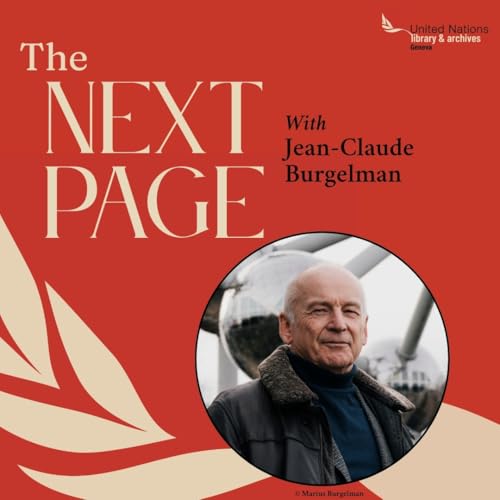
    In this episode we speak with Jean-Claude Burgelman about what open science means, why it accelerates innovation, and why we need it now.

    Jean-Claude Burgelman discusses practical benefits for businesses and NGOs, barriers like paywalled publishing and academic incentives, and the urgent need to make publicly funded data usable.

    Jean-Claude argues for multilateral infrastructure—a global open science cloud—and a new social contract for science, drawing on insights from this year's Frontiers Science House at Davos.

    The episode closes with a call to rethink institutions and governance so open science can drive faster, fairer solutions to global challenges.

    Resources: Ask a Librarian!

    Frontiers Planet Prize: https://www.frontiersplanetprize.org/

    Where to listen to this episode

    • Apple podcasts: https://podcasts.apple.com/us/podcast/the-next-page/id1469021154
    • Spotify: https://open.spotify.com/show/10fp8ROoVdve0el88KyFLy
    • YouTube: https://youtu.be/QBWMVpmW3pI

    Content

    Guest: Jean-Claude Burgelman

    Hosts: Amy Smith and Wouter Schallier

    Production and editing: UN Library & Archives Geneva

    Recorded & produced at the United Nations Library & Archives Geneva

    Show more Show less
    40 mins
  • AIxMultilateralism: Public AI - The New Multilateralism? with Jacob Taylor & Joshua Tan
    Jan 26 2026

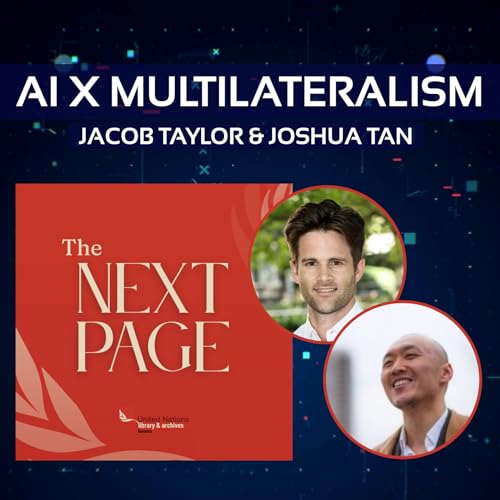
    This is AI x Multilateralism, a mini-series on The Next Page, where experts help us unpack the many ideas at the nexus of AI and international cooperation. Today, the majority of AI development and deployment is controlled by a small number of powerful firms. If this path continues, the next generation of digital infrastructure underpinning our societies will be privately owned and unaccountable to the public interest. Is there another way, one where where AI serves the common good? In this episode, Jacob Taylor (Fellow at the Brookings Institution’s Center for Sustainable Development and a 2025 Public AI Fellow) and Joshua Tan (Co-Founder and Research Director at Metagov) make the case for Public AI: shared, open AI infrastructure (much like highways, electricity grids, and public broadcasting), that is publicly responsible and harnessed to solve collective problems. Drawing on their article Public AI is the New Multilateralism and Metagov's Public AI White Paper, they argue that building public AI infrastructure can become a new form of multilateralism, where states, academia and civil society co‑create accessible, accountable AI systems that can be shared and re-purposed to meet a range of local, regional and global needs. They share real‑world examples of Public AI already emerging, explain why middle powers have the strongest incentives to lead Public AI, and outline an “Airbus for AI” model to close capability gaps, reduce the world's dependency on a few private platforms, and solve cross‑border problems.

    Resources mentioned:

    • The Public AI Inference Utility - publicai.co
    • Public AI - https://publicai.network/

    Production:

    Guests: Jacob Taylor and Joshua Tan Host, production and editing: Natalie Alexander Julien Recorded & produced at the Commons, United Nations Library & Archives Geneva

    Podcast Music credits: Sequence: https://uppbeat.io/track/img/sequence Music from Uppbeat (free for Creators!): https://uppbeat.io/t/img/sequence License code: 6ZFT9GJWASPTQZL0 #AI #Multilateralism #PublicAI #AIInfrastructure

    Show more Show less
    36 mins
  • U Thant: Peacemaker
    Dec 19 2025

    Our final episode of the year invites listeners into the life and legacy of U Thant, the longest‑serving Secretary‑General of the United Nations and a quiet architect of peace during some of the most dangerous moments of the Cold War.

    Drawing on the perspective of historian Thant Myint‑U, his grandson, the conversation revisits U Thant’s role in crises such as the Cuban Missile Crisis and the Congo, showing how his calm, principled diplomacy helped steer the world away from catastrophe.

    Grounded in Buddhist ethics and a deep belief in multilateral cooperation, U Thant’s leadership connected decolonization, social justice, and environmental concern long before these agendas were widely recognized on the global stage. Through archival stories and family memories, the episode explores how his example can inform efforts today to organize peace and renew trust in international institutions, as we reimagine the UN’s potential in a fractured world.

    Resources: Ask a Librarian!

    Myint-U, T. (2025). Peacemaker: U Thant and the Forgotten Quest for a Just World. W. W. Norton & Company.

    https://www.thantmyintu.com/peacemaker

    Where to listen to this episode

    • Apple podcasts: https://podcasts.apple.com/us/podcast/the-next-page/id1469021154
    • Spotify: https://open.spotify.com/show/10fp8ROoVdve0el88KyFLy
    • YouTube: https://youtu.be/UJRXUC80BSc

    Content

    Guest: Dr. Thant Myint-U

    Host, production and editing: Amy Smith, UN Library & Archives Geneva

    Recorded & produced at the United Nations Library & Archives Geneva

    Show more Show less
    35 mins
  • League of Minds: How Interwar Intellectual Cooperation Shaped Cultural and Political Relations
    Dec 12 2025

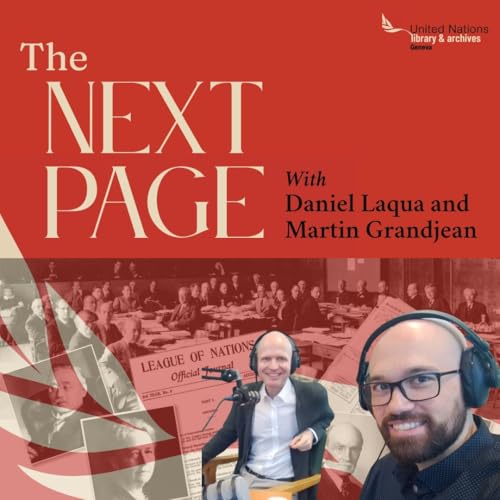
    On the launch of the latest publication in the UN Historical Series, published by the UN Library & Archives Geneva, this episode of The Next Page explores the history of intellectual cooperation around the League of Nations, tracing the creation of the International Committee in Geneva and the Paris-based International Institute for Intellectual Cooperation.

    Guest speakers Dr. Martin Grandjean, University of Lausanne, and Professor Daniel Laqua, University of Northumbria, discuss the Institute’s ambitions, institutional rivalries with Geneva, questions on elitism, inclusivity and the nature of the project, and examples of initiatives—from textbook debates and student exchanges to heritage and scientific cooperation—that helped shape cultural diplomacy and paved the way for later multilateral efforts like UNESCO.

    Resources. Ask an Archivist! Ask a Librarian!

    Grandjean, M. and Laqua D. (eds). Intellectual Cooperation at the League of Nations: Shaping Cultural and Political Relations. UN Historical Series.

    Where to listen to this episode

    • Apple podcasts: https://podcasts.apple.com/us/podcast/the-next-page/id1469021154
    • Spotify: https://open.spotify.com/show/10fp8ROoVdve0el88KyFLy
    • YouTube: https://youtu.be/554QVVqJaew

    Content

    Guests: Dr. Martin Grandjean (University of Lausanne) and Professor Daniel Laqua (University of Northumbria)

    Host, production and editing: Amy Smith, UN Library & Archives Geneva

    Recorded & produced at the United Nations Library & Archives Geneva

    Show more Show less
    46 mins