• 136: Pyrrho - Ancient Skepticism
    Mar 24 2026

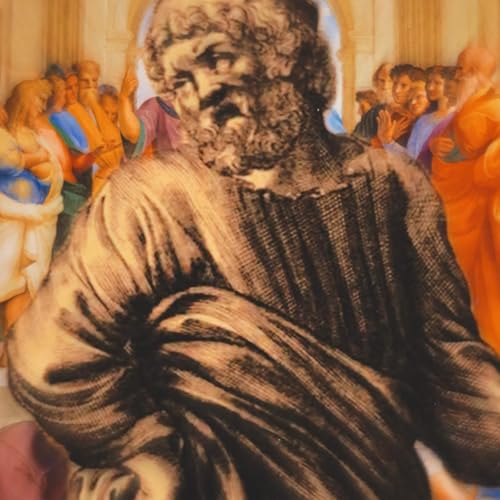
    There is nothing new under the sun: it was here, already, long ago. It was here before our time. This much must be said of the ancient skeptics, who put forward perspectival, relativistic, and moral anti-realist arguments during the Hellenistic age. The central figure is Pyrrho of Elis, who is only known through secondary sources, and whose life is surrounded by a number of fascinating anecdotes which speak to an of image life guided by indifference and the pursuit of ataraxia. In this episode, we'll discuss that concepts, as well as ephektos, adiaphoria, and the possibility of viewing skepticism as a power or a practice rather than a doctrine or ideology. We will also discuss the ten skeptical tropes of Pyrrho and the five tropes of Agrippa. Primarily, we will follow the chapter on Pyrrho found in Diogenes Laertius, but I've also included some insights from A.W. Benn's "The Greek Philosophers" and Mary Mills Patrick's book on Sextus Empiricus, as well Sextus Empiricus himself (particularly the chapter on Gorgias).

    Show more Show less
    1 hr and 32 mins
  • Untimely Reflections #42: Devin Goure - Star Trek & Philosophy
    Mar 17 2026

    Devin (Left Nietzschean) joined me to discuss the underlying philosophical themes of Star Trek, including a potential affinity with Nietzsche as regards the need for self-overcoming as opposed to utopia; the idea of moral "perfectionism", interpreted through "Schopenhauer as Educator"; interpreting the political positions and critiques of the show in their cultural context, as regards the significance of the Federation, Borg, and Dominion; the distinctive traits of each captain in classic Trek, including an interpretation of Kirk as an Odysseus figure; the depressing inability of "New Trek" to articulate a positive vision of the future, instead choosing to wallow in dystopia.


    Show more Show less
    1 hr and 35 mins
  • 135: Hume v/s Nietzsche - On Causality, Free Will & Habit
    Mar 10 2026

    In this episode, we'll compare Nietzsche's view of causality, habit, and free will to Hume. Although, in substance, they make very similar arguments, we'll explore important differences. Nietzsche arrives at his critique of causality through his attack on free will, and the subsequent understanding of metaphysical beliefs as necessitated by moral beliefs - whereas for Hume, the issue of liberty versus necessity is secondary to the critique of reason's ability to derive necessary connexions. For Hume, habit cannot be further explained, because this would be to ignore our practical affirmation of habit and the insufficiency of reason; Nietzsche wishes to investigate the genealogy of habit as part of his critique of morals. Perhaps most importantly, Hume places his philosophy in "subserviency" to the easy and obvious philosophy of commonsense, whereas Nietzsche sets his philosophy against common sense - and everything "common".


    Show more Show less
    1 hr and 43 mins
  • 134: David Hume - Enquiry Concerning Human Understanding
    Mar 3 2026

    Today we're going to become Humean, All Too Humean. This is an introduction to David Hume's life and works, brief consideration of his influences, and deep dive into Enquiry Concerning Human Understanding - the work that woke Kant from his dogmatic slumber. In our analysis we discuss: Hume's 'two species of philosophy'; Hume's distinction between ideas & impressions, and between relations of ideas & matters of fact; his critique of causality; his explanation of habit, or custom as a 'guide to human life'; a brief look at his comments on probability, on free will, on miracles; and Hume's moderate skepticism versus what he calls, Pyrrhonism.


    Show more Show less
    1 hr and 54 mins
  • Untimely Reflections #41: Gnostic Informant - The History of Demons
    Feb 24 2026

    Gnostic Informant on Youtube: https://www.youtube.com/@UCtdweFMJ5DGj7_q5IcpQhPQ

    Neal and I do a deep dive into the origins of the term "demon"/"demonic". What was the original meaning of the term "daimones" in Ancient Greece? How does the understanding of the term change, from the Hellenic to the Hellenistic to the Christian eras? We also discuss the imagery associated with the demonic, deriving from Pan, and discuss the anecdote from the ancient world, from which we get the phrase, "the Great God Pan is dead!"

    Show more Show less
    1 hr and 47 mins
  • Untimely Reflections #40: Hans Georg Moeller - Zhuangzi & Nietzsche
    Feb 17 2026

    A conversation with Prof. Moeller (Carefree Wandering). We discuss the political implications of Daoist philosophy, the Daoist critique of Confucian family roles and anthropocentrism, the comparison to Nietzsche's critique of modernist theories of truth, the differences between the two regarding their respective past and future orientations in philosophy, the difference in "vibe", and the parallel between the two as focused on achieving "great health".

    Butcher Ding Story: https://www.youtube.com/watch?v=vGtgGz5SsY0

    Happy Fish Story: https://www.youtube.com/watch?v=9nMCrj3soDU

    Prof. Moeller's new book: https://cup.columbia.edu/book/the-enigma-of-gender/9780231221276/

    Show more Show less
    1 hr and 23 mins
  • 133: Baruch Spinoza - The Intellectual Love of God
    Feb 10 2026

    There was much ado about Spinoza, at least amongst the German rationalists and romantics. In this episode, we're going beyond the metaphysics to talk about the entire purpose of Spinoza's Ethics: the path to human freedom, in which a human being can become liberated from domination of the affects. The way to achieve this, according to Spinoza, is purely through understanding. No willpower or effort is needed: with knowledge alone, one can understand the necessity of all things, and connect the idea of God to all things. This is the intellectual love of God, through which God infinitely loves himself. In this episode, we will also examine the topics of: Spinoza's three types of knowledge; the meaning of "sub species aeternitatis"; Spinoza's difference from Descartes & the Stoics.


    Show more Show less
    1 hr and 34 mins
  • 132: Daemonic, part 3 - Stefan Zweig & Nietzsche's Struggle with the Daemon
    Feb 3 2026

    In the conclusion to the daemonic series, we're looking at Stefan Zweig's Struggle with the Daemon - specifically, the section on Nietzsche. Particularly helpful for our analysis will be Zweig's comparison and contrast of Nietzsche with Goethe: both men contain the daemoniacal drive, but whereas Goethe holds it at a distance, Nietzsche gives himself over to it. By following Zweig's interpretation of Nietzsche's life and work, we can move from the abstract conception of it to a particular manifestation, and get a sense of the daemonic as it appears in an individual.


    Show more Show less
    1 hr and 28 mins