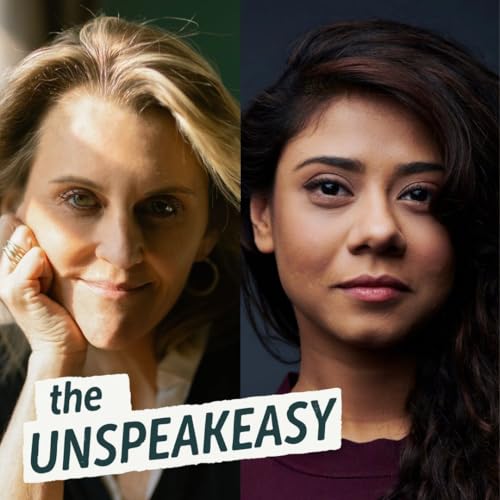
• Lionel Shriver's Most Problematic Novel Yet
    Mar 23 2026

    Bestselling novelist and commentator Lionel Shriver returns to the podcast to dicuss what might be her most controversial book yet. A Better Life takes on immigration through the story of a progressive Brooklyn woman who opens her home to a migrant. In this interview, she and Meghan discuss the book's themes and central characters, including the deliciously complicated Nico, a basement-dwelling fan of manospheric podcasts, and the role of the family's sprawling, Queen Anne-style house, which is almost a character in itself.

    They also talk about demography, population decline, and the cultural shift from seeing children as the default to seeing them as an elective. Lionel was a contributor to Meghan's 2015 book Selfish, Shallow and Self-Absorbed: Sixteen Writers On the Decision Not To Have Kids, and they revisit their respective choices in that regard, what people really mean when they talk about happiness and fulfillment, and why sacrifice may be more central to a meaningful life than our culture likes to admit.

    Guest Bio:

    A prolific journalist with a fortnightly column in Britain's The Spectator, Lionel Shriver has written widely for the New York Times, the London Times, the Financial Times, Harper's Magazine, and many other publications. She has written 16 novels, including Mania, Should We Stay or Should We Go, The Mandibles, and We Need to Talk About Kevin, and her work has been translated into 35 languages. Her latest novel is A Better Life.

    Show more Show less
    1 hr and 9 mins
  • Better Living Through Dying, with Annabelle Gurwitch
    Mar 16 2026

    This week Meghan is joined by actor, humorist, and six-time author Annabelle Gurwitch, who returns to the podcast to discuss her new memoir, The End of My Life Is Killing Me: The Unexpected Joys of a Cancer Slacker.

    Annabelle was diagnosed with stage IV lung cancer during COVID, entirely out of the blue, after what she assumed was a meaningless cough. Five years later, she remains an outlier on a targeted therapy that has kept her stable. In this conversation, Annabelle talks about how she has resisted the sentimental clichés surrounding illness, why she rejects the idea that cancer is a "battle," and how humor, contrarianism, and facing "the shipwreck of the soul" have shaped the way she lives now.

    Guest Bio:

    Annabelle Gurwitch is an actress, activist, and New York Times bestselling author of six books and two-time finalist for the Thurber Prize.

    Her essays have appeared in The New Yorker, New York Times, Washington Post, The Wall Street Journal, Boston Globe, and Hadassah Magazine, among other publications. Her six books include the New York Times bestseller and Thurber Prize finalist I See You Made an Effort.

    Annabelle co-hosted the fan favorite Dinner & a Movie on TBS, was a regular commentator for NPR. She is serving in leadership as a patient advocate with the International Association for the Study of Lung Cancer (IASLC).

    Show more Show less
    1 hr and 6 mins
  • It's the Drugs: Sam Quinones on Street Homelessness
    Mar 2 2026
    Meghan talks with investigative journalist and bestselling author Sam Quinones (Dreamland, The Least of Us) about the piece of the homelessness crisis we're often encouraged to treat as secondary: synthetic drugs, especially methamphetamine, and its connection to the rapid rise of street psychosis and encampment life.
    Sam explains how today's meth is fundamentally different from the "tweaker" era of the 1990s and early 2000s: cheaper, purer, more abundant, and more destabilizing. Known as P2P meth, this new form was perfectly suited to mass industrial production and reshaped street homelessness across the country, including places that historically had little visible homelessness at all.

    They also talk about the limitations of a single-cause narrative ("it's all housing costs"), the realities of Housing First, and why many recovery stories begin not with compassion-as-policy, but with the unpopular intervention that removes access to drugs: arrest and incarceration. And then for something completely different . . . Sam talks about his delightfully unexpected new book, The Perfect Tuba, and why band, discipline, and collective effort may offer a strange but persuasive antidote to a culture increasingly engineered for addiction.
    Guest Bio:
    Sam Quinones is an investigative journalist and bestselling author whose work focuses on addiction, drug trafficking, and social breakdown in the United States. He is the author of Dreamland, which examined the origins of the opioid epidemic, and The Least of Us, about fentanyl, methamphetamine, and the transformation of American street life. His latest book, The Perfect Tuba, explores community, discipline, and fulfillment through the unlikely world of band and brass instruments. He writes the Dreamland newsletter on Substack and hosts a podcast on addiction, recovery, and public policy.
    Show more Show less
    1 hr and 22 mins
  • A Special Tranche In Hell, with Sarah Haider
    Feb 23 2026

    Time for another reunion! Sarah Haider, Meghan's co-host on the late, great A Special Place In Hell, has a lot to say about the Epstein files, so she visited the podcast to unload.

    After opening the episode with an homage to the classic intro from our former podcast, the ladies talk about how everyone's a pedophile now, why Ghislaine Maxwell was drawn to such bad boyfriends, and why Epstein's favorite muffins (yes, literal muffins) were so delicious they inspired poetry.

    Because it's Sarah, they also discuss the latest in Fertility Crisis Discourse, including new nostalgia about teenage motherhood and Sarah's idea of a GI Bill for mothers.

    Finally, they reveal the only conditions under which we would revive A Special Place In Hell. The answer may (not) surprise you.

    Show more Show less
    1 hr and 27 mins
  • When Podcasts Guests Attack!
    Feb 19 2026

    A special solo episode! Now out from behind the paywall.

    As a recent bonus episode for subscribers, Meghan recorded some thoughts about a media dustup that was making her head explode. In the wake of the latest Epstein document dump, a smaller, unrelated story emerged a few weeks ago that carried some of the same themes. It involved New York Times columnist Ross Douthat's decision not to air an interview he recorded with journalist Seth Harp for his podcast Interesting Times.

    After Harp accused Douthat of spiking the episode out of cowardice, a chorus of online commenters demanded the tape be released anyway—raw, unedited, or handed over to the guest—so "the people" could decide.

    What interested Meghan wasn't who won a debate no one heard, but the apparently widespread belief that audiences are entitled to everything that gets recorded, regardless of editorial judgment. To her, this seems bonkers, but a surprising number of people seem not to realize that interviews get scrapped all the time. She's done it herself, and she explains some of the circumstances that led to it. This episode also contains a painful personal story about Fresh Air with Terry Gross. Get out your hankies.

    Show more Show less
    32 mins
  • Is Sex With Another Human A Thing Of The Past? with Dr. Debra Soh
    Feb 10 2026

    Is it really true that no one—or at least no one under 30—is having sex anymore? In this episode, Meghan talks with neuroscientist, author, and former sex researcher Dr. Debra Soh about her new book Sextinction: The Decline of Sex and the Future of Intimacy, a data-packed look at why millennials and Gen Z are having less sex than any cohort on record despite living in the most sexually permissive culture in history. From declining testosterone and endocrine disruptors to porn, dating apps, kink culture, sex dolls, and the rise of AI boyfriends and girlfriends (she tried a few), Debra argues that technology has become the new contraception—reshaping not just sexual behavior but intimacy itself. They also discuss hypergamy, hookup culture backlash, "sex positivity" overreach, and whether the future holds a rebellion back toward real-life connection and analog pastimes.

    Guest Bio
    Dr. Debra Soh is a neuroscientist who specializes in human sexuality and biological explanations for behavior. Her previous book, The End of Gender, was published in 2020.

    Show more Show less
    1 hr and 11 mins
  • A Post-Truth World Is Not Acceptable, with Michael Shermer
    Feb 2 2026

    In this episode, Meghan talks with science writer and professional skeptic Michael Shermer about his new book Truth: What It Is, How to Find It, and Why It Still Matters, and about why agreeing on basic facts has become so difficult, even when everyone is looking at the same video. They discuss Minneapolis, ICE raids, viral "exposé" culture, the transgender movement, the lab leak theory, the Jeffrey Epstein case, the way activism distorts institutions that are supposed to care about evidence, and why humans are much better at defending beliefs than revising them.

    Note that this episode was recorded on January 20, four days before the killing of Alex Pretti during ICE protests in Minneapolis. We discuss the killing of Renee Good.


    Guest Bio
    Michael Shermer is the Founding Publisher of Skeptic magazine and the host of the podcast The Michael Shermer Show. For 30 years he taught college and university courses in critical thinking, and for 18 years he was a monthly columnist for Scientific American. He is the author of Why People Believe Weird Things and The Believing Brain, Why Darwin Matters, The Science of Good and Evil, The Moral Arc, Heavens on Earth, Giving the Devil His Due, and Conspiracy: Why the Rational Believe the Irrational. His new book is Truth: What it is, How to Find it, Why it Still Matters. Follow him on X @michaelshermer.

    Show more Show less
    1 hr and 3 mins
  • How Young White Men Got Screwed, with Jacob Savage
    Jan 16 2026

    Jacob Savage, author of the ultra-viral Compact essay "The Lost Generation," was digital media's man of the month in December. Meghan interviewed him on December 26 for a special episode for paying subscribers, and here it is now from behind the paywall. Jacob's argument in a nutshell, is this: Starting around 2014, the push to diversify hiring in elite institutions, particularly academia, journalism/book publishing and entertainment, hit millennial white men hardest. Despite talent, hardwork, and even privileged connections, many were denied professional opportunities solely because of identity. Many were left stuck, sidelined, or quietly drifting.

    Jacob describes his path after graduating from Princeton in 2006 and sampling a few different fields before trying to become a television writer in Hollywood. Spoiler: it didn't work out well. Was his mistake his insistence that, as he writes, "the world treat me fairly, when the world was loudly telling me it had no intention of doing so"? Or were the systemic forces that conspired against him part of a larger movement that will have negative downstream consequences for generations to come?

    Guest Bio:
    Jacob Savage writes from Los Angeles.

    Show more Show less
    1 hr and 4 mins