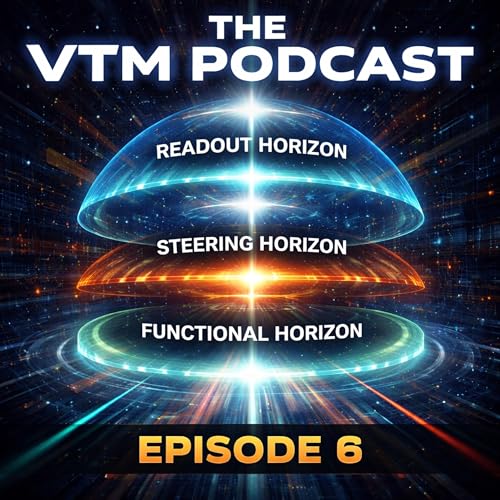
The VTM Podcast - Episode 6 - The Three Horizons: Why Seeing Isn’t the Same as Control Podcast By  cover art

The VTM Podcast - Episode 6 - The Three Horizons: Why Seeing Isn’t the Same as Control

The VTM Podcast - Episode 6 - The Three Horizons: Why Seeing Isn’t the Same as Control

Listen for free

View show details
In episode six of the Volumetric Time Model series, Ralph Clayton deepens the framework by introducing one of its most practical and clarifying ideas so far: the separation of reality into three distinct horizons of access.Up to this point, the series has explored a central tension—how something can fully exist while remaining only partially accessible to an embedded observer. We’ve looked at the difference between existence and access, the experience of forecasting without power, the limits defined by the agency horizon, and the growing gap between seeing and steering.This episode takes the next step by asking a sharper question: when something moves beyond your reach, what exactly is it that you’ve lost?Is it your ability to see what’s happening?Your ability to influence it?Or the ability for the system itself to keep functioning?These are not the same thing.Ralph introduces three separate horizons:The readout horizon, which defines the limits of what you can still perceive or extract as meaningful information. A process can still be unfolding in reality, but the signals reaching you may be too weak, delayed, distorted, or incomplete to be useful. The world has not gone silent—but for you, it effectively has.The steering horizon, which marks the point beyond which your actions no longer have meaningful causal impact. You may still see clearly. You may understand exactly what is happening and where it is going. But your ability to intervene arrives too late, too weakly, or into too much accumulated momentum to change the outcome.And the functional horizon, which is not about you at all, but about the system itself. This is the boundary where a process stops holding together—where instability, breakdown, or collapse takes over. A system can remain visible even as it fails, and it can continue running long after your influence over it has disappeared.By separating these three horizons, this episode dismantles a common but costly confusion: the tendency to treat all limits as the same kind of loss. We often assume that if we cannot control something, we must not understand it—or that if we can still see it, we must still be able to change it. But real life is more layered than that.A relationship can remain fully legible even after it has stopped being steerable.A health problem can be visible long before meaningful intervention happens.A project, a market, or even a society can signal its direction clearly while the window for changing course is already closing.This is the core asymmetry: knowledge and leverage are not the same currency.The episode also explores how these horizons can shift in different orders depending on the situation. Sometimes you lose control before you lose visibility. Sometimes poor visibility is exactly what destroys your ability to act. And sometimes systems fail so abruptly that all three horizons collapse at once.Beyond theory, Ralph brings the framework into everyday life—showing how misidentifying which horizon you’re facing leads to the wrong response. What looks like a motivation problem may actually be a feedback problem. What feels like ignorance may actually be a loss of leverage. What gets labeled as lack of discipline may really be an issue of timing, delay, or accumulated momentum.Each horizon demands a different kind of response:When readout fails, you need better signal, clearer feedback, and improved visibility.When steering fails, you need earlier action, tighter loops, and greater leverage.When function fails, the problem shifts toward stabilization, containment, and survival.Understanding which horizon you are actually dealing with can mean the difference between effective action and wasted effort.At a deeper level, this episode reinforces one of the central insights of the Volumetric Time Model: that access to reality is not all-or-nothing. Instead, it is layered, partial, delayed, and asymmetric. You may still have signal without control, or control without clarity, or a functioning system that is already on the path to failure.This is not a pessimistic view—it is a clarifying one.Because once you stop collapsing everything into a single vague idea of “access,” you can begin to see where possibility still exists. If you can still read, you are not in total darkness. If you can still steer, even slightly, the window is not fully closed. And if the system is still functional, there may still be room to recover or adapt.The three horizons—readout, steering, and function—offer a more precise map of reality as it is actually experienced from the inside.And with that map, confusion starts to fall away.This episode is for anyone who has ever felt the strange tension of seeing something clearly but being unable to change it—and for anyone trying to understand where, exactly, their limits really are.Because in the end, clarity, influence, and stability are not the same thing—and knowing the difference changes everything.Support this ...
No reviews yet