WBSRocks: Scaling Growth with AI, Enterprise Software, and Digital Transformation Podcast By Sam Gupta cover art

WBSRocks: Scaling Growth with AI, Enterprise Software, and Digital Transformation

WBSRocks: Scaling Growth with AI, Enterprise Software, and Digital Transformation

By: Sam Gupta
Listen for free

WBSRocks podcast features in-depth conversations on AI-enabled business models, customer experience, digital transformation, supply chain, eCommerce, industry 4.0, and enterprise software categories such as CRM, ERP, or analytics suites. The purpose of the show is to help CFOs, COOs, CEOs, and business owners with their daily commercial, operational, or financial challenges by taking a deep dive into business cases and processes, technology strategy and architecture, transformation initiatives, and business models. The show also offers an independent analysis of technology trends, various enterprise software vendors and solutions, and their mergers and acquisitions. Subscribe today to stay on top of digital transformation trends!

© 2026 WBSRocks: Scaling Growth with AI, Enterprise Software, and Digital Transformation
Economics Management Management & Leadership
Episodes
  • WBSP832: Scale Growth by Understanding DualEntry’s Capabilities, an Objective Panel Review - Part II
    Mar 25 2026

    Send us Fan Mail

    AI-native ERP platforms are challenging foundational assumptions about what ERP systems are, how they should be implemented, and where meaningful differentiation truly resides. Rather than centering workflows around human data entry, rigid configurations, and predefined transaction flows, platforms such as DualEntry are designed with AI as the primary operational layer, enabling systems to interpret business intent, automate accounting logic, and orchestrate processes with minimal manual intervention. This shift moves ERP from a system of record maintained by humans to a system of intelligence that actively participates in decision-making and execution. As a result, AI-first ERP platforms redefine implementation models, reduce dependency on extensive configuration and customization, and introduce a fundamentally different value proposition—one where competitive advantage comes from adaptive intelligence, continuous learning, and architectural flexibility rather than feature breadth alone.

    In this episode, Sam Gupta and Shrestha Dash from ElevatIQ, Andy Pratico from Essential Software Solutions, and Phil Coerper from Ringling Business Solutions conduct an in-depth independent review of a leading AI-native platform DualEntry.

    Video: https://www.elevatiq.com/events-and-webinars/dualentry-an-independent-review-part-ii/

    Questions for Panelists?
    🔗Sam Gupta: linkedin.com/in/samguptausa/
    🔗Phil Coerper: https://www.linkedin.com/in/philcoerper09/
    🔗Andy Pratico: https://www.linkedin.com/in/andy-pratico-80175410/
    🔗Shrestha Dash: https://www.linkedin.com/in/shrestha-dash-662b00204/

    Background Soundtrack: Away From You – Mauro Somm

    For more information on growth strategies for SMBs using ERP and digital transformation, visit our community at wbs. rocks or elevatiq.com. To ensure that you never miss an episode of the WBS podcast, subscribe on your favorite podcasting platform.

    Show more Show less
    1 hr and 3 mins
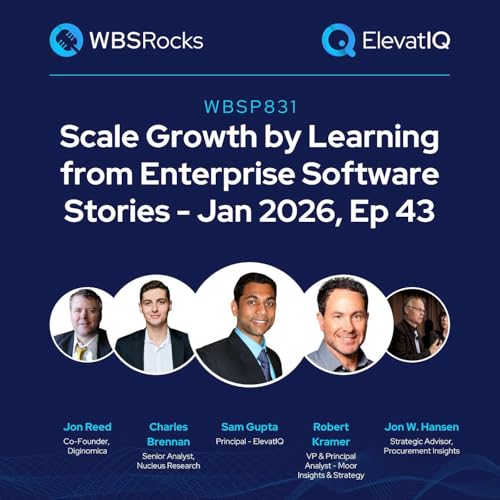
  • WBSP831: Scale Growth by Learning from Enterprise Software Stories - Jan 2026, Ep 43, an Objective Panel Discussion
    Mar 24 2026

    Send us Fan Mail

    Recent announcements across the enterprise software landscape highlight an accelerating shift toward AI-native capabilities, deeper operational visibility, and composable enterprise architectures. Integrations such as Beroe’s DataHub with the Model Context Protocol and Panaya’s Seemore agentic layer reflect growing momentum around context-aware AI orchestration, while Pipefy’s AI agents and SAP’s AI-enhanced retail innovations demonstrate how vendors are embedding intelligence directly into operational workflows. Strategic acquisitions—including Accenture’s move to acquire Faculty and Flexera’s expansion through multiple purchases—underscore the race to strengthen AI-driven services and platform breadth. Meanwhile, Rockwell Automation’s expansion of its MES portfolio, Certinia’s Winter ’26 release, Flowfinity’s platform enhancements, and ECI Software Solutions’ acquisition of Amper Technologies reinforce the importance of real-time manufacturing visibility, service lifecycle integration, and process automation. Collectively, these developments signal a broader transition from static enterprise systems toward adaptive, AI-driven platforms designed to improve execution speed, operational insight, and scalability.

    In today's episode, we invited a panel of industry analysts for a live discussion on LinkedIn to analyze current enterprise software stories. We covered many grounds including the direction and roadmaps of each enterprise software vendors. Finally, we analyzed future trends and how they might shape the enterprise software industry.

    Video: https://www.youtube.com/watch?v=zoX9TLCKcQY

    Questions for Panelists?
    🔗Sam Gupta: linkedin.com/in/samguptausa/
    🔗Robert Kramer: linkedin.com/in/robert-kramer-58239b22/
    🔗Jon Reed: linkedin.com/in/jonerp/
    🔗Jon W. Hansen: linkedin.com/in/jwhansen/
    🔗Charles Brennan: linkedin.com/in/charles-brennan-048901132/

    Background Soundtrack: Away From You – Mauro Somm

    For more information on growth strategies for SMBs using ERP and digital transformation, visit our community at wbs. rocks or elevatiq.com. To ensure that you never miss an episode of the WBS podcast, subscribe on your favorite podcasting platform.

    Show more Show less
    1 hr and 2 mins
  • WBSP830: Scale Growth by Learning the Top Field Service Systems In 2026 w/ Sam Gupta
    Mar 23 2026

    Send us Fan Mail

    Field service operations play a critical role in connecting customer experience, asset reliability, and recurring revenue generation, making them a strategic function rather than a purely operational one. As service models expand to include installations, preventive and predictive maintenance, equipment rentals, and aftermarket support, the supporting systems must evolve beyond simple scheduling or work order tracking. Modern field service platforms must coordinate technician dispatch, parts availability, service contracts, asset history, and real-time performance data while enabling seamless collaboration between service, finance, and supply chain teams. This deeper operational integration allows organizations to improve first-time fix rates, maximize asset uptime, increase service profitability, and deliver more consistent, high-quality customer experiences in increasingly complex service environments.

    In this episode, our host Sam Gupta discusses the top field service systems in 2026. He also discusses several variables that influence the rankings of these field service systems. Finally, he shares the pros and cons of each field service system.

    Video: https://www.youtube.com/watch?v=iNCWWbSRXKc
    Read: https://www.elevatiq.com/post/field-service-systems/

    Questions for Panelists?
    🔗Sam Gupta: linkedin.com/in/samguptausa/r-58239b22/

    Background Soundtrack: Away From You – Mauro Somm

    For more information on growth strategies for SMBs using ERP and digital transformation, visit our community at wbs. rocks or elevatiq.com. To ensure that you never miss an episode of the WBS podcast, subscribe on your favorite podcasting platform.

    Show more Show less
    19 mins
No reviews yet