War & Peace Podnotes, A Study Guide Podcast By Sean Roman cover art

War & Peace Podnotes, A Study Guide

War & Peace Podnotes, A Study Guide

By: Sean Roman
Listen for free

A chapter by chapter guide to Tolstoy's War & Peace. These are Summaries/Cliffnotes on a podcast, hence Podnotes. It is best used as a supplement to your reading of the classic.

The episodes and descriptions will provide information, context and commentary on each chapter -- and will likely take a lifetime to complete. The goal is for each episode to come in under 10 minutes.

The original work fluctuates between French and Russian and there are multiple English translations of War & Peace. [French was the language aristocrats in the Russian Empire used from the late 18th to early 20th century]. There are also variations on how War & Peace is chaptered. This podcast follows the commonly used chaptering contained in Penguin Classics and the Everyman's Library.

All rights reserved.
Art Drama & Plays Political Science Politics & Government Social Sciences Spirituality World
Episodes
  • Sevastopol Sketch II (Part 2 of 3): Mikhailov & Co.
    Apr 1 2026
    This is part 2 of 3 on Tolstoy’s 2nd Sevastopol Sketch, which focuses on May of 1855 and declares the ineffable value of Truth as hero.I’m presenting this episode after covering Austerlitz, a conflict symbolic of the vain pursuits of rulers. Further, similar to the result of Austerlitz, the Crimean War was a extraordinary humiliation for Russia that forced societal change. This sketch also contains memorable depictions of death amidst armed conflict.This story places the reader 6 months into the 11-month siege where “the Angel of Death hovers over all. “ This includes the 4.5 mile-long defensive line made of trenches with 8 major bastions. Notably, the Crimean War marks one of the rare times in the 19th century where France, England & Ottomans where allies. The War is also notable for advances in technology by the victors, including in naval artillery and how it was documented using telegraphs and photos. Florence Nightingale also gained recognition for her approach to nursing. This sketch focuses on a handful of fictional low-ranking officers. The climax is an artillery shell landing between two, where time slows down. Tolstoy brings you into their souls.The book begins with an introduction then focuses on the lead, Mikhailov, who is unmarried and noted not to own land. He is physically awkward and simple, but still “a man of worth.” He is thinking of a letter from a friend and day-dreams how his macabre reality can be a ladder for advancement. He realizes how many men he knew perished and how many he will meet who will meet the same end. He is lamenting transferring to Crimea. Mikhailov walks to the main boulevard an encounters his fellows - a small group imbued with basic decency as well as vice. In describing their hierarchy, it is pointed out how in any walk-of-life, there is someone higher – a so-called aristocrat. The various characters profiled include: Kalugin - an adjunct depicted as having a Gentleman’s demeanor; Prince Galstin - who holds the highest rank among this group; and Col. Neferdoff and Calvary Captain Praskukhin, who share the designation as two of the “122 men of the world” who volunteered from retirement. The group commiserates about their war stories and complaints. In describing the superficial natures of these men, Tolstoy paraphrases the first chapter of Ecclesiastes, similar to how he did when Andrei was lying on his back at Austerlitz. In a narrator’s voice, Tolstoy cries out:Vanity! vanity! Vanity everywhere, even on the brink of the grave, and among men ready to die for the highest convictions. Vanity! It must be a … peculiar malady of our century…Why did Homer and Shakespeare talk of love, of glory, of suffering, while the literature of our age is nothing but an endless narrative of aspiring elitists and vanity?Mikhailov, before his assignment, travels to his apartment and realizes his next trip to bastion would be his 13th. He felt he would be killed but would vacillate and fathom: “if I make it…..I will be promoted.” All the men had similar forebodings. Mikhailov then writes a farewell note to his father. His servant of 12 years, Nikita, was inebriated and prepared his Master. This included dressing Mikhailov and putting together a bundle of cheese and vodka. Mikhailov insults Nikita yet an affection is portrayed and both share a poignant goodbye.The other men went to Prince Galtsin’s quarters, where he has multiple servants and a piano. The men have tea and crackers and discuss tales of heroic actions and the latest updates on casualties. Prince Galstin then sat at his piano and Praskukhin sings along. The men know what lies ahead and make the best of their situation.As they leave for their posts, they notice the bombs overhead, with Kalugin observing how the “real work of the night has begun.” Tolstoy has the men to regard the visual of artillery fire as a celestial show.A Cossack soldier arrives and mentions how reinforcements are needed to replace the many killed. Kalugin follows the Cossack but Prince Galtsin doesn’t have to and walks the streets, where the cannon and rifle fire are palpable. He passes wounded soldiers, many carried on stretchers, others supported by the arms of a comrade. He was able to question one of them. The wounded met the onrush of a contingent of the Ottomans, yelling Allah! Nearly all of this unit were killed and the Ottomans took a valuable position.Galtsin was shocked and was nearly arguing with the man, hoping the hear that the enemy was repulsed. Others join in to relay the reality and Galtsin feels ashamed for impugning the man. He follows the wounded to a vast hall serving as a triage center, where after being looked at, some would get transported to a hospital and others to a chapel serving as a morgue. Tolstoy then takes us to the Horror inside.
    Show more Show less
    12 mins
  • Bk. 1, Pt. 3, Ch. 19: little napoleon
    Mar 8 2026

    Andrei lies moaning from a head wound on the Pratzen Heights, symbolic of the numerous souls dead or wounded.

    The depiction of Andrei chasing military glory but falling short, was influenced by how Kutuzov historically lost his son-in-law, Theodor von Tiesenhausen, at Austerlitz. Kutuzov sent the young noble, who served as an aide-de-camp, to rally retreating troops. After Tiesenhausen seized a fallen standard and ran forward, he was quickly shot in the chest. Frenchmen swarmed him and there was a barbaric scuffle over his military decorations. When Napoleon took a victory lap, he noticed the “glorious” sight of the barely alive Tiesenhausen still holding the flagstaff.

    Andrei is a physical causality but was imbued with a realization of the baseness of war. Going in and out of consciousness, Andrei held onto the value of his vision. Unable to open his eyes, he thought, “Where is it, that lofty sky that I did not know?” He did not remember the intricate battle plans nor leading the charge. What brought him back to earth was the burning pain in his head. When he heard the sound of approaching horses and French voices, he finally opened his eyes and captured the clouds floating majestically and the blue infinity beyond.

    Tolstoy has Napolean have a fictional interaction with Andrei while making his triumphant walk. Napolean comments on the gallantry of the fallen, notably a grenadier whose body was swelling and blackening. It is sinking in for Andrei that there is very little admirable about such a man’s life being wasted. Napolean approached Andrei, whose hand was still on the flagstaff and asserted: “That’s a fine death!” Andrei now regarded Bonaparte’s words as the buzzing of a fly. Napoleon seemed insignificant compared with the sky, which is representative of the Almighty.

    Andrei desperately wished to be assisted back to life. He collected all his strength to utter a sickly groan. Napoleon immediately ordered Andrei to be treated and rode on met Marshal Lannes, who congratulated his Master. Andrei remained in agony, but regained his bearings after he was placed with other wounded officers.

    Napoleon encounters Andrei once again when he inspects the overflow of valuable prisoners. The senior officer captured was Nikolai Repnin-Volkonsky, an Imperial Guard Colonel, who Andrei recognized from Petersburg. Napoleon commended Repnin, saying: “Your regiment was honorable in fulfilling their duty.” Repnin responded “The praise of a great commander is a soldier’s highest reward.” More kind yet superficial words were bestowed on a young lieutenant. Napoleon then sees and remembers Andrei and calls him, “mon brave” an old fashioned term meaning “my good fellow” or “my good man.” Andrei remains silent on the only occasion he would meet his one-time idol. All the vain interests that absorbed men like Napoleon now seemed so insignificant. This is Tolstoy’s comment on the value of military glory. Andrei thought of the pettiness of such men compared to the lofty, equitable and gentle sky. His mind was on a plane of solemnity. Various factors led to his mental state including: the loss of blood, nearness of death and appreciation of the divine. Napoleon instructed that Andrei and others be cared for by his own doctor and bid Prince Repnin, Au revoir!” He galloped away -- shining with satisfaction.

    Frenchmen who had carried Andrei had stolen the gold icon his sister gave him. However, seeing the favor the Emperor bestowed, quickly returned the charm. Beholding the icon made Andrei consider: “it would be good if everything were as clear and simple as it seems to Mar’ya.” He yearns to know where he should seek for help and what to expect beyond the grave. Andrei considered the nature of the Almighty and how to address his prayers. Andrei realizes that he understands the greatness of something incomprehensible but paramount. He conceptualized the Almighty’s ineffable power and contrasted this with image on his amulet, which is a critique of graven images.

    When Andrei’s stretcher moved on, he again felt pain that was difficult to endure. He experienced visions of his father, wife, sister, and future son. He considered his quiet home life and peaceful happiness that he never appreciated. He realized only the heavens promised a similar peace.

    Upon examination, Napoleon’s doctor pronounced a grave prognosis: “He is a nervous and sickly subject…and will not recover.” Inevitably, the doctor and War Machine moved on leaving Andrei and others to the care of the inhabitants of the district.

    That finally ends analysis of Book 1, which is about 25% of the novel.

    Cover Image is from the painting: Eruption of Vesuvius, 1824, by Johan C. Dahl.

    Show more Show less
    10 mins
  • Aleksei Nikitin: In the Spirit of Tolstoy
    Mar 3 2026
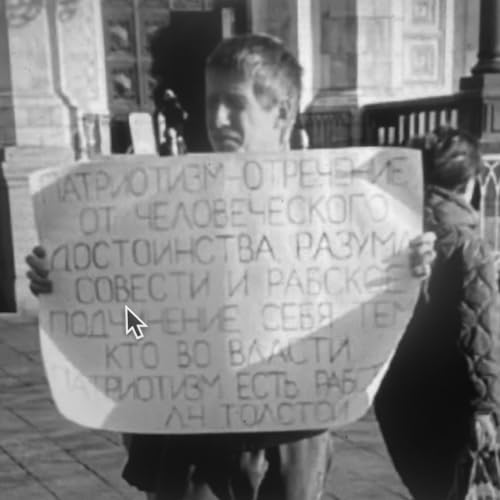
    This project is approaching the final chapter of Book I, a critical juncture with Napoleon victorious and holding the greatest reputation man can bestow. Even after Napoleon suffered a string of defeats years later, his reputation was colossal when Tolstoy wrote War &Peace. Many readers coming to this book do not realize Napoleon is something of a dark force utilized to portray how to view those who send others to die for a ruler's vain ambitions. In this regard, it is important to recall how Tolstoy was influenced the Bible book of Ecclesiastes, which comments on vainglorious ambitions as well as the meaningless of everything without an appreciation of the Transcendent. Tolstoy is reaching to you from another age, highlighting how you can recognize War’s profane nature compared to what is above. Tolstoy recognizes how calls to war are a siren’s song as well as how easy it is to get young men to answer, usually via a small bounty or appeal to patriotism.Acknowledging the idiosyncratic pacifist Tolstoy became, his work still recognizes how a defensive war is more justified than the type of conflict at Austerlitz. Further, Tolstoy was exceptionally critical of his own government, which makes War & Peace so relevant in our times. In this spirit, I bring up the following story:Upon Russia’s mass invasion of Ukraine in early 2022, Aleksei Nikitin, a regular citizen from Moscow, tried to make a difference and stood up to power.Aleksei recognized crossing his neighbors’ border and unleashing the largest land invasion since the Second World War is the type of aggression Tolstoy condemned. Aleksei brought Tolstoy into his public protest by writing an excerpt on a poster-board from the 1894 essay “On Patriotism.” It read:“Patriotism is the abdication of human dignity, reason and conscience and a slavish submission to those in power. Patriotism is slavery.”It was a controversial sentiment then and remains so. This essay described Tolstoy’s conception of patriotism -- in that militaristic age -- as a vulgar sentiment used by governments to justify their war machines. He argued it is opposite to what he took out of the Bible, namely Christian brotherhood. Aleksei’s use of the essay speaks to what Tolstoy has Andrei grasp as Andrei views the senselessness of a red-haired Russian artilleryman squaring off against a French attacker – both Christians struggling over a mop as if it was the Holy Grail. Tolstoy was speaking to the baseness of what he witnessed, as a soldier on campaigns in Chechnya and being on the losing side of the Crimean War.Tolstoy points out that men mercilessly hacking one another have a great deal more in common with one another – than the men of supposedly higher status, who sent them to die. Tolstoy described, in another part of the essay:"It is even impossible to imagine, how and for what, Russian and German workmen, peacefully and conjointly working on the frontiers or in the capitals, should clash. And much less easily can one imagine animosity between some Kazan peasant who supplies Germans with wheat, and a German who supplies the peasant with scythes and machines. It is the same between French, German, and Italian workmen."Aleksei Nikitin was arrested and the Moscow police statement on the proceeding was carefully worded and likely came from their Intelligence Service:“This writer’s (Tolstoy’s) works and articles were harshly critical of the ruling (Czarist) regime, including justifying violence against the government. Therefore, the actions of Citizen Nikitin should be interpreted as a call to overthrow the existing authorities and also to follow the ideology of Tolstoy.”This was a revealing acknowledgement that the philosophy of Tolstoy is threat to a system throwing countless men into their War Machine. Nevertheless, the Russian government succeeded in stunting that portion of citizenry who were in line with the ideals of Tolstoy. Once the internal dissension was suppressed, the Russian leader found it prudent to create, a “Tolstoy Peace Prize.”Over his career, Tolstoy brought out how such aggression brings out an ever-lasting hatred by those affected. Some of such work involves Chechnya. One of Tolstoy’s first short stories, “The Raid,” from 1853, explored amidst the Chechen landscape -- what motivates man to kill his fellow. Further, one of his final works, “Hadji Murad,” tells the story of brutal campaigns against Chechnya, which involved the burning of villages, fields, and livestock. Tolstoy took to heart how raids would leave the helpless crying in despair.He recognized, how such aggression promotes a natural resistance, like many Chechens have demonstrated for generations; and like the overwhelming majority of Ukrainians have capably demonstrated in our times.
    Show more Show less
    10 mins
No reviews yet